
A deadly gas may have therapeutic potential
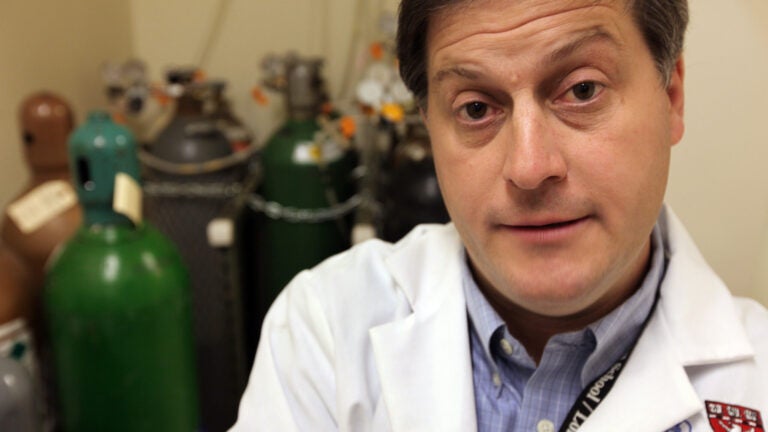
It’s common knowledge that carbon monoxide can be lethal — the colorless, odorless gas is such a hazard that people guard against its toxic effects by installing detectors in their homes. But four years ago, a Beth Israel Deaconess Medical Center researcher received a federal grant to probe a surprising idea — that small amounts of carbon monoxide might have healthful benefits.
That initial $1.4 million grant to Leo Otterbein, an associate professor of surgery, was part of what appeared to be a grudging shift in medicine — a growing doubt that the gas, which is naturally produced by cells, is always bad. Researchers at a handful of institutions have launched clinical trials testing carbon monoxide as a possible therapy for a variety of conditions.
One trial is examining the effects of breathing carbon monoxide before and after colon surgery. Another is testing whether carbon monoxide might have an anti-inflammatory effect that could benefit patients with COPD, a progressive lung disease. In yet another study, researchers are using the gas to try and decrease the blood pressure of patients with pulmonary arterial hypertension, a rare disease.
Now, in a study published in the December issue of Cancer Research, Otterbein chips away again at the traditional view of carbon monoxide as a menace. Otterbein and colleagues found that administering carbon monoxide to cancer cells in a dish could increase the cells’ susceptibility to chemotherapy 1,000-fold, while protecting normal cells. In mice with prostate and lung cancer, carbon monoxide inhibited tumor growth.
Otterbein began his work on carbon monoxide as a young scientist and quickly learned that challenging the prevailing views in biomedicine isn’t easy. In a 2009 interview, he recalled presenting some results suggesting that carbon monoxide might be beneficial and being set upon by colleagues who picked apart his data and his ideas.
Otterbein wasn’t deterred. He refined his experiments and accumulated data, probing the mechanism and cellular processes by which carbon monoxide might produce its effects. The effects he has found may help explain puzzling observations that had been made over the years: smokers — who inhale carbon monoxide every time they light up — fare better than non-smokers after organ transplants, and smoking seems to have protective effects in patients suffering from a form of inflammatory bowel disease.
Big shifts in medical thinking make great yarns; a simple anecdote or an intuitive idea that for years couldn’t gain traction but eventually proves itself to be true and important makes for a fascinating story. It highlights how medicine and science can be blinded by assumptions and biases, just like other human endeavors. But at this point no one knows the end of the carbon monoxide story — only time and more research will tell whether the gas has potent positive health effects.
I asked Otterbein a question I don’t often get to ask scientists. What would happen if the clinical studies of carbon monoxide ultimately failed to show any therapeutic effect? Otterbein championed this idea and worked on it until a scientific funding agency gave him a major vote of confidence — a large grant to systematically probe what was going on. But, if in a few years those results suggest that the effect turns out to be more complicated or less clear than it once seemed, what is a scientist to do? If the clinical trials assessing the benefit of carbon monoxide don’t find one, what next? Does he or she give up? Keep pushing harder?
Science is probing the unknown, which can translate into fantastic stories of success and keen insight into a phenomenon. But it often leads to more questions, more complexity, or answers to a question that are much less useful to patients than anyone hoped.
“I probably have to postpone the answer, and wait to see what happens,’’ he said. “But my goal is not just to cure a mouse of cancer or liver disease, it has to have some translational benefit.’’




To comment, please create a screen name in your profile
To comment, please verify your email address
Conversation
This discussion has ended. Please join elsewhere on Boston.com