
Kepler telescope’s planet-hunting days are most likely over
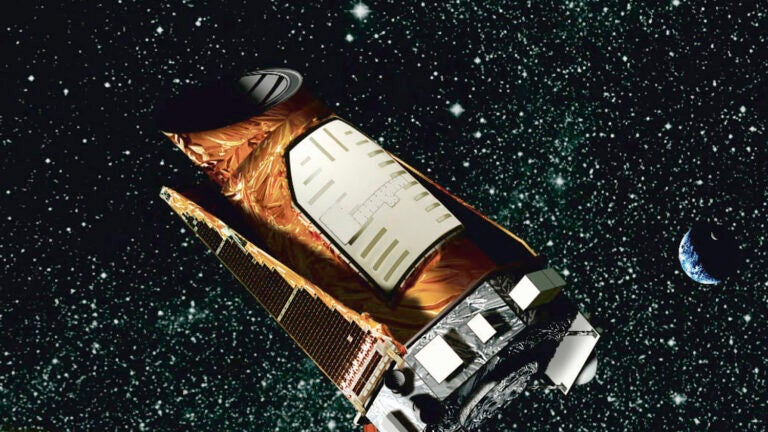
After months of trying to fix the Kepler space telescope’s positioning mechanism, NASA officials are giving up, meaning the mission’s planet-hunting days are most likely over..
NASA scientists are holding out hope that some other scientific use can be made of the spacecraft, calling on the scientific community to send ideas about how it can be repurposed. But the telescope will be best known for the way it has profoundly altered our sense of place in the universe. Kepler found 135 confirmed planets circling other stars, and several thousand planet candidates, including the first Earth-sized worlds found outside our solar system.
Kepler switched into “safe mode’’ in May, after a gyroscope used to aim the telescope broke. At the time, its hunt for habitable worlds was inching nearer and nearer to the sweet spot where the planets were neither too cold or too hot, too big or too small, to be home to life.
“At the beginning of our mission, no one knew if Earth-size planets were abundant in the galaxy. If they were rare, we might be alone,’’ William Borucki, Kepler science principal investigator at NASA’s Ames Research Center, said in a statement. “The data holds the answer to the question that inspired the mission: Are Earths in the habitable zone of stars like our Sun common or rare?’’
NASA left open the possibility that the spacecraft’s scientific life could be extended, including the possibility of future planet-hunting with a new strategy.
Even if those efforts are unsuccessful, researchers who worked on the mission aren’t mourning.
“We had some really interesting experiments to do on the extended mission. Certainly, they would have been worth doing. But we can hardly complain given that we filled the baseline mission and we have a terrific dataset to work on,’’ said David Latham, a co-investigator for Kepler at the Harvard-Smithsonian Center for Astrophysics, where about two dozen astronomers analyze the data from the mission.
He added that while Kepler’s most well-known legacy will be its contributions to our knowledge about how common planets of various sizes are in other solar systems, it has had a profound effect on astrophysics, too. The telescope’s rich data has spurred a whole field of astroseismology, in which researchers study the internal structure of stars and their rotation and oscillation.
Asked whether the Harvard-Smithsonian Center for Astrophysics would host a party or any other kind of farewell to Kepler, he said no — the scientists aren’t nearly done with Kepler because they have a gold mine of data to continue to analyze for years to come to find additional planets.
Latham said he is already preparing for the next planet-hunting mission, called TESS. That mission is expected to launch in early 2018.




To comment, please create a screen name in your profile
To comment, please verify your email address
Conversation
This discussion has ended. Please join elsewhere on Boston.com