
Newsletter Signup
Stay up to date on all the latest news from Boston.com
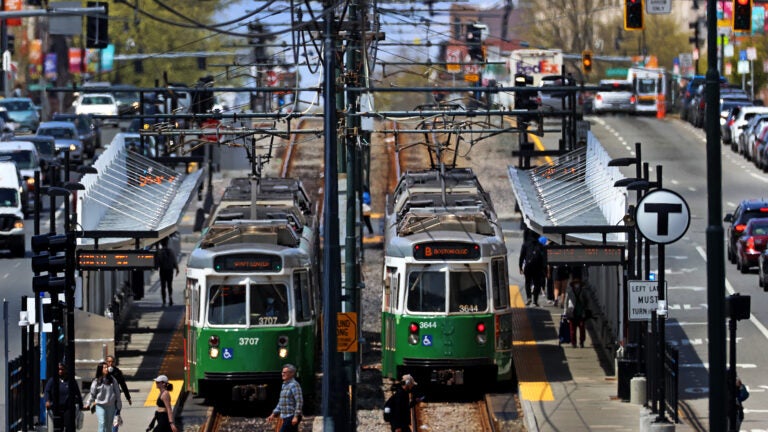
T riders are now more than halfway through a 9-day downtown Green Line closure, and needless to say, the experience of navigating trolleys, shuttles, and subway transfers has been sort of a mixed bag.
Three of us at Boston.com put our morning commutes to the test earlier this week and documented our experiences. While the ride to work went smoothly, the journey home was another story (spoiler alert: there were delays, insufficient signage, and Green Line breakdowns for at least two of us).
With large portions of the Green Line shut down and other service disruptions in the works, we asked readers whether their Green Line commute has been disrupted.
The answer was a resounding yes; of the 140 readers who responded to the informal poll, 125 said the shutdown’s impact has been “pretty bad.” While 12 readers said their commute has been about the same during the shutdown, three felt their commutes have actually been good so far.
Some readers had plenty to say, sharing horror stories of long waits, poor accessibility, and confusing directions.
Brookline resident Inge Formenti usually uses a combination of the C Branch and the 57 bus to get to and from classes at Boston University. She told Boston.com she’s had to call a Lyft multiple times this week because the bus was full and runs infrequently, or because she didn’t want to be late to class. The 57 bus is one of the alternate routes the MBTA is offering during the Green Line closures.
Formenti, who has impaired mobility and uses a walker, said she’s also had to cancel two physical therapy appointments and give up her tickets for Saturday’s BU hockey game due to the added Green Line hassle.
Reflecting on her usual riding habits, she said: “I’ve never had a really bad trip. But of course, now we’ve got all the really bads from the whole year combined in one.”
Formenti first lived in Boston in 1969, fell in love with the area, and vowed to move back someday. That day came last January, and Formenti said the T is now one of the first things that springs to mind whenever she thinks about things to do around Boston.
“That’s how I divide activities in the city. It’s central to my life, and it’s central to a lot of people,” she said. “When you start spitting bus numbers at each other, then you know they’re a Bostonian.”
Formenti said the latest closures and service disruptions have left her feeling sad about the state of the T.
“They’ve been ignored by whoever funds them for years. It’s like, ‘Well, it works. We don’t need to give them any money,’” she said. “I think they had some really bad management, … and now it’s all caught up with them, and now they have to spend some money — which hopefully they will get — to make things work. And they are busting their butts.”
Formenti suggested that the T could have put more buses into service on routes that are being used in lieu of trains — the 57 and 39 buses, for example. The Green Line closures would have also been easier on riders if they had happened during a warmer season, when some riders could have opted to walk or bike rather than wait for a shuttle, she said.
The MBTA is running shuttle buses from Kenmore to Copley and recommends that riders walk the few blocks between Copley and Back Bay stations and switch to the Orange Line for downtown service.
As Woburn resident Mandy Cheng noted, it’s not a pleasant walk in the cold.
Cheng, who works near Babcock Street on the B Branch, typically takes an express bus to Government Center and switches to the Green Line. She hadn’t heard about the shutdowns before she arrived at Government Center on Tuesday; pressed for time, she ended up taking an Uber to work.
“I was surprised on Tuesday when I realized the shutdown is deeply impacting my commute, but at the same time, not too surprised about the shutdown,” she said in an email interview. “It’s kind of normal for the MBTA to have shutdowns all the time.”

Cheng questioned why the T isn’t running shuttles from Copley to Park Street or Government Center, rather than directing most riders to the Orange Line. She described her commute home on Tuesday via the Orange Line as “terrifying,” noting that the platform and train were overcrowded.
“I was thinking how am I going to get on the train? So I tried to walk further away from the stairs, but it was not helping,” Cheng recalled. “When the train came, thankfully I was able to squeeze in, but I was standing in the crowd without any handles or bars to grab.”
While she praised the MBTA workers stationed at the shuttle bus stops, Cheng suggested the MBTA could have more staff and more obvious signs at Copley so people unfamiliar with the area know how to get to Back Bay.
“I usually am very patient with the MBTA when there’s an issue that makes my commute longer or I’m a bit late for work, usually I’m okay when they have so few B line trains compared to other Green Lines, I know they’re trying and all the drivers are doing their best,” she said. “But the changes are too slow. I hope they have plans and can make it happen efficiently. I don’t care if we can pay the fares with our smartphones like in NYC, I just want a working and reliable transportation system.”
Some responses have been lightly edited for clarity.
“I live downtown by Government Center and work in the Longwood Medical Area. It’s normally 35-40 minutes door to door when riding the Heath Green Line train. It’s taking me roughly an hour to get to work now — with about 15 minutes of it walking in the Boston cold. I tried Ubering one day and it takes just as long because of all of the construction sites above ground. I moved to Boston from LA 3 months ago. Anyone complaining about LA traffic has never been to Boston!” — Victoria, downtown
“Ball Square to Hynes Convention Center, so these closures seem uniquely designed to torture me. Green Line to Orange Line to shuttle, during the last two weeks of the semester 😭” — KB, Medford
“Instead of a 20 min ride, it took me 70 min. To Downtown Crossing. It was [disgusting]. I was literally dumped 1 block from Copley, told to walk up the street to Orange Line. No signs. … I am semi disabled, walk with a cane. I saw no extra buses or help available to aid challenged persons.” — Pol P., Allston
“I usually take the Green E line into work near Arlington Station. Funnily enough, the 39 bus has gotten me there faster than the train did. Maybe the closures will address the noticeably slow shared lanes on Huntington Ave.” — Joe, Jamaica Plain
“I didn’t know about the closures on Monday morning (11/27) and was unpleasantly surprised with three modes of transportation that brought my 35 minute commute to an hour. This week, I’ve been taking the commuter rail from Boston Landing, which is about a 15 minute walk from my apartment near the Allston St. and Comm Ave. intersection.” — Reese, Allston
“The 39 bus is not an adequate replacement for the E line, unless they start sending out significantly more buses. The 39 only comes every 20+ minutes; whereas, the T usually comes every 7 minutes. There are mass amounts of people waiting at every stop and not everyone is getting on — and then having to wait 20 minutes for another chance at getting a bus. Honestly, the MBTA is probably counting on everyone taking Lyft/Uber instead — but who can afford that!?” — Rose, Boston
“Indescribably frustrating and disastrous. I just can’t fathom out what MBTA is thinking. I thought my commute couldn’t be worse but this is just the worst of all. I’m from Seoul and have never seen such an unreliably dysfunctional public transportation system in my entire life. MBTA is public enemy number one.” — Angela L., Quincy
“My commute to work is now 1.5 [hours] as opposed to 45 min. I’m also disabled, so walking all that way uphill in the cold is difficult.” — Sarah, Brighton
“My morning commute from the St. Mary’s T stop to JFK/UMass took over 90 minutes, and I left St. Mary’s around 5:50 AM!!! Why, oh why did they have to start this project now instead of waiting till after the start of the New Year?” — Steve W., Brookline
Boston.com occasionally interacts with readers by conducting informal polls and surveys. These results should be read as an unscientific gauge of readers’ opinion.

Stay up to date on all the latest news from Boston.com




To comment, please create a screen name in your profile
To comment, please verify your email address
Conversation
This discussion has ended. Please join elsewhere on Boston.com