
Sign up for the Today newsletter
Get everything you need to know to start your day, delivered right to your inbox every morning.
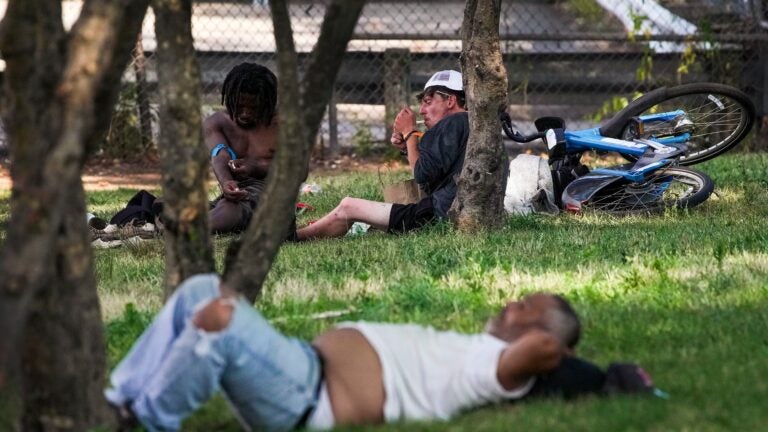
State and Boston officials, including Mayor Michelle Wu, announced the state House Ways and Means Committee will commit $4 million towards programs aimed at addressing substance use around the intersection of Massachusetts Avenue and Melnea Cass Boulevard.
Speaking at a press conference Thursday afternoon, House Ways and Means Chairman Aaron Michlewitz said the funding will be included in the House budget set to be released next week.
The area, commonly known as “Mass. and Cass,” has long been the visible epicenter of Boston’s opioid crisis.
Michlewitz said the largest portion of the funding — $2.24 million — will go to the city to provide housing support for people seeking recovery, covering up to 200 people for as long as a year.
Additional funding includes $650,000 for contracted clinical support staff, $500,000 for the Suffolk County District Attorney’s Office to create a pre-arraignment diversion program focused on treatment instead of incarceration, and $460,000 for the Boston Public Health Commission to expand transitional support and clinical stabilization services. Another $150,000 will fund a mobile operations vehicle to monitor the area and provide on-site assistance, Michlewitz said.
“Our commitment from the House is being made because we are confident in the city’s commitment to this issue, particularly under Mayor Wu’s leadership,” he added.
Wu said the funding builds on years of planning and coordination among city agencies and service providers.
“For Boston to be a home for everyone, every person, every family, needs a pathway to taking care of their own, and every person in crisis needs a pathway to quality care,” she said.
Over the past year, the city has expanded outreach efforts through its Coordinated Response Team and Neighborhood Engagement Safety Team, working alongside the Boston Police Department and community partners to connect people to treatment.
Wu said those efforts have led to more than 890 cases being managed and helped over 600 people access inpatient substance use treatment.
The city recently launched what Wu described as a “warmer weather initiative,” aimed at increasing police presence and addressing open-air drug activity as conditions bring more people outdoors.
“Across the board, we’re seeing fewer crowds, fewer 311 calls, and fewer needles,” Wu said. “More people are getting the support that they need, and we know we need to keep going on all those fronts.”
Boston Public Health Commission Executive Director Bisola Ojikutu said the investments come as overdose deaths show signs of decline, though the crisis remains severe.
In the past decade, approximately 3,000 people in Boston have died from overdoses, according to Ojikutu. Recent data shows a 38 percent drop in opioid-related deaths in Boston — the lowest level since 2015, she said.
“Every life lost is more than just a statistic. These are parents, brothers, sisters, friends and partners,” Ojikutu said.
She added that from her work with patients who lived in the intersection, connecting people to treatment and stable housing can be life-saving.
“More work is obviously needed,” she said. “I’m extremely grateful to our provider partners who roll up their sleeves and do really challenging work on a daily basis … It is important to note that Boston has stood out as a national leader in our response as a country to the substance use crisis, and I am very proud of our legacy of crafting innovative, collaborative, evidence-based, and compassionate policy and programming.”
Get everything you need to know to start your day, delivered right to your inbox every morning.




Be civil. Be kind.
Read our full community guidelines.To comment, please create a screen name in your profile
To comment, please verify your email address