
Sign up for the Today newsletter
Get everything you need to know to start your day, delivered right to your inbox every morning.
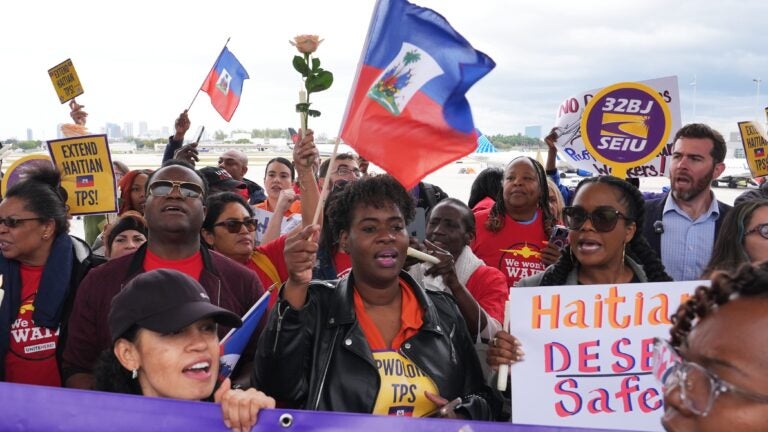
Relief rippled through Haitian communities and advocacy groups Monday after a federal judge blocked the Trump administration from ending temporary immigration protections for Haitians, a move that would have stripped work authorization and deportation protections from more than 350,000 people across the country.
Originally set to expire Monday, Feb. 3, Temporary Protected Status (TPS) has allowed Haitians to remain and work in the United States since it was granted following the 2010 earthquake.
Conditions in Haiti have only worsened in recent years: Since March 2024, the country has been under a state of emergency, and the U.S. State Department issued a rare “Level 4: Do Not Travel” advisory last summer due to widespread gang violence, kidnappings, and a deepening humanitarian crisis.
U.S. District Judge Ana Reyes, in Washington, D.C., granted a request Monday to pause the termination as a lawsuit challenging the administration’s decision moves forward.
For Guerline Jozef, co-founder and executive director of the Haitian Bridge Alliance, the ruling brought a sense of relief.
“I felt happiness for the community because they were able to go to sleep last night — knowing that today, the world wasn’t going to be pulled from under them,” she said.
But Jozef also emphasized that the issue extends beyond those directly affected. Haitians, she noted, are deeply embedded in the U.S. workforce, particularly in health care, transportation, and caregiving roles that many communities rely on every day.
Massachusetts Gov. Maura Healey issued a statement, stressing the impact the decision could have had on the state’s workforce. Haitian TPS holders, she said, are especially vital in health care and home care roles.
“If President Trump had his way, thousands of nurses, home health aides, and other essential employees would not have been able to work tomorrow, and patients and families who are dependent on caregivers would have suffered,” she said.
Some TPS holders saw their work authorization being taken away before the TPS expiration date arrived, Jozef said. Therefore, Healey said she is notifying employees across Massachusetts that their employees are eligible to work.
Even beyond their economic contributions, Jozef said, the judge’s decision speaks to a broader moral question.
“It is the right thing to do. It is the human thing to do,” she said. “We are way past any political view. We have to center the need to have a proper immigration reform based on human rights.”
On Capitol Hill, U.S. Rep Ayanna Pressley has been pushing for a long-term extension for TPS for Haitians. Last month, she announced a discharge petition aimed at forcing a House vote on legislation that would require a three-year extension of TPS for Haitians. The petition needs 218 signatures to advance and has gathered just over 100 as of Tuesday.
“The judge’s rejection of Trump’s TPS termination attempt makes plain: It is inhumane, deadly, and unlawful to deport people to a country experiencing political, economic, and humanitarian crisis,” Pressley said in a statement released Tuesday.
She added that the ruling should energize lawmakers to move forward with broader protections.
“We won’t stop fighting for extended protections. My discharge petition would do just that, and we must move it forward without delay,” Pressley said. “Our Haitian neighbors are integral members of our communities, and they deserve safe homes here.”
Civil liberties advocates also weighed in, with Carol Rose, executive director of the American Civil Liberties Union of Massachusetts, describing the judge’s move as the correct decision.
“There is no evidence that the Trump administration took the time to make a clear-eyed assessment of the risks these families would face back in Haiti before moving to revoke TPS,” she said in a statement sent to Boston.com Tuesday.
Ending TPS, Rose said, would undermine a longstanding humanitarian safeguard rather than improve public safety.
“Dismantling this essential humanitarian protection would not make America safer,” she said. “Congress must mobilize to protect TPS holders from the administration’s brutal and inhumane deportation campaigns.”
Still, legal experts caution that the relief may be short-lived.
“While the court’s decision is a relief for now, it’s very much a temporary one, and there remains a great deal of uncertainty about what comes next,” Giselle Rodriguez, a Boston-based immigration attorney, said.
Rodriguez described the ruling as a “stopgag” rather than a final resolution. She said the Department of Homeland Security is likely to appeal, which could send the case into higher courts and potentially spark a broader legal battle over how much authority the administration has to terminate TPS.
For now, TPS remains in effect — holders are authorized to work and protected from deportation. But Rodriguez said key questions remain unanswered, including how aggressively immigration authorities will act while the case is pending and how employers will respond amid legal uncertainty.
“While there is still some level of protection in place, it is limited,” she said. “At this stage, we cannot say with certainty how enforcement agencies or employers will behave in the interim, and many of these questions will likely only be resolved as the litigation continues and higher courts weigh in.”
Get everything you need to know to start your day, delivered right to your inbox every morning.




To comment, please create a screen name in your profile
To comment, please verify your email address
Conversation
This discussion has ended. Please join elsewhere on Boston.com