
Extra News Alerts
Get breaking updates as they happen.
WASHINGTON — Democrats who have tried and failed for years to unseat Sen. Susan Collins, the veteran moderate Republican from Maine, are pinning their hopes this time on recruiting Janet Mills, the state’s seasoned Democratic governor, to challenge Collins’ bid for a sixth term next year.
But Mills, 77, is being circumspect about her plans for what could be one of the most competitive Senate races in the country. And some Maine Democrats believe she is too conventional a choice to defeat Collins, a powerful political force who has demonstrated her staying power.
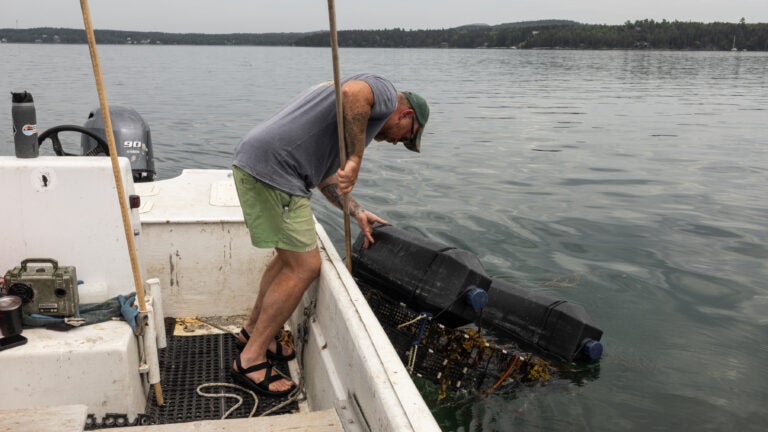
Enter Graham Platner, 40, an oyster farmer and former Marine who served three tours in Iraq and one in Afghanistan, and is set Tuesday to announce a long-shot challenge to Collins, with a campaign focused on making life better for his state’s working class.
“We need to stop using the exact same playbook that keeps losing over and over and over again,” said Platner, a political unknown who serves as the local harbor master in the tiny town of Sullivan. “Running establishment candidates who are chosen or supported by the powers that be in D.C. — in Maine specifically — has been a total failure, certainly in attempts to unseat Susan Collins. It is time for us to try something new.”

A competitive pistol shooter who worked as a bartender at the Tune Inn on Capitol Hill while attending George Washington University on the GI Bill, he said that “everyone knows we live in a system that is not built to represent working-class people.”
Platner said he had been approached in the past to run for local office, and had always turned it down. But when a group of labor unions focused on climate issues reached out to him about running for Senate, Platner found himself open to the idea.
“The political situation feels like a precipice,” he said. “It feels like it will go really, really dark, or we have an opportunity to claw something back for working people in this country.”
An untested candidate like Platner may be a risky bet, but some Democratic strategists said that at a moment of deep anti-Washington sentiment, voters are demanding new faces over veteran politicians they view as part of a system that has failed them.
Platner said he was recruited by political organizers who were worried that “there was going to be a bad decision made for this race, and they went looking around this state for someone. I am terrified that the Democrats are going to squander what could otherwise be a spectacular opportunity.”
He said his campaign would focus relentlessly on the dire economic landscape that has made it difficult to afford a house or health care in his state. And his pitch is that he has a unique ability to “appeal to a lot of voters in Maine who aren’t usually on the side of a Democratic politician, or a lot of people who just stopped voting, because they see a political system they feel does not and cannot represent them.”
He has already attracted some national political operators to work on his campaign. His sepia-toned launch video was produced by Morris Katz, a top adviser to Zohran Mamdani, the Democratic nominee for New York City mayor. A senior adviser is Joe Calvello, who previously worked on the campaign of Sen. John Fetterman, D-Pa.
Platner, whose light social media footprint indicates that he has supported Sen. Bernie Sanders, I-Vt., said he did not define himself as a progressive or a centrist. But he laughed at the idea that he would have any challenge in connecting with supporters of President Donald Trump. Half of his friends and colleagues at the dock voted for Trump, he said.
“I’m a waterman who works in the ocean with his hands. I’m a competitive pistol shooter — that’s my weekend hobby. I have an extensive combat background,” he said. “Even if I tried to put myself into the buckets that we as a society have created, I don’t fit into any of them.”
Maine Republicans disagree.
“Being a Bernie Bro and Kamala Harris donor is a profile to appeal to Portland progressives, not centrist and conservative voters in rural Maine,” said Jason Savage, the executive director of the Maine Republican Party. (Platner made a small donation to Harris’ campaign last year, and in 2016 donated to Sanders’ presidential campaign.)
In his launch video, Platner says, “Nobody I know around here can afford a house. Health care is a disaster, hospitals are closing, we have watched all of that get ripped away from us.”
He adds: “At least the other side tells people that the system is failing them, that the system doesn’t represent them, that the system was never made for them. The other side is saying that.”
Jordan Wood, a progressive former congressional aide, entered the race in April, making a pitch that Collins “hasn’t changed the system — she’s part of it.”
For years, Collins, 72, who leads the powerful Appropriations Committee, has been able to fend off well-funded Democratic challengers despite Maine voting Democratic in the past three presidential elections. But this cycle, she is facing record-low polling, and her race is one of the top targets for Democrats seeking to win back control of the Senate.
Only 38% of Maine voters approve of her job performance, according to a recent Morning Consult poll, while 54% disapprove. In 2019, before her last reelection campaign, 52% of Maine voters had a favorable impression of Collins, according to a Morning Consult poll.
Another poll, conducted by Pan Atlantic Research, showed less dire results for Collins, who had a net positive favorability rating of 4 points. That poll showed Mills with a net positive rating of 8 points, a decline of 14 points since 2022.

Platner may need to hone his attacks on Collins as he tries to make the case against her. In the interview, he criticized Collins for allowing Trump’s sprawling domestic policy bill to win approval by the Appropriations Committee, then voting against it on the Senate floor. Yet the legislation was not a spending bill, and never went through the committee.
Mills, a two-term governor and former prosecutor, is still seen by her party’s establishment as the strongest candidate to defeat Collins. She clashed with Trump at the White House this year over his threat to deny federal funding to Maine over the issue of transgender athletes competing in women’s sports.
But Mills is also not viewed as a perfect candidate. At a time when many Democratic voters are demanding generational change, Mills, if elected, would be 79 when taking office, making her the oldest first-term senator in history.
“I would think seriously about it, but I’m not ready to make any decisions along those lines,” Mills told a local television station in Maine this month.
This article originally appeared in The New York Times.
Get breaking updates as they happen.





To comment, please create a screen name in your profile
To comment, please verify your email address
Conversation
This discussion has ended. Please join elsewhere on Boston.com