
White House unveils plan for $200 million ballroom, Trump’s long-sought imprint
Officials said a 90,000-square-foot addition to the East Wing would be paid for by President Donald Trump and other donors.
WASHINGTON — First came the gold decor in the Oval Office. Then President Donald Trump brought his Mar-a-Lago style to the Rose Garden before installing a new flagpole in front of the White House.
Now, Trump is unveiling plans to fulfill a long-held desire to add a state ballroom off the East Wing, a $200 million, 90,000-square-foot project that would be one of the largest renovations to the historic building in decades.
The project poses myriad questions about potential conflicts of interest and the feasibility of such an undertaking, which Trump expects to be completed before he leaves office. White House officials said the president and other donors would pay for the renovations but declined to give details.
In his six months in office, Trump has sought to reshape institutions in his image through sweeping policy changes, upending the federal bureaucracy and leaving his stamp on the private sector and the arts. But the president, a onetime real estate developer, is also hoping to cement his legacy by leaving his imprint on the structure of the White House.
“We’re good at building,” Trump said Thursday. “I’m good at building things, and we’ll get it built quickly and on time. It’ll be beautiful — top of the line.”
The 90,000-square-foot ballroom project would allow the administration to host events for about 650 people, more than triple the capacity of the largest room in the building, the East Room, according to a White House statement.
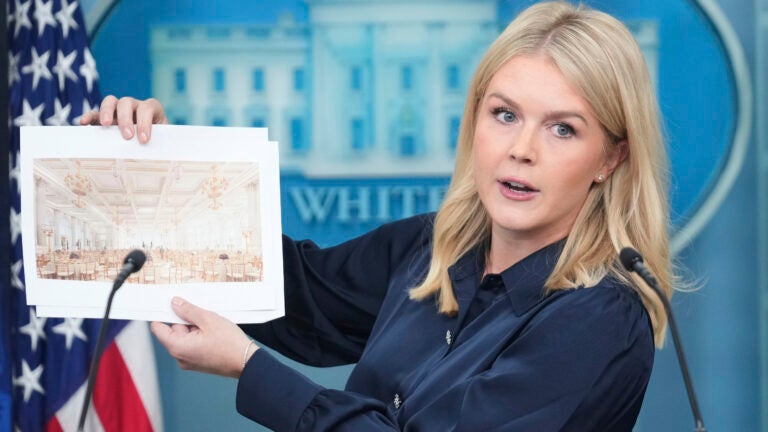
The administration plans to begin construction in September and finish the project before the end of Trump’s term, according to Karoline Leavitt, the White House press secretary.
Trump said the new ballroom would allow officials to host large events for world leaders and other guests without needing to stand up a large tent on the White House South Lawn. The renovation would be one of the largest projects on the White House grounds since President Harry Truman created what is now the West Wing, according to presidential historian Douglas Brinkley.
“He’s been wanting to be seen as the builder president so that whoever in the future goes to the White House, they’ll be in the Trump auditorium,” Brinkley said. “It has the potential to be a plus if the design of this ballroom is done well, but if it’s done in a ridiculously lavish, gold-plate style that is simply a reflection on Trump.”
According to images released by the White House, the administration is envisioning a ballroom that would appear to resemble one of the rooms in Mar-a-Lago, Trump’s Florida residence and resort. One image showed a ballroom lined with golden chandeliers and golden chairs surrounding dozens of tables.
Trump said he was focused on maintaining the integrity and tradition of the White House.
“The White House ballroom will be substantially separated from the main building of the White House, but at the same time its theme and architectural heritage will be almost identical,” Leavitt said.
Leavitt said that Trump and other donors would pay for the renovation. The administration has tapped McCrery Architects, Clark Construction and AECOM for the project.
While historians and government ethics experts say Trump has the authority to pursue the construction project, they also raised concerns over the ways in which Trump enlisted the companies for the expansion and how the new ballroom would be funded.
White House officials did not respond to questions on whether they had made a competitive contracting process for the project.
The timing of the project’s announcement is also significant. Trump just a week ago seized on a sprawling renovation project undertaken by the Federal Reserve to modernize one building built in 1935 and another in 1932. Trump has zeroed in on the expensive price tag of the project — about $2.5 billion — to accuse the central bank’s chair, Jerome Powell, of mismanagement.
Now the president is pursuing renovations that could provide an opening for donors aiming to gain favor with the White House, according to ethics experts.
“People who want to be in good with the president are going to write checks,” said Richard W. Painter, who served as the chief ethics lawyer in the White House Counsel’s Office under President George W. Bush. “It’s just a whole extension of the pay-to-play problem that we’ve had in government for years.”
Painter also said he was concerned that expanding the capacity of the White House would allow Trump and future administrations to invite their donors to the White House.
“It’s all teed up for a very transactional approach,” Painter said.
Construction of the ballroom would fulfill a wish-list item for Trump. David Axelrod, a former senior adviser in the White House during the Obama administration, wrote in his 2015 memoir that Trump had offered to build a new ballroom for the White House.
“He said you have these state dinners in little tents,” Axelrod said in an interview, adding an expletive that he said Trump used. “He says: I build ballrooms. I build the most beautiful ballrooms in the world. You can come to Florida and see it for yourself. Let me build you a modular ballroom that you can assemble and take apart.”
Axelrod said the Obama administration did not follow up with Trump on his offer.
“This has been a long-standing thought on his part,” Axelrod said.
Axelrod questioned the necessity of the planned addition, noting that he had never heard a world leader complain about a state dinner.
Just how much the East Wing of the White House will change is unclear.
Leavitt said the ballroom would be built where the “East Wing currently sits.” When asked whether the project required tearing down that section of the White House for the new ballroom, she said the East Wing would be “modernized.”
But the project will force some government workers to move, at least temporarily.
During the renovations, many staff members will have to be relocated from the East Wing, Leavitt said. That includes those in the White House military office, the visitor’s offices and the office of the first lady, Melania Trump.
This article originally appeared in The New York Times.





To comment, please create a screen name in your profile
To comment, please verify your email address
Conversation
This discussion has ended. Please join elsewhere on Boston.com