
Marjorie Taylor Greene is first Republican lawmaker to call Gaza crisis a ‘genocide’
Marjorie Taylor Greene was the first Republican in Congress to use the term to describe the dire humanitarian situation in Gaza. But others in the MAGA movement have expressed growing concern about Israel.
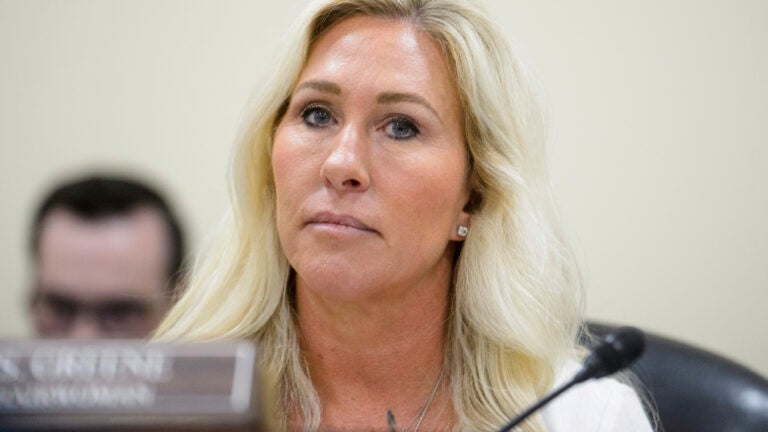
WASHINGTON — Rep. Marjorie Taylor Greene of Georgia, an avatar of MAGA politics on Capitol Hill, this week became the first Republican in Congress to describe the situation in the Gaza Strip as a “genocide,” breaking sharply with her party in an indication of growing skepticism on the right about Israel’s conduct of the war.
“It’s the most truthful and easiest thing to say that Oct. 7 in Israel was horrific and all hostages must be returned, but so is the genocide, humanitarian crisis, and starvation happening in Gaza,” Greene said in a social media post Monday evening.
Her comments drew a clear contrast with the vast majority of Republicans in Congress, who have made unqualified support for Israel a hallmark of their foreign policy approach. Many of them, including Greene in the past, have attacked Democrats who have criticized Israel as antisemitic and sympathetic to terrorists. The vast majority of Republicans have not budged from that stance.
But Greene’s unvarnished language spoke to a simmering rift on the right just as President Donald Trump on Monday acknowledged the starvation in Gaza after largely deflecting on the issue for months. Trump broke with Israeli President Benjamin Netanyahu, who has said there is no starvation in the war-torn enclave.
In recent weeks, Greene and some other right-wing Republicans have grown more outspoken in opposing what is happening in the Middle East, particularly after Trump bombed Iran, enraging some in his “America first” base. The skepticism is not limited to Greene or to Capitol Hill, and appears to be gaining ground particularly among a younger generation less reflexively supportive of Israel.
At a recent conservative student conference, Dave Smith, a libertarian commentator, drew applause during a debate moderated by right-wing activist Charlie Kirk when he bluntly rejected the idea that the United States should be in lock step with Israel.
“Obviously, Christians and Jews and Muslims have a connection to that land, but that doesn’t mean we have to bomb Iran for Israel,” he said onstage. He added that it also “doesn’t mean that we have to support Israel slaughtering people in Gaza.”
Matthew Brooks, CEO of the Republican Jewish Coalition, denounced Greene’s remarks as “part of an ongoing pattern of her saying outrageous and outlandish ridiculous things,” and said that Trump, who is “clearly standing unequivocally with Israel,” defines the MAGA point of view.
“This is not about it being the dam breaking in MAGA world,” he said.
But he also acknowledged an uptick in skepticism toward Israel among younger people on the right, attributing it to their ignorance about the issues.
“What we’re seeing among young MAGA people is an ill-informed view of things,” Brooks said, adding that it was challenging “to educate this generation” while working with other groups.
“I don’t think they are anti-Israel; I think they are getting incorrect information and are getting impacted by social media,” he said.
Steve Bannon, the former White House chief strategist who now hosts an influential right-wing podcast, said that even though Greene was in the distinct minority among congressional Republicans, her views reflected her political base.
“Marjorie Taylor Greene just reflects her constituency; I don’t think she’s an outlier at all,” Bannon said in an interview Tuesday, adding that she “is channeling hard-core evangelical Christians.”
Should that view take hold more broadly inside the GOP, it would be a remarkable shift from the traditional Republican foreign policy view of Israel, which is driven in large part by Christian beliefs in the biblical importance of Jerusalem.
It is not clear how many other Republicans will follow the lead of Greene, who has long been among the few GOP members of Congress who publicly questions American support for Israel. The Georgia Republican, the first QAnon supporter to be elected to Congress, also has trafficked in antisemitic conspiracy theories, including when she suggested in a 2018 Facebook post that a devastating wildfire that ravaged California was started by “a laser” beamed from space and controlled by a prominent Jewish banking family with connections to powerful Democrats.
Still, Greene is not alone among her Republican colleagues in criticizing what is happening in Gaza.
“Standing with Israel means eliminating every barbaric Hamas terrorist,” Rep. Lance Gooden of Texas wrote on social media, in a quote Greene recirculated. “It also means rejecting the killing and starvation of children in Gaza.”
In the Senate on Tuesday, there were few signs of any shift among Republicans.
Sen. Lindsey Graham of South Carolina said there was no genocide occurring. Sen. Thom Tillis of North Carolina said the label was an inflammatory distraction. And when asked for his view, Sen. Bernie Moreno of Ohio simply repeated “Hamas! Hamas! Hamas!” Once the group laid down its weapons, he added, “we’re good to go.”
Greene, however, has issued a series of escalating criticisms of Israel.
Earlier this month, she said in a statement that “Israel bombed the Catholic Church in Gaza, and that entire population is being wiped out as they continue their aggressive war in Gaza.” The remarks were made after a failed bid, led by Greene, to strip $500 million of American military funding that Congress had approved as part of its annual defense support for Israel.
The effort failed with only six members — two Republicans and four Democrats — voting in favor. That coalition included Rep. Rashida Tlaib, D-Mich., the only Palestinian American serving in Congress.
The pairing of Greene and Tlaib was an unlikely one. Greene two years ago led a failed effort to censure Tlaib, accusing her of “antisemitic activity” and “sympathizing with terrorists” after the Democrat spoke at a pro-Palestinian protest about the “dehumanizing conditions” in Gaza and called for “lifting the blockade” against humanitarian aid.
On Sunday, Greene posted on social media that she could “unequivocally say that what happened to innocent people in Israel on Oct 7th was horrific. Just as I can unequivocally say that what has been happening to innocent people and children in Gaza is horrific.”
This article originally appeared in The New York Times.





To comment, please create a screen name in your profile
To comment, please verify your email address
Conversation
This discussion has ended. Please join elsewhere on Boston.com