
Sign up for the Today newsletter
Get everything you need to know to start your day, delivered right to your inbox every morning.
Juneteenth, the holiday that marks the end of slavery in the United States, has been celebrated at the White House each June 19 since it was enshrined into law four years ago. But Thursday, it went unmarked by the president — except for a post on social media in which he said he would get rid of some “non-working holidays.”
“Soon we’ll end up having a holiday for every once working day of the year,” Trump said in mangled syntax, not mentioning Juneteenth by name nor acknowledging that Thursday was a federal holiday. “It must change if we are going to, MAKE AMERICA GREAT AGAIN!”
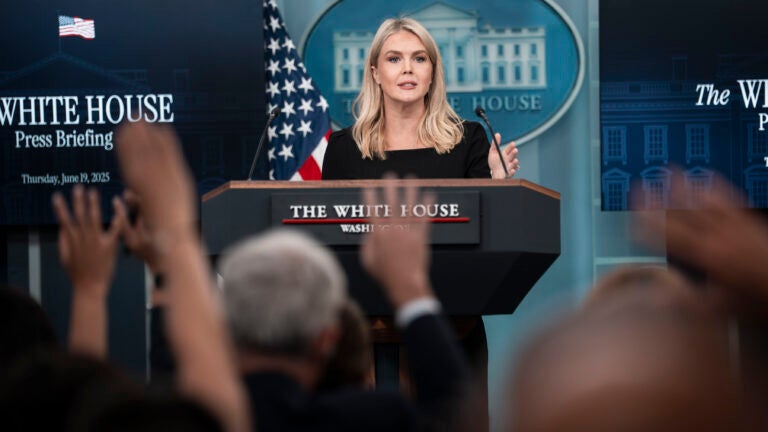
Karoline Leavitt, the White House press secretary, indicated to reporters earlier in the day that she was not aware of any plans by Trump to sign a holiday proclamation. In the past week alone, he’d issued proclamations commemorating Father’s Day, Flag Day and National Flag Week, and the 250th anniversary of the Battle of Bunker Hill — none of which are among the 11 federal holidays.
In response to a reporter’s question about Juneteenth, Leavitt acknowledged that Thursday was “a federal holiday,” but noted that White House staff had shown up to work during a briefing that focused primarily on the matter of whether Trump would order strikes on Iran.
Trump, who has often used holidays as an occasion to advance his political causes and insult critics and opponents on social media, chose the occasion of Juneteenth instead to float the idea of reducing the number of federal holidays, claiming that they are costing businesses billions of dollars. While most federal employees get those holidays off, private businesses have the choice to close or remain open.
Juneteenth commemorates June 19, 1865, the day when a Union general arrived in Galveston, Texas, nearly 2 1/2 years after President Abraham Lincoln signed the Emancipation Proclamation, to finally inform enslaved African Americans there that the Civil War had ended and that all enslaved people had been freed. Months later, the 13th Amendment was ratified, abolishing slavery in the final four border states that had not been subjected to Lincoln’s order.
It is the newest federal holiday, enshrined into law in 2021 by Congress and then-President Joe Biden. Trump cannot undo it without an act of Congress.
The lack of revelry at the White House for a holiday that has been cherished by generations of Black Americans was perhaps not a surprise. Since returning to office, Trump has moved to purge the federal government of diversity, equity and inclusion initiatives and sanitize — or even erase — references to Black history.
Even so, the decision not to mark the holiday was an abrupt reversal from his last term, when Trump issued statements on Juneteenth for three years, before it was ever a federal holiday.
“Melania and I send our warmest greetings to all those celebrating Juneteenth, a historic day recognizing the end of slavery,” he wrote in 2017, extolling Maj. Gen. Gordon Granger’s announcement in Galveston that all slaves were free.
In 2018 he invoked Granger again, and praised “the courage and sacrifice of the nearly 200,000 former enslaved and free African Americans who fought for liberty.”
But Trump’s second term has been marked by a widespread effort to slash funding for diversity initiatives, prompting backlash from states, schools and the corporate world. Some cities and institutions that have had their funding cut reported that their Juneteenth celebrations would be smaller this year.
Trump’s critics dug in sharply, using Juneteenth to call attention to what they called the administration’s attempts to bury Black history.
Rep. Hakeem Jeffries of New York, the Democratic leader, accused the White House and Trump’s allies of engaging in “an intentional effort to turn back the clock” and divide the country by banning books about Black history, dismantling DEI programs and undermining the citizenship protections of the 14th Amendment.
“Today, we celebrate the freedom that Black Americans long fought for and the rich culture that grew from that great struggle,” Jeffries, the first Black leader of a party in either chamber of Congress, said in a statement. “That struggle roars on.”
The holiday also came as Trump marked a new low in his relationship with the NAACP, the oldest and largest U.S. civil rights organization, which said this week that it would not invite Trump to its national convention, breaking from a 116-year tradition of inviting the president to its marquee event.
Biden established Juneteenth as a federal holiday in 2021, after interest in the history of the day was renewed during the summer of 2020 and the nationwide protests that followed the police killings of Black Americans including George Floyd and Breonna Taylor.
During his presidency, Biden held a concert on the South Lawn of the White House to commemorate the holiday and gave remarks. On Thursday evening, Biden attended a Juneteenth celebration at Reedy Chapel African Methodist Episcopal Church in Galveston, sitting at the head of the church next to local leaders. He was honored for signing the federal holiday into law and praised for his appointment of Ketanji Brown Jackson, the first Black woman to serve on the Supreme Court.
Speakers did not name Trump, but criticized his administration’s policies, especially on diversity.
“Black history is American history,” Biden told the crowd to cheers, according to a livestream of his remarks.
Biden also took to task those who thought Juneteenth should not be a federal holiday.
“Some say to you and to me that this doesn’t deserve to be a federal holiday,” Biden said. “They don’t want to remember what we all remember — the moral stain, the moral stain of slavery.”
This article originally appeared in The New York Times.
Get everything you need to know to start your day, delivered right to your inbox every morning.



To comment, please create a screen name in your profile
To comment, please verify your email address
Conversation
This discussion has ended. Please join elsewhere on Boston.com