
Sign up for the Today newsletter
Get everything you need to know to start your day, delivered right to your inbox every morning.
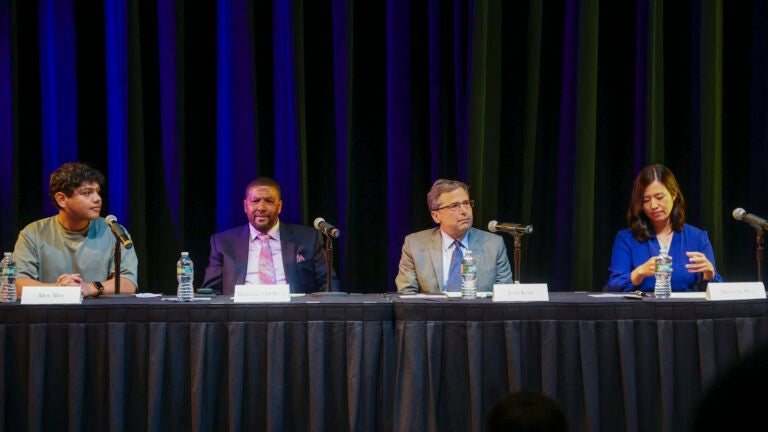
Boston’s mayoral race is picking up steam, as Mayor Michelle Wu seeks to win a second term. Recent polling shows that Wu is in strong shape, and ousting an incumbent mayor is a historically rare feat in Boston politics.
But Wu does have her vulnerabilities, and Josh Kraft is looking to exploit them. The son of Patriots owner Robert Kraft and a longtime philanthropist and nonprofit leader, Josh Kraft is running a well-funded campaign on a slightly more moderate platform than Wu. He is seeking to capitalize on discontent with Wu among some of Boston’s business leaders, while portraying her as an ineffectual leader who doesn’t listen to community members enough. Wu has countered by playing up Kraft’s privilege and his inexperience in Boston’s political scene.
A candidate forum hosted by 11 of the city’s Democratic Ward Committees last Thursday gave Wu and Kraft the opportunity to spar face-to-face. They were joined onstage by Alex Alex and Domingos DaRosa, two lesser-known candidates. Here are five takeaways.
Former Speaker of the House Tip O’Neill used to be fond of saying that “all politics is local.” As the Trump administration seeks to wield its power in clashes with major liberal cities like Boston, that saying is more relevant than ever. The actions of the federal government, and the appetite for resistance among many Bostonians, will figure heavily into this year’s mayoral race.
Through heated back-and-forths with federal officials and in high-profile congressional testimony, Wu is already capitalizing on the politics of resistance in the new Trump era.
She doubled down during the forum, positioning herself as a strong fighter for liberal values. Wu highlighted the city’s role in pushing back against President Donald Trump’s efforts to cut NIH funding and the city’s lawsuit against the Trump administration to save funding that helps prevent homelessness. She decried an “unprecedented attack on higher education” as a way for the federal government to control “who can think and speak freely in our country.” Boston has a crucial role to play in opening the door for continued opposition, she said.
“When Boston speaks up, when we fight back strongly and we step out, that creates a space for all of our universities as well to feel protected and to start stepping out and fighting as well,” Wu said.
Kraft said he was similarly unafraid to fight the Trump administration. He was sure to mention how Trump’s tariffs are likely to increase housing costs, a central pillar of his campaign. Kraft said he was ready to fight against the government’s mass deportation plans and any possible attempts to suspend due process or habeas corpus protections.
When asked about attacks on higher education, Kraft spoke about the importance of free speech rights on campuses and the value of diversity, equity, and inclusion policies.
“DEI is a crucial part of education, because the more diverse an administration is, professorships are, the more you learn, the more experiences you can share with students so people have a deeper understanding of everyone’s experience in America, or not in America,” he said.
As the cost of living for everyday residents increases, many voters may be especially concerned with how well leaders can steward the city’s finances. During her first term, Wu expended significant political capital backing a divisive effort to shift Boston’s property tax burden onto commercial owners and away from homeowners. The city’s powerful business and real estate communities largely opposed the effort, and Kraft is looking to capitalize on their discontent with Wu’s plan.
Wu and Kraft had a tense exchange over the city’s budget. Last month, Wu unveiled a budget proposal that seeks to prepare for “worst case” scenarios while still increasing funding for certain city services. During the battle of the tax plan last year, she resisted calls to cut the budget.
Although Wu is planning for the “unplannable” in her budget proposal, the mayor said that she is also not buying into the notion that aggressive cuts are necessary. In explaining this, she compared Kraft to Elon Musk’s much-derided Department of Government Efficiency initiative at the federal level.
“It’s not just billionaires at the federal level who said we need to cut everything in the name of efficiency,” Wu said.
Kraft called the Wu administration’s resistance to budget cuts “disrespectful” to citizens that are forced to make tough financial decisions every day.
“It’s easy to stand on the sidelines when you’re new to the city, new to any city policymaking, to say ‘just cut, cut, cut’ and not have to say from where,” Wu said in a not-so-subtle dig at the fact that Kraft is a newcomer to elected politics.
One of the sharpest divisions between Wu and Kraft emerged when the candidates were asked whether they would make it a priority to reduce residents’ dependence on cars. Kraft said that this would not be a priority for him. In the long-term, Kraft said that diversifying transportation methods and improving the MBTA would be worthwhile pursuits. But his immediate focus would be on improving roads and sidewalks.
“There’s a lot of folks in this city, I hear from them every day, they need their car. They have to get their child to day care, they have to get to work,” he said.
Wu said that she would “absolutely” focus on allowing Bostonians to rely on their cars less. She touted the city’s work supporting the MBTA in its efforts to eliminate slow zones and building out alternative transportation infrastructure. But Wu also directly referenced an interview Kraft did with Politico recently where he was asked if he has any plans to address traffic congestion. Kraft said that he did not, and that he has been focused on the issue of bike lanes instead.
“That’s not a plan, that’s not even a concept of a plan,” Wu said.
As mayor, Wu invested heavily into adding bike and bus lanes throughout the city. But backlash ensued, as some complained that the city lacked a cohesive plan guiding this construction and that traffic congestion and pedestrian safety were negatively impacted. She has since moderated slightly on the issue. But Kraft still frequently attacks Wu for, in his telling, plowing ahead with bike and bus lane constriction instead of listening to what actual residents want. Kraft says he supports bike lanes generally, but wants to pause construction and collect more data.
The area’s crises of homelessness, mental health, and substance use coalesce at the intersection of Massachusetts Avenue and Melnea Cass Boulevard in Boston. Shortly after taking office, Wu oversaw the dismantling of a large encampment there and pushed a related “housing surge” for those affected. The next year, Wu again took action to clear a large tent encampment that had sprung up on nearby Atkinson Street, citing public safety concerns that caused some nonprofits to pull their workers from the area.
While the administration successfully cleared the area, congregant drug use and crime have spread to other areas of the city. Wu has acknowledged these spillover effects and says she is working to address them. But this created an opening for Kraft, who last month unveiled his own plan for Mass. and Cass and blamed Wu for spreading the crisis instead of handling it properly.
Kraft said he would give the Wu administration an “F” grade on its handling of Mass. and Cass. He said that the city needs to have a “recovery first” approach while also working proactively to “bring order” to parts of the city where people are gathering to use drugs.
When asked to grade her administration’s work on the issue, Wu said that she would give it an “incomplete.” Her team has built up new infrastructure to help those in need, prioritizing low-threshold housing and one-on-one interactions with those living on the streets, she said. That there are no permanent encampments in Boston is a testament to the success of these plans, she added.
“It’s a difficult thing to say we’re going to tackle the problem right and not just contain it and look away, but really address it, even if that means we need to provide a citywide response,” Wu said.
While Wu and Kraft are the major players in the mayoral race, the forum was a valuable opportunity for Alex and DaRosa to introduce themselves to voters.
Alex, a 24-year-old Dorchester resident, spoke about his history coming to Massachusetts illegally as a child before gaining his citizenship. After graduating from New York University in 2023, Alex moved back to Boston.
He decided to run for mayor after growing disillusioned with the city’s response to residents like him. Alex spoke about sending dozens of applications to the city to no avail, and being shunned when he sought to propose a “clean Boston initiative.”
“I was compelled to join this race because I do not trust that the leading candidates or typical coverage will speak frankly about issues in transit, housing, education, labor, and democracy,” he said. “Even if voters won’t vote for me, I hope that they recognize the value of my perspective and the pressure that I provide.”
DaRosa touted his work as a city employee for 20 years, as a community organizer, and as a Pop Warner football coach. He previously ran for the City Council in 2017, 2019, and 2021. DaRosa said that he would fight for more housing, safer streets, and better mental health services. He recently told The Boston Globe that Boston’s schools need to focus more on extracurricular activities and that reopening the Long Island recovery campus should be an immediate priority.
DaRosa is particularly outspoken about the opioid crisis and has organized community members to help pick up needles in Roxbury. He made headlines in 2020 when he left hypodermic needles outside former Gov. Charlie Baker‘s Swampscott home in an act of protest.
Video of the full candidate forum can be viewed below:
Get everything you need to know to start your day, delivered right to your inbox every morning.



To comment, please create a screen name in your profile
To comment, please verify your email address
Conversation
This discussion has ended. Please join elsewhere on Boston.com