
In Karoline Leavitt’s world, Trump’s word is enough
The White House press secretary is shaming some members of the Washington media and fielding softballs from others — all with a self-assured smile.
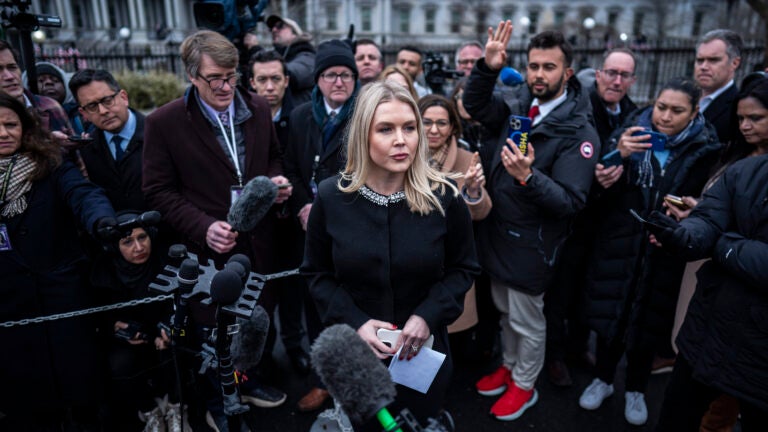
Before Karoline Leavitt begins a White House briefing, before she emerges from behind the sliding door that separates the West Wing from the briefing room, before she takes the podium with a sunny “Good afternoon, everybody!”and begins her monologue about another newsy week in Donald Trump’s America, she gathers her staff to pray. She asks God for confidence, for the ability to articulate her words, to have a good briefing on behalf of the president, the administration and the American people.
Trump’s newest press secretary is radiant, blond and apple-cheeked – as if one of Da Vinci’s Madonnas had been styled for a Fox News hit. Her delivery is righteous, if a bit smug. God gives everyone gifts, Leavitt believes; hers is public speaking. And for roughly a half-hour, once or twice a week, she delivers Trump’s word to a room filled with professional skeptics.
On Feb. 12, it concerned a literal word.
“I was very up-front in my briefing on Day One that, if we feel that there are lies being pushed by outlets in this room, we are going to hold those lies accountable,” Leavitt said. “And it is a fact that the body of water off the coast of Louisiana is called the Gulf of America. And I’m not sure why news outlets don’t want to call it that, but that is what it is.”

She was talking about the Associated Press. The nonpartisan news organization had announced it was primarily sticking with “Gulf of Mexico,”the gulf’s name for more than 400 years, so as not to confuse its readers, who span the globe. The previous morning, Leavitt had summoned the AP’s chief White House correspondent to inform him that the wire service would no longer be permitted inside the Oval Office.
It was the latest salvo in the president’s war, almost a decade old, on those he perceives to be his enemies in the political press. In his first press briefing, eight years earlier,Sean Spicer had berated the White House press corps for its reporting on the size of the crowd at Trump’s first inauguration. Kellyanne Conway speaking in Spicer’s defense, coined the term “alternative facts.”Back then, Leavitt was a sophomore at a Benedictine college in her native New Hampshire, absorbing the anti-press rhetoric of early Trumpism and echoing it in a singsong voice on her student news station. Now 27, she presides over a briefing room where the White House’s affection for alternative facts is no longer shocking.
At her first briefing, Leavitt said that Elon Musk’s U.S. DOGE Service had found approximately “50 million taxpayer dollars that went out the door to fund condoms in Gaza” – a claim for which the administration, challenged by fact-checkers, could not wrangle any persuasive evidence. But while Leavitt’s remark inspired a few late-night jokes, it didn’t seem to scandalize the American public, which reelected Trump last year despite his well-known pattern of making false and exaggerated claims.

“We’re desensitized to it,” shrugged one veteran White House reporter, who spoke on the condition of anonymity because they were not authorized to speak on behalf of their news outlet.
“Karoline is the next generation of Trumpian democratization of information,” Conway says.
“I told the president the other night: ‘I’m a bit jealous, sir,’” Spicer says.
What a difference eight years makes.
In 2017, the White House press corps still expected that they and the press secretary would be working from a common set of facts. Spicer remembers his six-month stint behind the lectern as “openly hostile.” He recalls feeling the heat even from “conservative-leaning outlets,” who “had their own view on what they wanted Trump to do.”
By and large, influential figures on the right now go along with Trumpwhen it comes to what is conservative, what is true, what is American. Leavitt’s generation barely remembers there being any friction between Trump and the GOP in the first place.
“That’s why it’s very natural for her – it’s not like there’s an evolution that you saw with other people,” says Jalen Drummond, a friend of Leavitt’s who served alongside her as an assistant press secretary in the first Trump administration. “It’s the only party she’s known as an adult.”

Leavitt grew up in Atkinson, a wooded suburb on New Hampshire’s southern border. The Leavitt kids – Karoline and her two older brothers – went to Catholic school in Lawrence, a working-class city on the Massachusetts side. Neither of her parents had attended college. They owned a used truck dealership and seasonal ice cream shop. Fox News was always on in their house. Karoline dreamed of being a broadcast journalist, and she and one of her brothers used to record make-believe newscasts on the family camcorder.
She went to St. Anselm College, in nearby Manchester, on a softball scholarship. Friends she made there described her as clever, fun-loving and especially loyal – the kind of person you want in your corner.
Leavitt started developing her political voice around the same time Trump’s was resonating with people like her parents. The press is “frankly crooked,” she wrote in a 2016 op-ed, published in the St. Anselm Crier – “unjust, unfair, and sometimes just plain old false.” During her sophomore year she co-founded a broadcasting club that produced a weekly campus news program. In addition to getting in reps on news and weather, the club was also a platform for Leavitt to practice performing political analysis to the camera.
“Everyone can expect the transfer of – the peaceful transfer of power in this country,” she said during a showafter Trump’s first inauguration. “That’s what makes America so great.”

Junior year, she applied fora summer gig at Fox News but ended up taking an internship with the Trump White House, which meant early mornings and late nights writing letters in the president’s name from the Eisenhower Executive Office Building. She returned to Washington after graduation, in 2019, and eventually made it inside the West Wing, working in the press shop and learning at the elbow of Kayleigh McEnany, his fourth press secretary. Leavitt had “front-of-the-classroom energy,” says Drummond, and wasn’t afraid to speak up if she felt her superiors weren’t faithfully reflectingTrump’s message.
Then, Trump lost. And the message became: He’d won.
Privately, Leavitt had said that she believed Trump had been defeated and disagreed with his claims of a stolen election, according totwo people who spoke on the condition of anonymity to describe private conversations they recalled having with her. (Leavitt says she doesn’t recall such conversations, noting that she spoke out strongly and immediately about election interference.)In any case, faithfully reflecting Trump’s message became the future of Republican politics. After the election, Leavitt took a job as communications director for Rep. Elise Stefanik (R-New York). She watched her new boss oust Liz Cheney from GOP leadership and consolidate the party behind Trump and his denial. “Karoline learned from Elise that voters in the MAGA movement will reward and support you when you take tough positions to fight for the cause,” says Alex deGrasse, Stefanik’s top political adviser, who considers Leavitt an “unwavering” MAGA true believer.
Before long Leavitt was running for Congress herself, in the 2022 midterms. “It was stolen,” she said of the 2020 election during her campaign, adding: “We need candidates who are willing to speak truth about the election.”
Leavitt won her primary but lost to the Democratic incumbent. That winter, she went to Palm Beach to try to find a way back into Trumpworld. Soon she was doing TV for MAGA Inc., Trump’s super PAC. “She really understood and embraced our philosophy of bare-knuckle comms,” says Taylor Budowich, then the super PAC’s executive director. “She has a fantastic presence and delivery for TV, and also has the iron stomach for Trump politics.”
By the summer, she was the national press secretary for Trump’s campaign. She was also pregnant. Leavitt and her husband – a real estate developer 32 years her senior, whom she met through a mutual friend during her congressional campaign – were expecting a boy in July. “I told her to take a month,” Chris LaCivita, the campaign’s co-manager, recalls telling her as her due date neared. “She said ‘No, no, no – I’m in a hurry. I need 10 days.’”
She gave birth to her son on July 10.Three days later, a would-be assassin opened fire at Trump’s rally in Butler, Pennsylvania. Leavitt went back to work that day.
When it came time to recommend a press secretary, “I never gave it a second thought,” LaCivita says. “It was always going to be Karoline.”

Leavitt got the job, but she didn’t get the office.
Press secretaries in the past have been assigned a particular West Wing workspace – a big one, close to the Oval, with the wood-burning fireplace and view of the North Lawn. This time, that office went to Budowich, now a deputy chief of staff who oversees the entire press and communications operation. That operation has several fronts, including a team that serves pro-Trump content directly to people who may or may not read newspapers or watch cable news. Leavitt’s job is to be the face of the administration – except that’s actually the president, who publicly addresses the press far more often than she does.
She got a smaller office down the hall from Budowich. It’s something of a chancery for her diplomatic role with Trump’s so-called “enemies of the people.” She keeps her door open most times of the day; reporters amble in and out to get her to answer their questions. When she’s not channeling the president’s contempt, she can be collegial with members of the Fourth Estate, replying to requests for comment with friendly exclamation points.
Next door to Leavitt is White House communications director Steven Cheung, who is also her boss. Cheung and Leavitt have a kind of “good cop, bad cop” dynamic, according to colleagues: Leavitt to diplomatically respond to members of the press, Cheung to knock their heads together.

“It’s my favorite thing,” Leavitt said, describing the team’s interactions with the “liberal media” on a podcast last month.
“They email, ‘Karoline, ethical experts are saying …,’ and then you say this: ‘This is Steven Cheung, my great colleague, our White House communications director.’”
Leavitt continued: “We write back, ‘Which experts?’ And then they send the names, and we Google them, and they’re, like, Democrat donors funded by George Soros. … We copy and paste their Wikipedia [entries] and we’re like, ‘These experts, a – hole?’”
Okay, so “good cop” is a relative term.
Since February, the White House has been exercising tighter control over the “pool,” a rotating group of journalists covering the president’s public activities when space is limited, serving as the eyes and ears of the entire press corps. The composition of the pool has long been overseen by the White House Correspondents’ Association, an organization of journalists. Trump’s fight with the Associated Press gave Leavitt’s team the opportunity it had been looking for to seize control of the pool.
“Nobody has the right to go into the Oval Office and ask the president of the United States questions,” Leavitt said on Feb. 12. “That’s an invitation that is given.”
On Feb. 25, S.V. Dáte, a reporter for HuffPost, was gearing up for his turn on pool duty the next day when he heard from the White House. “We actually can’t fit you in the pool tomorrow,” a press aide texted.

– Jabin Botsford / The Washington Post
During Dáte’s previous turn in the pool rotation, he had asked Trump about a post JD Vance made on X, in which the vice president said that “judges aren’t allowed to control the executive’s legitimate power.” That comment had alarmed those who are worried that the White House might disobey a court order.
“The vice president suggested that if the Supreme Court rules in a way that you don’t like, they could just enforce it by themselves,” Dáte said. “Do you agree with that?”
“I don’t know even what you’re talking about,” Trump replied. “Neither do you. Who are you with?”
“HuffPost, sir.”
“Who?”
“HuffPost.”
“Oh, no wonder,” Trump said. “I thought they – I thought they died.”

– Jabin Botsford / The Washington Post
On Feb. 26, the day Dáte had been scheduled for pool duty, was the first day the White House had taken over the pool. An Axios reporter got his slot. That afternoon, Dáte spotted Leavitt in the White House press workspace and asked her why he’d been singled out. She told him he should be “grateful” that HuffPost was still allowed in the pool, according to two witnesses to the exchange.
Leavitt says that Dáte had been replaced the previous day because his turn happened to coincide with the debut of the press team’s new rotation, and that he and HuffPost have not been kicked out of the pool. “That is a fallacy that S.V. wants to believe in his head because he thinks that we care that much about him,” she says. But the press secretary also says she thinks that the HuffPost reporter hates Trump and is not interested in facts. (“S.V. Dáte’s long record of trusted, honest, fact-based reporting speaks for itself,” Whitney Snyder, HuffPost’s editor in chief, told The Washington Post in a statement. “The White House’s decision to remove HuffPost from the pool rotation and smear S.V. to the press is unprecedented and outrageous.”)
Peter Baker, chief White House correspondent for the New York Times, sees writing on the wall.
“It’s clear they’re sending a message – if we write or broadcast something they don’t like, we can be punished by having access to the pool cut off,” Baker says. “There’s nothing subtle about it.”

Leavitt, literally shimmering in sparkly mint-green bouclé with pearl buttons, smiles and leans into the lectern as she repeats a Trump claim that has baffled economists on the right and left: Tariffs are effectively “a tax cut for the American people.”
It’s March, and she’s sparring with the AP again. “Have you ever paid a tariff? Because I have,” said reporter Josh Boak, suggesting that tariffs tend to make retail prices go up. “They don’t get charged on foreign companies, they get charged on the importers.”
“And ultimately,” Leavitt parries, “when we have fair and balanced trade, which the American people have not seen in decades, as I said at the beginning, revenues will stay here, wages will go up and our country will be made wealthy again.”
The press secretary’s voice is smooth, controlled, declarative – gone is the singsong lilt of her college broadcasts. She can scowl with her eyes while smiling.
“I think it’s insulting that you are trying to test my knowledge of economics and the decisions that this president has made,” she continues. “I now regret giving a question to the Associated Press.”
The James S. Brady Briefing Room is, in many respects, the same as it has always been. (The AP, for example, still has its seat there.) The same two-minute warning sends makeup-faced television reporters and their rumpled wordsmith colleagues flocking toward the same seven narrow rows of retractable chairs. The seating chart is still controlled by the White House Correspondents’ Association, which sorts the press corps into a peer-approved hierarchy: TV networks and wires in the front row, national newspapers and radio in the second, then digital, international and regional outlets filling out the rest.

But along the edges of the room, an alternative political press has begun to take shape – at the invitation of Leavitt’s team, which controls who gets to be in the room, if not where they sit.
Brian Glenn, a correspondent for the right-wing cable channel Real America’s Voice (and boyfriend of Georgia Republican Rep. Marjorie Taylor-Greene), can be found there. So can Monica Page Luisi, the new White House correspondent for MAGA youth group Turning Point USA. The Gateway Pundit is back in the room. So is Matt Boyle, the Washington bureau chief for Breitbart News.
“It’s the golden age of American journalism back in the White House,” Boyle says.
“The press pool and the briefing room should better reflect how the American public consumes information,” Budowich says. “The goal is to build a media environment that better serves the public and the outlets, and we think that can be responsibly achieved.”
The first question at each briefing goes to the “new media” seat, which Leavitt has defined as “independent, podcasters, social media influencers and content creators” who “produce news-related content.” So far, the press shop has invited some journalists from down-the-middle digital publications, such as Semafor and Axios, for this honor. Often, though, the privilege has gone to friendly outlets, such as Breitbart and the Daily Wire. Sage Steele, a former ESPN reporter turned conservative content creator, used her turn to ask Leavitt how Congress could make sure no future administration could “destroy” Title IX. Later that day, Steele appeared behind Trump as he signed an executive order banning transgender women from competing in women’s sports.
Leavitt takes plenty of questions from the legacy media outlets, but takes care to include the Trump-friendly newcomers standing along the periphery.

“What is making young people want to serve in the military under the Trump administration, and how does that contrast to Biden’s failure consistently to meet recruiting average?” The Gateway Pundit’s Jordan Conradson asked on Feb. 5.
“What does it say that the Democrats, while they couldn’t stand for Americans or stand for victims, they stood for war and clapped for war?” asked Breitbart’s Nick Gilbertson on March 6, the day after Trump’s address to a joint session of Congress.
“I wanted to ask about this video I saw this morning set to the tune of, I believe, ‘Closing Time,’ about deportation of illegal migrants,” said the Daily Wire’s Mary Margaret Olohan on March 17. “What’s the strategy behind the White House’s videos they’ve been putting out on this?”
The administration had just deported Venezuelan immigrants to a prison in El Salvador, saying they were members a Venezuelan gang. Trump said that they were invading the country and that he was expelling them under the Alien Enemies Act, an obscure wartime law. A judge had issued an order temporarily blocking the deportations until they could be hashed out in court; by the end of the week, he would be grilling a Justice Department lawyer about whether the administration had disregarded that order. It was unclear, based on public reporting, how many of the men were gang members – the government hasn’t shared its evidence – and an immigration enforcement official has acknowledged that “many” do not have criminal records in the United States.
But, according to Trump, they were “violent, vicious and demented criminals” and the judge who ordered the pause was a “radical left lunatic.” And so Leavitt spoke righteously of the White House’s decision to post a video of the cuffed men being put on a plane, set to Semisonic’s 1998 rock anthem about last call at the bar.
“I think the White House and our entire government clearly is leaning into the message of this president,”Leavitt replied to Olohan. As for the video:“I think it sums up our immigration policy pretty well,” she said.
The press secretary’s mouth curled into a smile as she quoted the lyrics.
“You don’t have to go home but you can’t – stay – here”

– Jabin Botsford / The Washington Post





To comment, please create a screen name in your profile
To comment, please verify your email address
Conversation
This discussion has ended. Please join elsewhere on Boston.com