
Extra News Alerts
Get breaking updates as they happen.
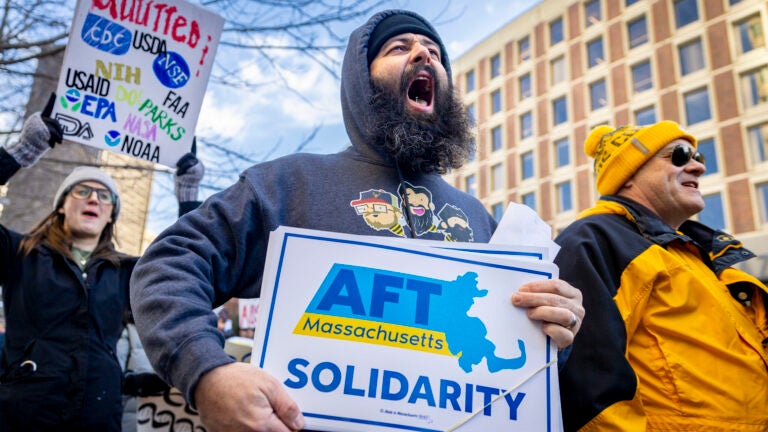
BOSTON (AP) — A federal judge in Massachusetts on Friday extended a temporary block of the Trump administration’s drastic cuts in medical research funding that many scientists say will endanger patients and delay new lifesaving discoveries,
U.S. District Judge Angel Kelley had issued a temporary restraining order earlier this month in response to separate lawsuits filed by a group of 22 states plus organizations representing universities, hospitals and research institutions nationwide.
Across the country, several mayors — including Boston mayor Michelle Wu — have filed friend-of-the-court briefs to push back against Trump’s order to cut NIH funding, The Boston Globe reported.
“For decades, Congress has made a clear choice to use federally-funded research to invest in cities, build a broadly-distributed infrastructure for scientific discovery, create jobs, and drive economic growth in communities across the United States,” Wu said in a statement Thursday obtained by The Boston Globe. “We join with cities across the country — in red states, purple states, and blue states — to stop this illegal action that will cause layoffs, lab closures, and undermine scientific progress in American cities.”
The new National Institutes of Health policy would strip research groups of hundreds of millions of dollars to cover so-called indirect expenses of studying Alzheimer’s, cancer, heart disease and a host of other illnesses — anything from clinical trials of new treatments to basic lab research that is the foundation for discoveries.
During a hearing Friday, Kelley said she was extending that temporary block while deciding on a more permanent ruling. Kelley was appointed by Democratic President Joe Biden.
The states and research groups say the cuts are illegal, pointing to bipartisan congressional action during President Donald Trump’s first term to prohibit it.
“Yet here we are again,” attorneys argued in a court motion, saying the NIH is “in open defiance” of what Congress decreed.
Sen. Patty Murray, a Democrat from Washington state, tried unsuccessfully to block the NIH cut during an overnight Senate budget debate, saying it “violates bipartisan appropriations law. I should know, I helped author that provision. And Republicans should know – they worked with me to pass it.”
In court Friday, Trump administration attorney Brian Lea argued the issue is “broad discretion power of the executive branch” in how to allocate funds.
The administration also claims Kelley’s courtroom isn’t the proper venue to arbitrate claims of breach of contract and that states and researchers haven’t shown the cuts will cause “an irreparable injury.”
The NIH, the main funder of biomedical research, awarded about $35 billion in grants to research groups last year. The total is divided into “direct” costs – covering researchers’ salaries and laboratory supplies – and “indirect” costs, the administrative and facility costs needed to support that work.
The Trump administration had dismissed those expenses as “overhead” but universities and hospitals argue they’re far more critical. They can include such things as electricity to operate sophisticated machinery, hazardous waste disposal, staff who ensure researchers follow safety rules and janitorial workers.
Different projects require different resources. Labs that handle dangerous viruses, for example, require more expensive safety precautions than a simpler experiment. So currently each grant’s amount of indirect costs is negotiated with NIH, some of them small while others reaching 50% or more of the total grant.
If the new policy stands, indirect costs would be capped at 15% immediately, for already awarded grants and new ones. NIH calculated that would save the agency $4 billion a year.
A motion filed earlier this week cited a long list of examples of immediate harm in blue states and red states. They included the possibility of ending some clinical trials of treatments at the University of Wisconsin, Madison, that could leave “a population of patients with no viable alternative.”
Officials at Johns Hopkins University were more blunt, saying the cut would end or require significantly scaling back research projects potentially including some of the 600 NIH-funded studies open to Hopkins patients.
“The care, treatments and medical breakthroughs provided to them and their families are not ‘overhead,’” university president Ron Daniels and Hopkins Medicine CEO Theodore DeWeese wrote to employees.
Attorneys also argued the cuts would harm state economies. The University of Florida would need to cut “critical research staffing” by about 45 people, while construction of a new research facility in Detroit expected to create nearly 500 new jobs could be paused or even abandoned, they wrote.
“Implementing this 15% cap will mean the abrupt loss of hundreds of millions of dollars that are already committed to employing tens of thousands of researchers and other workers, putting a halt to countless lifesaving health research and cutting-edge technology initiatives,” the lawsuit said.
Neergaard reported from Washington.
Get breaking updates as they happen.





To comment, please create a screen name in your profile
To comment, please verify your email address
Conversation
This discussion has ended. Please join elsewhere on Boston.com