
Sign up for the Today newsletter
Get everything you need to know to start your day, delivered right to your inbox every morning.

Months after Massachusetts voters rejected a ballot measure to legalize some psychedelics, a burst of newly filed bills has reignited debate on Beacon Hill.
Just shy of 57% of voters in November said “no” to Question 4, which would have paved the way for licensed psychedelic centers and allowed adults to grow, possess, and use five natural substances under certain circumstances. But while the measure failed resoundingly at the polls, advocates say there’s still growing support for legalized and expanded access.
And lawmakers are taking note.
“Over the course of the Question 4 campaign, constituents reached out to me to say that this kind of treatment saved their life,” state Rep. Steve Owens said in a statement provided to Boston.com. “I think we owe it to them to at least continue the conversation.”
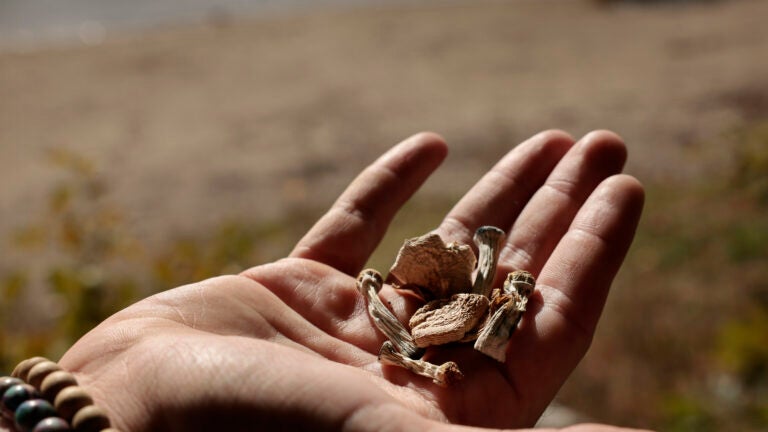
Owens is one of 10 state lawmakers who recently filed psychedelics-related bills, many of them aimed at exploring access to and potential uses for substances like psilocybin, or so-called “magic mushrooms.” Rather than Question 4’s sweeping push to legalize therapeutic centers and decriminalize personal use, the proposed bills pitch smaller, more targeted measures.
Owens’s bill, for example, would remove certain criminal penalties related to psilocybin that wasn’t medically prescribed, essentially aiming to decriminalize the drug as a treatment for conditions like PTSD. Other decriminalization efforts include a pair of “by-request” bills from state Sen. Cindy Friedman and Rep. Marc T. Lombardo, and another from Rep. Homar Gómez.
Rep. Lindsay Sabadosa, meanwhile, filed a bill to establish a five-site pilot program under which nonprofit therapeutic centers could offer psilocybin treatment for mental and physical health.
“Psychedelic therapy is an emerging field with significant potential for addressing mental health challenges, including PTSD, depression, and substance use disorders,” Sabadosa said in a statement. “The legislation seeks to establish a pilot program for psilocybin treatment centers to ensure that access remains patient-focused, community-centered, and driven by medical and scientific research.”
She added: “Just as medical cannabis provided a safe, regulated pathway for therapeutic use, this pilot program would be a crucial step toward ensuring that any future access to psilocybin therapy in the Commonwealth is safe, equitable, and evidence-based.”
The issue isn’t a new one for Sabadosa, who sought last session to make it lawful for adults to possess, use, obtain, grow, or give away the same five psychedelics covered under Question 4: psilocybin, psilocyn, dimethyltryptamine, ibogaine, and mescaline. Some of those substances prompted concerns in the lead-up to the 2024 ballot measure, with naysayers pointing to serious side effects and calling for further research.
In this latest legislative push, several lawmakers have zeroed in on psilocybin, one of the most-studied psychedelics. Research has suggested psilocybin can offer relief from certain mental health conditions, and the U.S. Food and Drug Administration has designated it a “breakthrough” therapy for treatment-resistant depression and major depressive disorder.
A bill from Rep. Marjorie Decker would establish the “Psilocybin-Assisted Therapy Program,” a pilot to explore the research and development of psilocybin services for adults with conditions like PTSD, depression, and end-of-life distress.
“My father suffered from PTSD after being drafted during the Vietnam War and serving two tours, and this is an area I care deeply about,” Decker said in a statement. “I have had many conversations about the potential of this pilot with constituents and advocates.”
The bill is awaiting referral to a committee for review, a process that can take anywhere from several weeks to a few months, Decker explained. She said she was particularly drawn to the issue after Massachusetts General Hospital launched a new Center for Neuroscience of Psychedelics to better understand how psychedelics could be used to improve treatment options for mental illnesses.
“Expanding psilocybin research and access plays an important role in advancing public health, especially in light of the increasing rates of mental health conditions,” Decker said. “It is important for the Legislature to gain a deeper understanding of this area to expand research in this field and pave the way for meaningful change for those affected by these conditions.”
Another proposal from Friedman would direct public health officials to establish a pilot program for the monitored mental health care of patients using psychedelics in a supervised, licensed mental health clinic. The bill also limits pilot permits to a maximum of three clinics participating in the program “for the purposes of establishing the best and safest clinical practices for psychedelic mental health treatment programs in the commonwealth and for the purposes of collecting patient outcomes data regarding the benefits of psychedelic pharmacotherapy.”
“Serving on the Special Joint Committee on Initiative Petitions last session, I was certainly intrigued by the support around exploring alternative medicines, especially for the treatment of mental health conditions,” Friedman said in a statement. “While total legalization wasn’t approved by the voters, there are merits to continuing to look towards the path of alternative medicine, and using a pilot program at licensed treatment facilities to prove this concept will be a great step in this direction.”
Some of the other notable bills similarly focus on studying or planning for broader use and accessibility. Rep. Mike Connolly called for the formation of a task force to study the public health and social justice implications of legalizing psilocybin and other psychedelic plants and fungi. Rep. Patrick Kearney, meanwhile, proposed “a comprehensive framework supporting public health and safety through regulated adult use, support services, and cultivation of psilocybin-containing fungi; and providing for taxation and appropriation thereof.”
Psychedelics advocates have made incremental gains throughout Massachusetts in recent years; eight communities have decriminalized the substances. The movement has also seen support from the state’s congressional delegation, with Sen. Elizabeth Warren voicing support for Question 4 last fall — so long as “we get the right regulations in place.”
Advocates formerly associated with the Question 4 campaign played a role in seven of the 10 bills filed, according to Parents for Plant Medicine founder Jamie Morey. She has teamed up with CJ LoConte, a veteran and fellow grassroots activist, to lead the nonprofit organization Mass Healing, a successor to the “yes” campaign’s Massachusetts for Mental Health Options.
In a January press release, the group said its post-election polling found more than half of respondents were supportive of removing criminal penalties for personal use of psychedelics, and roughly two-thirds supported therapeutic access. An informal poll of Boston.com readers in October likewise saw overwhelming support for legalizing psychedelic mushrooms, with 74% of respondents voting in favor.
“Psychedelic mushrooms have been used for thousands of years, and clearly have a reason to be used,” reader Cannon W. opined. “It makes no sense that these mushrooms are still illegal when other substances, like alcohol, which are generally more harmful, are not.”

Get everything you need to know to start your day, delivered right to your inbox every morning.





To comment, please create a screen name in your profile
To comment, please verify your email address
Conversation
This discussion has ended. Please join elsewhere on Boston.com