
Jill Stein won’t stop. No matter who asks.
People in Stein’s life have implored her to abandon her bid for president, lest she throw the election to Donald Trump. She’s on the ballot in almost every critical state.
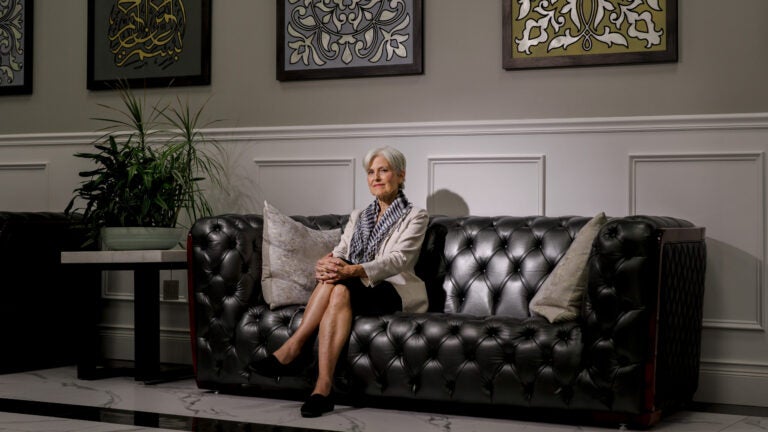
Jill Stein, the Green Party’s serial presidential candidate, has heard the pleading from strangers.
“How does it feel to be personally responsible for actually bringing Donald Trump into power?” Stein recalled being asked this year by a man in New York — another heckler accusing Stein of tipping the 2016 election.
She has absorbed the glowering across her anxious blue neighborhood outside Boston.
“When people are being propagandized,” Stein said, “they won’t be especially friendly on the street, put it that way.”
And as she weighed another campaign this time, she found resistance in the most intimate constituency: her own family.

“For her political activities, she does not have the support of the family,” one of Stein’s adult sons said in an interview, asking not to be identified by name to avoid any personal or professional repercussions from associating with her. “When she told us she was going to run again back in October 2023, we asked her not to.”
Stein has ignored them all.
Now, strategists in both parties agree, her decision might well echo again through history — by helping a man whose values she nominally abhors.
Stein is back on the ballot almost everywhere that matters, returning to the campaign fore in an ostensible coin-flip race between Trump and Vice President Kamala Harris. Democrats see Stein’s bid as a direct threat in a year when even relatively small voter pools might carry near-existential stakes.
While Stein condemns both “zombie political parties” as tools of Wall Street and war profiteers, her campaign has focused largely on hammering Harris, blaming the White House she serves for relentless violence in the Gaza Strip and Lebanon.
And Democrats, as never before, are focused on Stein.
The party has prepared a negative ad blitz for the election’s final weeks, its first-such effort ever directed at a third-party candidate. Fearful that Stein might divert critical votes in places like Michigan, Democrats are also pressing their case on billboards plastered recently across swing states: “Jill Stein Helped Trump Once. Don’t Let Her Do It Again.”
For the last eight years, Stein has taken her place as a peace-peddling, Democrat-bashing, Republican-aided, formerly Russian-boosted villain of the left (and champion, admirers say, of the further left) while Trump’s opponents relitigate his rise and move desperately to prevent his return.
In 2016, when Stein received nearly 1.5 million votes, her support in the decisive states of Michigan, Wisconsin and Pennsylvania exceeded Trump’s margins of victory. Some national polls now place her around 1%, which could be more than enough to make a difference and infuriate her detractors anew.
Such is the lot of the third-party candidate, quadrennially scorned by voters who often wish they had options beyond the major parties’ nominees — only to conclude, by election’s eve, that the choice is effectively binary.
“Forget the lesser evil,” Stein likes to counter. “Fight for the greater good.”
She dismisses the “spoiler mythology” that has come to define her mainstream identity, noting — accurately enough — that some of her supporters would never back Harris anyway.

She said that Democrats would do well to look inward, disputing that she bears any responsibility for Trump’s fortunes, then or now.
“Those conversations never go anywhere,” Stein, 74, said in a wide-ranging interview.
But then, to Democrats’ eternal distress and consternation, neither does she.
Her bid can feel precision-engineered to damage Harris with key subgroups: young voters appalled by the U.S.’ support for Israel; former supporters of Bernie Sanders’ presidential campaigns who feel abandoned by Democrats; and Arab American and Muslim voters, especially in Michigan, where fury at Harris and President Joe Biden has been conspicuous for months. (The state, decided in 2016 by just over 10,000 votes, has more than 300,000 residents with Middle Eastern or North African ancestry.)
“The goal is to punish the vice president,” Hassan Abdel Salam, a founder of Abandon Harris, a group dedicated to her defeat, said this month at a rally in Dearborn, Michigan, headlined by Stein. The group has since endorsed Stein.
“We are not in a position to win the White House,” another speaker, Kshama Sawant, a former member of the Seattle City Council, told a crowd of about 100 inside an Arab American cultural center. “But we do have a real opportunity to win something historic. We could deny Kamala Harris the state of Michigan.”
In the interview, Stein said she had “kind of a divergent point of view” of her candidacy, with an emphasis on the “kind of.”
“I myself do not speak in terms of defeating one candidate,” she said. “But I really understand — for the communities that are being savaged by Kamala Harris right now and Biden — I totally understand why their prime directive right now is to clarify that this comes with a price to pay.”
At minimum, Stein seems to concede this much: The goal is to be heard and counted.
If she helps to reinstall Trump, well, that would certainly register.
“I like her very much,” Trump said of Stein at a rally in June. “You know why? She takes 100% from them.”
Mindful of 2016 (and Ralph Nader’s 2000 campaign before that), Democrats are giving Stein their full attention.
Supplementing the ad campaign, Harris’ allies have also emphasized some of Stein’s curious associations and remarks, including statements considered deferential to Russia and figures with ties to Trump and Republicans who have worked to help Stein secure ballot access.
In Wisconsin, a lawyer who was previously involved in lawsuits seeking to overturn the 2020 election results represented the Green Party. In New Hampshire, a veteran Republican operative submitted signatures for Stein.
Jay Sekulow, who defended Trump at his first impeachment trial, has worked on behalf of the Green Party in Nevada, a rare battleground where Democrats have successfully thwarted her.
“We have never knowingly received help from Republicans,” Stein said, a claim that Democrats find ludicrous. “Now, they might have done this once or twice, having kind of snuck in under the radar.”
To Stein, any disdain toward her represents the imperial flailing of a desperate party.
She has likened Democratic voters to a spouse trapped in a toxic relationship, “constantly making excuses for your abusive partner.”
Asked if she could imagine any good-faith reason for voters — even those who are plenty frustrated with Democrats — to support Harris for the sake of stopping Trump, she paused for a beat.
“I believe that some people are genuine,” she said, “in being misinformed.”
Medicine, music, politics
Stein does not look the part of a Democratic scourge.
She is a Harvard-trained internist and former folk rocker who gave interviews this month beside a handmade campaign banner that read “People Planet Peace.”
She pushes a $25 minimum wage and the abolition of student and medical debt, shuttling between toss-up states like Michigan and less competitive ones like Texas and Washington without obvious electoral coherence.
Her highest elected office was a seat on a town body in Massachusetts more than a decade ago, but she “would not accept as written in stone” that she will not be sworn in as president in January.
Raised in a Reform Jewish household outside Chicago, Stein aligns herself with civil rights leaders across the ages, gilding her appearances with curated quotations.
“Martin Luther King said … ”
“Remember what Alice Walker said … ”
“As Frederick Douglass said,” she said in the interview, reciting the line twice within 10 minutes, “‘Power concedes nothing without a demand.’”
In Michigan, she campaigned while flanked by men in fezzes, who stood silently in formation as she accused Harris of fomenting genocide in Gaza. (An aide referred to the men as her security; one called himself simply “a friend.”)
Stein’s running mate, Butch Ware, a professor at the University of California, Santa Barbara, who has studied African and Islamic history, has called Harris the “Black face of white supremacy” and likened Barack Obama to a “house Negro.” On Oct. 7, one year after the Hamas-led attacks that amounted to the largest massacre of Jews since the Holocaust, Ware recorded a video to “commemorate the one-year anniversary of the modern equivalent of Nat Turner’s rebellion,” invoking the American slave revolt of 1831.
Stein’s coalition, such as it is, can be disorienting.
Her campaign was recently compelled to disavow an endorsement from antisemitic white supremacist David Duke, who supported Trump’s past runs. (Duke told followers that Stein was “the only candidate who speaks clearly against the war in the Middle East.”)
On some subjects, Stein can sound something like Trump and his associates.
She complains of being “shadow-banned” on social media and dismisses “the Russia-gate smear” that ensnared her after Trump’s election.
In 2015, Stein attended an event in Moscow celebrating RT, the Russian TV network that gave heavy airtime to her 2016 campaign, sitting at a table with President Vladimir Putin of Russia and Michael Flynn, Trump’s first national security adviser. (Stein has downplayed the episode, saying she was there to preach peace.)
Investigators later determined that the Kremlin-backed Internet Research Agency used social media accounts in 2016 to promote Stein, hoping to help Trump. No public finding has suggested that Stein was aware of the effort.
To some who have known her for years, the notion of Stein as an international chaos agent is broadly absurd.
At Harvard, she distinguished herself as a gifted student, a nonconformist and a guitarist forever seeking optimal acoustics.
“She would sit in the stairwell with her guitar and sing, to her own amusement,” said Ty Cobb, a schoolmate who later worked as a White House lawyer under Trump, whom he has since criticized. “She was sort of a free spirit back then, had her own drummer.”
After college, Stein continued playing music as she transitioned into medicine, occasionally merging the two pursuits.
“She wrote songs to remember all the bones,” said Mark Allen, a retired advertising executive who became friends with Stein in the 1970s.
As a Vietnam War-era dissident long skeptical of mainstream politicians, Stein said she generally voted Democrat anyway before being galvanized by Nader and the Green Party.
Her political career began in 2002, when she said she was approached to run for governor of Massachusetts. The field included Mitt Romney, the Republican front-runner.
“I moved from clinical medicine to political medicine because politics is the mother of all illnesses,” Stein said — a line she has used since at least her 2012 presidential campaign.
Quickly, she inspired the kind of political zingers that continue to trail her. Some who know her suspect that her contempt for Democrats congealed around this time, deepening with each campaign.
“It was basically the same thing,” Stein said. “‘A vote for Stein is a vote for Romney.’”
Although Stein received more than 3% of the vote, a surprisingly strong showing, and acquitted herself capably on the debate stage, one exchange seemed to capture her party’s perpetual quest for name recognition.
Romney turned toward Stein to address a point she had made about education policy.
“Carla, I agree,” he said, accidentally naming the Libertarian candidate, Carla Howell, who corrected him (“I’m Carla”) as Romney backpedaled. “I’m sorry. Excuse me. Dr. Stein.”
A matter of principle
For months, people who know Stein — friends, relatives, long-lost peers — have discussed privately how best to get through to her.
They worried she was aiding Trump, despite her protestations. They believed that another dead-end campaign would undercut the ideals she claimed to embody.
Some tried to raise the subject delicately through intermediaries. Others composed painful, pointed messages and sent them directly.
“Your constituents and their votes in swing states could make the difference as to whether the U.S.A. joins the many authoritarian nations of the world,” Allen, the friend from the 1970s, wrote recently to Stein, urging her to instruct supporters to back Harris. “If the election weren’t so close, I’d vote for you, as I did in 2016. Instead, I’m asking you to please be courageous and strategic.”
He received no response.
While both major parties have trained their focus on Stein as a possible factor, some strategists expect third-party support to be more muted this time.
In 2016, when many voters were convinced that Hillary Clinton was a shoo-in, protest voting could feel fairly low-stakes. Few consider Harris’ candidacy a sure thing.
In recent weeks, Democratic leaders like Jaime Harrison, the party chair, and Rep. Alexandria Ocasio-Cortez have gone out of their way to tweak Stein, whom the Congress member described as a “predatory” figure who exploits voters’ understandable grievances.
“Democrats have finally learned the lessons of 2000 and 2016,” said Lis Smith, an adviser to the Democratic National Committee on third-party and independent candidates.
Republicans have learned some lessons, too.
“No Republican knows that oil production under Biden is higher than ever. But Jill Stein’s people do,” Steve Bannon, Trump’s former White House chief strategist, said earlier this year, adding, “The more exposure these guys get, the better it is for us.”
After consecutive campaigns in 2012 and 2016, Stein did not run in 2020. The Green Party nominee that year, Howie Hawkins, received only about 400,000 votes.
For a time, it appeared that Cornel West, a left-wing intellectual, would represent the Green Party in 2024. After he decided to run instead as an independent, Stein reassumed the mantle — and reignited Democratic complaints about her.
“The Republicans don’t do it, for some strange reason, as much as the Democrats,” Nader said in an interview, noting that Libertarians, who are historically considered likelier to siphon votes from Republicans, had not faced equivalent venom or legal challenges. (Gary Johnson, the 2016 Libertarian nominee, received more than 4 million votes.)
Nader said that Democrats’ habitual finger-pointing masked their own failure to appeal to disaffected voters. He accused the party of “massive political bigotry.”
Stein’s supporters tend to explain their choice as a product of principle and exasperation.
Bob McMurray, a campaign volunteer who attended the rally in Dearborn, said he voted for Clinton and Biden in the last two elections. But he faulted Democrats for violence in the Middle East, he said, and could not abide another nose-holding November, even as he surmised that Trump would be worse for Gaza.
“I’ve spent my entire adult life voting for the lesser of two evils,” he said. “I’m tired of it.”
Stein has also suggested that a Trump victory might serve the cause of left-wing protest.
“It’s sad to say,” she said, “but the common wisdom is that under Democrats, the anti-war movement goes to sleep.”
Asked why she seemed to denounce Harris so much more often, Stein said that while the Democrats’ case against Trump was “generally true,” Republicans illogically attack Democrats “for being too socialist and for being Marxist.”
“If only,” her campaign manager, Jason Call, interjected with a laugh.
As a committed activist, Stein said, it was her duty to “correct the record,” drawing on decades of field research.
“The Democrats,” she said, exhaling for effect, “you have to really study them.” And no one could keep her from her chosen trade.
This article originally appeared in The New York Times.




To comment, please create a screen name in your profile
To comment, please verify your email address
Conversation
This discussion has ended. Please join elsewhere on Boston.com