
Newsletter Signup
Stay up to date on all the latest news from Boston.com
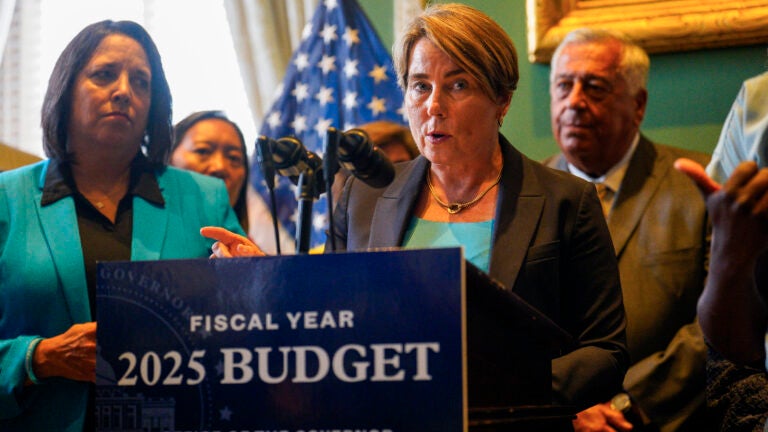
The new Mass. state budget, signed by Gov. Maura Healey on Monday, includes a Special Commission on Antisemitism and directions to provide resources to schools to address hatred against Jewish people.
“It’s been heartbreaking and unacceptable to see the rise in antisemitism and hate here in Massachusetts and across the country,” Healey said in a statement to Boston.com. “I’m grateful to the Legislature and advocates whose work will ensure that Massachusetts is stronger and safer for our Jewish community and all who call our state home.”
Vice President of the Anti-Defamation League’s East Division Peggy Shukur told Boston.com that working with the Massachusetts Department of Elementary and Secondary Education in addition to the commission can make a real impact.
“Having a commission to really go deep and study this and make actionable recommendations, and at the same time putting a light on DESE to develop evidence based resources and curriculum can really be a game changer and a model for other states in trying to fight a problem that is just getting bigger right now,” Shukur said.
The budget amendment comes as incidents of antisemitism reached a 205% increase from 2022 to 2023 across New England, according to the ADL. A total of 440 antisemitic incidents in Massachusetts were recorded by the ADL in 2023 – a 189% increase from the year before.
“What we’ve heard from members of the community is a real, genuine sense of fear,” Jeremy Burton, CEO of Jewish Community Relations Council of Greater Boston, told Boston.com.
The commission will report data trends relating to antisemitism and evaluate the Commonwealth’s hate crime statutes. It will also identify and evaluate efforts to combat antisemitism in the Commonwealth by reviewing best practices from other states and jurisdictions.
The amendment requires the commission to submit a report of the study and strategy recommendations by Nov. 30.
The “tight timeline,” Shukur said, “underscores the urgency of the moment.”
The commission is also tasked with making recommendations to implement the White House’s Strategy to Counter Antisemitism in the Commonwealth.
Burton said the commission will be using the national strategy to make recommendations to combat antisemitism in “all levels of society” and advise the Legislature on the best actions to take.
“There’s a real opportunity here for people from across Massachusetts’ society, from across Massachusetts’ government, and the community, to have a serious public conversation about how to combat antisemitism and look for concrete actions that they can be recommending to the legislature, to the governor, and to other actors in our civic space,” Burton said.
The commission will consist of three people appointed by the Senate president, three people appointed by the speaker of the house, and two people appointed by the governor.
Education commissioners, Massachusetts attorneys, and the Massachusetts State Police will be represented, as well as members of Jewish community organizations and civil rights experts.
Schools will be given resources to address antisemitism, including model and evidence-based curricula, guidance to assist in the selection of materials, and professional development and training on “antisemitism, ethnic, racial, and religious hate and discrimination.”
“Directing and authorizing DESE to provide model based, and evidence based curriculum and guidance and professional development training is something that these schools are hungering for and will welcome if done well,” Burton said.
Shukur said teaching about “who the Jewish people are, and what the Jewish experience is” in schools is an “effective way to prevent people from adhering antisemitic beliefs.”
“Focusing on schools so that there are better resources, curriculum, and responses is really something that needs to be prioritized,” Shukur said.
In recent weeks, the Massachusetts chapter of the Council on American-Islamic Relations and other groups urged Healey to veto the measures to combat antisemitism and cited a rise in anti-Muslim incidents reported to them in 2023.
“CAIR-MA strongly supports measures to address all forms of religious bias,” said Tahirah Amatul-Wadud, CAIR-MA executive director, in a statement. “Yet no other religious identity is protected under these proposals.”
Burton said it is a “false flag” to “pit antisemitism against other forms of hate, and say that by addressing this, we are denying those.”
Antisemitism is a “very specific form of intolerance and hatred” and should not be conflated with other forms of hate, Burton said.
“Without looking at [types of hatred] in their particulars, how they show up, how they represent, we often flatten them and flatten our understanding of what they are,” he said. “[Antisemitism] needs to be understood and addressed specifically in its own particular representative ways, even as one is committed to combating all forms of hate.”

Stay up to date on all the latest news from Boston.com



To comment, please create a screen name in your profile
To comment, please verify your email address
Conversation
This discussion has ended. Please join elsewhere on Boston.com