
Newsletter Signup
Stay up to date on all the latest news from Boston.com
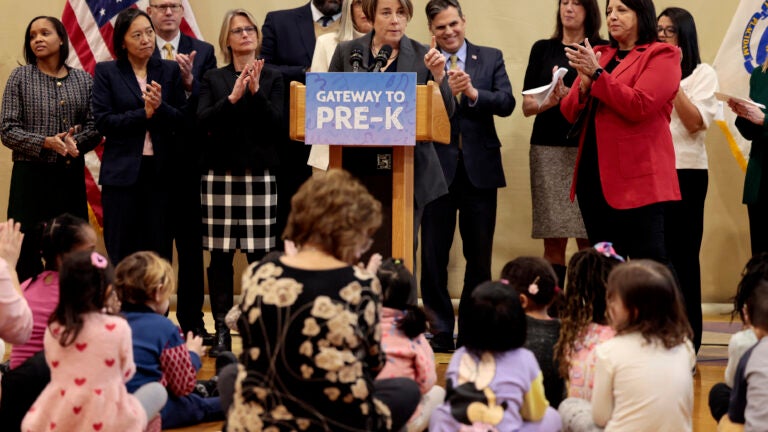
Gov. Maura Healey’s administration made an announcement they called “unprecedented” on an agenda that aims to improve the early child care industry and accessibility for residents across the commonwealth.
Healey and Lt. Gov. Kim Driscoll announced a plan called “Gateway to pre-K” to a crowd of state officials, educators, and children at a YMCA in Malden Tuesday that they say will make child care and preschool more affordable to more residents, build new care centers through business partnerships, and continue funding grants that go toward care centers.
“Look, the goal is to get to universal pre-K for every 4 year old in the state,” Healey said. “What we’re going to work to do is by the end of 2026, every 4 year old in every Gateway City will have access to universal pre-K. That’s not too far away, but that’s how committed we are to this.”
There are 26 Gateway Cities in the state, including Malden, which are lower-income cities with populations between 35,000 and 250,000. Twelve of those cities offer preschool for free or a reduced cost, The Boston Globe reports. The Healey administration wants to expand it to all 26.
Noting that the burden of finding adequate and affordable child care is especially high for low-to-moderate-income families, Healey also announced an initiative to expand financial assistance eligibility to 4,000 more families. The program would include those who make 85% of the state median income — less than $84,094 annually for a family of two and $103,880 for a family of three — which is an increase from the current 50% state median income cap.
Healey also signed an executive order to bring together the business community and various state agencies to expand access to child care and help build new facilities, pointing out that inadequate child care prevents economic development and creates workforce issues.
“We know that child care is such a linchpin to the health and wellbeing not only to families and the success of these little guys — which is so imperative, and that is first — but it’s absolutely essential to everything we do as a state, who we are, and where we’re going to go,” Healey said.
A press release said the administration would look into “employer tax credits or other incentives for offering or assisting with employee child care.”
Lastly, the Commonwealth Cares for Children funding, or C3 grants, will continue to receive money in the next fiscal year. Those grants have helped child care centers recruit and retain staff through increased salaries and bonuses and afford improvements at the facilities.
“Together I know we can expand access and lower costs,” Healey said. “This is a big challenge for our state — a challenge for states around the country. But here in Massachusetts, where we have always prized education, where we have always valued our littlest learners… we’re going to get this done.”

Stay up to date on all the latest news from Boston.com





To comment, please create a screen name in your profile
To comment, please verify your email address
Conversation
This discussion has ended. Please join elsewhere on Boston.com