
Newsletter Signup
Stay up to date on all the latest news from Boston.com
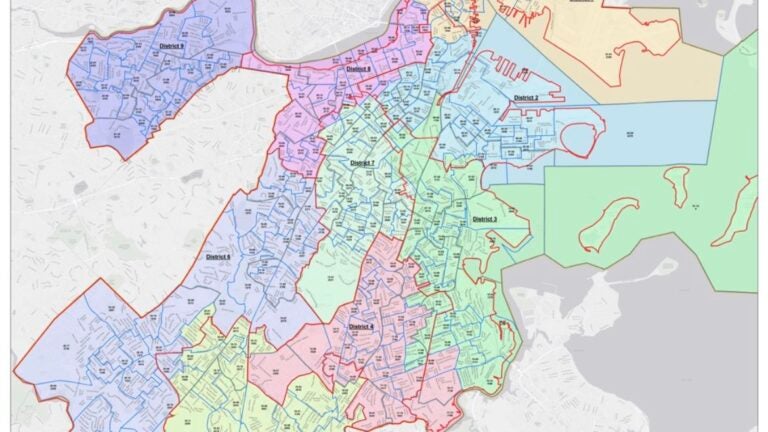
Now that a federal judge has barred use of the new Boston City Council district map that the council approved last fall, the council has an extremely tight deadline by which to come up with and agree upon a new district map.
In a letter to the Boston City Council Wednesday, Mayor Michelle Wu set May 30 as the date by which a new map must be approved to allow the Boston Election Commission to prepare for the Sept. 12 preliminary election.
This is a big ask, given how contentious and drawn out the original redistricting process was. Four of the 13 city councilors voted against the map, and two of them contributed thousands of dollars to the legal challenge that resulted in the preliminary injunction issued Monday that has brought them back to the drawing board.
But Mayor Wu is offering more help to the council this time around. In the letter, Wu said her office would submit a new district map for them to consider.
Wu wrote that her office’s map would provide “a robust opportunity for all voters to see themselves represented and reflected on the city council, and [prioritize] placing whole neighborhoods together within individual districts.”
This seems to be an appeal to both the conservative and progressive sects of the city council, with her emphasis on representation directed at progressive councilors, and her emphasis on keeping communities together directed at conservative councilors.
Conservative and moderate members of the council objected to the original map’s divvying up of District 3, which would have placed right-leaning and white-majority neighborhoods from Dorchester in District 4, which centers around Mattapan. They also objected to the moving of a similar neighborhood in South Boston from District 2 to District 3.
In both cases, councilors argued that the new districts separated closely-knit communities, and that other councilors were trying to cede political power away from voters in these neighborhoods.
On the other side, progressive councilors felt the new divides were the only way to avoid “packing” Black voters into one district, thus undercutting their political power. These councilors have also openly sought to create districts that empower historically disenfranchised populations in the city, such as people of color and immigrants.
Given that the old map was scrapped because Judge Patti Saris felt race played too big a role in the map’s formation, and that the deadline to approve a new map is incredibly tight, it is imperative that Boston officials find a way to balance the concerns of both the conservative and progressive councilors.
In her Wednesday letter, Mayor Wu said she is also moving to push back the deadline for candidates to file papers to run for city council seats via a home rule petition. The petition would need to be approved by the city council and the state legislature.
Wu is proposing moving the deadline from May 23 to June 20, which would ensure candidates know which district they can run in based on their residence before filing.
Moving back the deadline for submitting candidate papers is especially important for District 3. Not only has its current councilor, Frank Baker, announced that he will not run for reelection, but it is also one of the districts which will likely undergo the most change under the new map. Candidates for this district cannot know for certain whether they even reside in the district before the new map is approved.
Despite the urgency with which the city needs a new city council district map, on Wednesday during the city council meeting, the council could not even unite around which committee should be tasked with making the new map.
Council President Ed Flynn assigned the issue to the Council as a Whole Committee, which is simply a committee that includes all members of the council.
Flynn’s reasoning was that this would allow all members of the council to have a say in the process, and that this is the proper committee for the task, as it is responsible for dealing with lawsuits against the council.
But Flynn quickly encountered opposition to this idea. District 1 Councilor Gabriela Coletta appealed his decision, asking to have the issue sent to the Committee on Civil Rights and Immigrant Advancement.
Coletta argued first and foremost that redistricting and the right to vote is a civil rights issue.
“The act of voting is a civil right. The protection and enforcement of such, dictated by the Voting Rights Act, needs to always fall under this lens, and so what I am proposing is not a new concept,” she said.
Coletta also argued in favor of sending the issue to the Civil Rights Committee by pointing out that its vice chair is Councilor Erin Murphy. Murphy voted against the original new district map, but, importantly, did not help fund the legal challenge to the map.
“We are charged by a federal court ruling…to go back to the drawing board. We need to ensure that any and all political motivations are left at the door, and that we conduct a fair and open and impartial process moving forward,” Coletta said.
Notably though, Murphy said later on that she thought the redistricting issue should go to the Council as a Whole Committee.
Coletta also said the Civil Rights Committee has the benefit of being chaired by Councilor Ruthzee Louijeune, who is a lawyer with experience in redistricting law.
Finally, Coletta argued, the fact that both Louijeune and Murphy are at-large councilors encourages them to have all Boston residents in mind when creating a new map, as opposed to having loyalty to one district.
Though many councilors supported Coletta’s appeal, the argument over committee placement for the issue of redistricting seemed to center around whether or not to send it to the Council as a Whole Committee.
At-Large Councilor Julia Mejia said many members of the council did not want the issue to go to that committee because it is chaired by Flynn, who was one of two councilors to help fund the legal challenge to the now-defunct map.
“There’s a level of mistrust here,” she said.
District 3 Councilor Frank Baker, the other member of the council to fund the map’s legal challenge, countered by agreeing that there is mistrust within the council, but that it is because the original map ignored the voices of some members of the council.
“Not one person asked me my opinion on District 3!'” Baker said during an impassioned critique of the past redistricting process. “Not one person came to District 3…to see what you were cutting up…I had no say…Committee of the Whole, we all have a say. That’s where it should go.”
But District 5 Councilor Ricardo Arroyo, who originally chaired the Redistricting Committee, took issue with Baker’s assertion that he and others had no say in the process.
“I think there’s an issue here, where people keep saying ‘I didn’t have a voice, I didn’t have a voice’ — but they were the loudest people in these processes. They were in every single hearing,” Arroyo said. “They did have a voice, simply, the body as a majority did not go in that direction.”
Ultimately, the council voted in favor of Coletta’s appeal, sending the issue of redistricting to the Civil Rights Committee.
All councilors voted in favor of the appeal except for Baker, Murphy, Flynn, and At-Large Councilor Michael Flaherty, mirroring the split over the approved-but-now-defunct new district map from last fall.
In addition to Louijeune and Murphy, the Civil Rights Committee includes Coletta, Arroyo, and Mejia. These five councilmembers will now be in charge of creating a new district map.
All of these councilmembers were on the Redistricting Committee which created the original map, minus Coletta. That committee also included Flaherty, District 9 Councilor Liz Breadon, and District 4 Councilor Brian Worrell.
Breadon and Worrell, who ultimately chaired the Redistricting Committee, voted in favor of sending the task of redistricting to the Civil Rights Committee this time around.
Stay up to date on all the latest news from Boston.com



To comment, please create a screen name in your profile
To comment, please verify your email address
Conversation
This discussion has ended. Please join elsewhere on Boston.com