
Newsletter Signup
Stay up to date on all the latest news from Boston.com
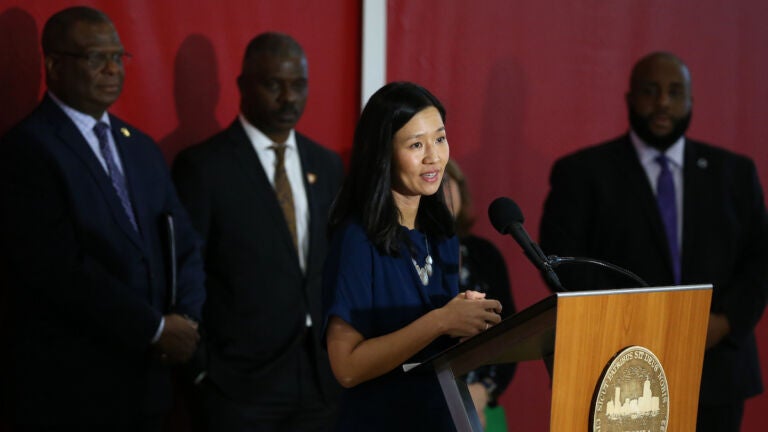
Mayor Michelle Wu on Wednesday unveiled proposals for a $4.28 billion operating budget for fiscal year 2024 and a $4.2 billion five-year capital plan she contends will position Boston for growth in key areas, especially by making Boston more family-friendly, while providing investments for essential city services.
Speaking at City Hall, Wu described the budget as “an intentional investment” that’s also about “getting back to basics as well.”
She suggested the foundation to her fiscal vision is about equipping city departments with what they need to be efficient, especially after several years of shake-ups brought on by the city’s COVID-19 emergency operations.
Some of the city’s 19,000 public employees, she noted, took on multiple roles to manage constituent needs during the pandemic, while other departmental needs went unaddressed.
“We want to make sure that rather than just always announcing new things … the focus also has to be on doing what we already do well, and making sure that the work is sustainable for the workforce,” Wu said.
The administration has also made progress toward settling collective bargaining agreements with several of the city’s employee unions, after all of the previous contracts had expired by the time Wu took office in late 2021.
According to the mayor, 85% of the city’s unionized workforce now have updated and signed contracts. The latest budget proposal covers funding those agreements, Wu said.
The operating budget is a 6.8% or $274 million increase over the fiscal year 2023 budget, with the majority of the raise, or 31%, representing investments to Boston Public Schools and charter school tuition assessments. Another 28% is intended to “maintain core city services and invest in a wide range of supports for community needs,” according to the Wu administration.
In a letter to city councilors earlier this week, Wu said the city can swing the raises because of its record of “strong and stable financial management.” Boston again landed a strong AAA bond rating from both rating agencies, Moody’s and S&P Global, and is also seeing revenues rebound as the COVID crisis has dwindled down, she wrote.
Her administration mapped out a few key areas of investments: making Boston family-friendly; making sure residents are healthy and safe; ensuring the city is green, growing, and prepared for the future; providing constituent services; and closing the racial wealth gap.
“This is a budget that is about people, the people of our city, our residents and constituents and also the people who work for the city of Boston,” Wu said Wednesday.
Wu’s budget is now in the hands of the City Council, which has several months to review it and consider amendments before sending it back to the mayor for final approval.
Here are a few highlights from the operating budget and capital plan:
The mayor’s proposal touts a key theme of her administration: Striving to make Boston a premier city to raise a family.
“Boston should be the best place in the country to raise a family, with high quality, supportive programs and facilities accessible to all our residents,” Wu wrote in the letter to councilors.
Wu touted a slate of education investments, including boosting the universal Pre-K budget by $4 million, creating over 350 new seats for students.
Wu is also looking to advance her Green New Deal for Boston Public Schools with $374 million in upgrades to school buildings. Other infrastructure enhancements include $43 million in construction capital for new libraries in Codman Square, Fields Corner, and Egleston Square, and $178 million in new capital funding for construction and renovations for public pools.
Additionally, Wu is planning to put $500,000 toward youth swim lessons and another $750,000 to expand public library hours on weekdays and Saturdays.
To help meet Boston’s goals of de-carbonization, Wu’s proposals would put $50 million toward upgrading energy systems to be fossil-fuel free in properties managed by the Boston Housing Authority.
“This is a huge downpayment on this work,” BHA Administrator Kate Bennett said Wednesday. “We’re very appreciative and excited about it because not only will it reach a climate change goal, but it will bring greener, healthier, and more comfortable homes to our residents.”
The city would also dedicate $750,000 for trees and green infrastructure to help replace paved areas with plants and $1.4 million to introduce electric bikes to the city-run Bluebikes fleet. Wu is also looking to fund $5 Bluebike passes for 10,000 residents — a $550,000 expense.
Additionally, the proposals reserve $84 million in new capital funding for the creation, reconstruction, and ongoing maintenance of public parks.
According to officials, the budget proposal allocates $5 million to expand the city’s voucher, rental relief, and accessory dwelling unit programs.
“Accessory dwelling units are a great way to increase our housing supply and help families stay together by building another unit for a family member,” Sheila Dillon, the city’s chief of housing, said Wednesday. “So we’re getting a resource, an investment in this program to start a loan program and provide technical assistance to people that want to build ADUs in their backyards or garages or attached to their homes.”
Wu is also looking to put $451,000 toward the newly formed City Planning and Design department — funding needed to support the Planning Advisory Council, according to the budget. The council, created through an executive order in January, is charged with considering changes to the city’s planning code and moving planning operations from the Boston Planning and Development Agency to the new department.
“The Council will meet for the purpose of increasing coordination among departments that engage in citywide and neighborhood planning,” the budget filing says.
Stay up to date on all the latest news from Boston.com



To comment, please create a screen name in your profile
To comment, please verify your email address
Conversation
This discussion has ended. Please join elsewhere on Boston.com