
Newsletter Signup
Stay up to date on all the latest news from Boston.com
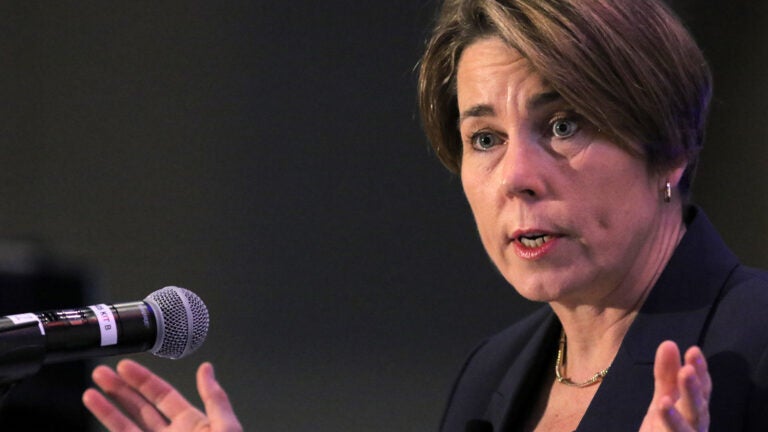
Massachusetts stands to benefit from a $1 billion windfall generated by the so-called “millionaires tax” for the first time this coming fiscal year, and Gov. Maura Healey is proposing a near-even split of the revenue between investments in education and transportation.
In her first budget proposal as governor unveiled Wednesday, Healey is earmarking $510 million for education and child care initiatives and another $490 million to be spent on public transit and transportation infrastructure. The cash comes exclusively from funds generated by the Fair Share Amendment approved by voters last November.
Healey envisions the lion’s share of education funding will go toward higher education — some $360 million — with $140 million reserved for capital projects, $93 million for financial aid expansion, and $18 million for UMass and state university equity and inclusion programs.
An additional $20 million is planned for MassReconnect, Healey’s program to make community college free for state residents over the age of 25.
Another $140 million in early education and care initiatives would open up more child care opportunities and better position the state to bring in universal pre-K programs, she said.
A majority of transportation funding, meanwhile, would be funneled to the MBTA, with $186 million proposed to advance capital projects and an additional $5 million to launch a means-tested fare system for thousands of low-income riders.
MassDOT would get $164 million, with $100 million of that sum reserved for bridge repairs.
Voters passed the Fair Share Amendment through Question 1 at the ballot box in November. The vote changed the state’s constitution to establish an additional 4% surtax on income over $1 million to fund, specifically, public education and transportation agendas.
Healey, as a candidate last fall, maintained she would guard the funding to ensure officials spent it strictly on those two areas.
Her budget proposal follows through on that pledge, as Healey’s administration plans to create the succinctly-named “Education and Transportation Fund” to house all revenue generated by the surtax.
“This will ensure that the Fair Share Amendment will be used exclusively for education and transportation,” Healey said Wednesday. “It will be protected. It will be transparent.”
According to the administration, the fund will establish a minimum balance and will set limits on recurring, annual spending. Revenue collected over the annual limit will go toward one-time investments.
These mechanisms are intended to protect the account from economic downturns and major year-over-year fluctuations.
After all, officials are also trying to determine what they can expect from the tax revenue long term.
“This new revenue source is an exciting opportunity to make critical, lasting investments in education and transportation,” the administration wrote in a budget briefing document. “However, in the near term, estimates of collections from the new surtax will be uncertain as more data is collected on exactly how much revenue will be generated annually.”
Notably, the Fair Share Amendment fundamentally relies on “collections from highly volatile revenue sources, including capital gains,” which can fluctuate much more than taxable income, officials wrote in the briefing.
“Much of the Fair Share revenue will come from capital gains because of the income mix of those subject to the surtax,” the briefing reads. “Even in strong economic periods, capital gains are volatile as they reflect stock market and other investment activity, as well as individual taxpayer decisions on when to recognize gains and losses for tax purposes.”
Early education and care:
K-12 education:
Higher education:
Municipal assistance for transportation:
MassDOT Highway:
MBTA:
MassDOT rail and transit:
On Wednesday, the Raise Up Massachusetts coalition, the group behind the amendment, thanked Healey for protecting the tax revenue for its intended purposes.
But the group also argued Healey’s $742 million plans for tax relief, especially those that will benefit the state’s wealthiest residents by slashing the capital gains tax and increasing the estate tax threshold, “would ultimately undermine the Fair Share Amendment’s goals of a fairer tax system and greater investment in critical public goods.”
“Tackling the real challenges to the Commonwealth’s economic competitiveness — from working families’ struggles to afford housing and child care, to our economy’s need for an educated workforce and safe and reliable transportation infrastructure — will require making significant investments over the coming years, not giving enormous tax breaks for wealthy stock traders and multi-million-dollar estates,” the coalition said in a statement.
“While the Governor’s budget proposes several meaningful new initiatives, it doesn’t come close to making the investments necessary to address our workforce challenges, tackle our broken childcare system, end the housing affordability crisis, or fix the MBTA and build a 21st century statewide transportation system,” the statement continues. “Instead, a massive permanent tax cut for the wealthy would most likely lead to catastrophic budget cuts the next time we hit a recession.”
Under her tax relief plan, the governor is proposing to eliminate the estate tax for all estates valued up to $3 million and to cut the short-term capital gains tax by more than half, from 12% to 5%.
Appearing on GBH’s “Boston Public Radio” Thursday, Healey defended both tax cuts, reiterating that Massachusetts is an outlier in its approach to both taxes and that by changing each, the commonwealth will be more competitive on the national stage.
A 5% capital gains tax is more closely in line with other states, Healey contends.
“I’m really focused on affordability. I’m also just focused on competitiveness,” Healey said Thursday. ” … People [are] making really real-time decisions right now about whether they’re going to move to New Hampshire, move down to North Carolina, to Florida, to Texas. We had 100,000 people leave our state in the last year-and-a-half.”
On the estate tax, Massachusetts is one of only 12 states with such a tax and shares the lowest threshold for taxation among the dozen, except for Oregon.
Healey indicated Thursday her thinking on where the estate tax threshold should fall has evolved over time, at least in part, because of the state’s high cost of housing.
As property values have greatly appreciated over the past several decades, families with middle-class incomes but valuable property can be subject to the estate tax, which currently kicks in at $1 million, Healey explained.
“I understand this is subject to debate, but honestly, I am focused on affordability and I am focused on competitiveness and making sure that residents and families are able to grow and thrive here in the state,” she said.
Stay up to date on all the latest news from Boston.com





To comment, please create a screen name in your profile
To comment, please verify your email address
Conversation
This discussion has ended. Please join elsewhere on Boston.com