
Newsletter Signup
Stay up to date on all the latest news from Boston.com
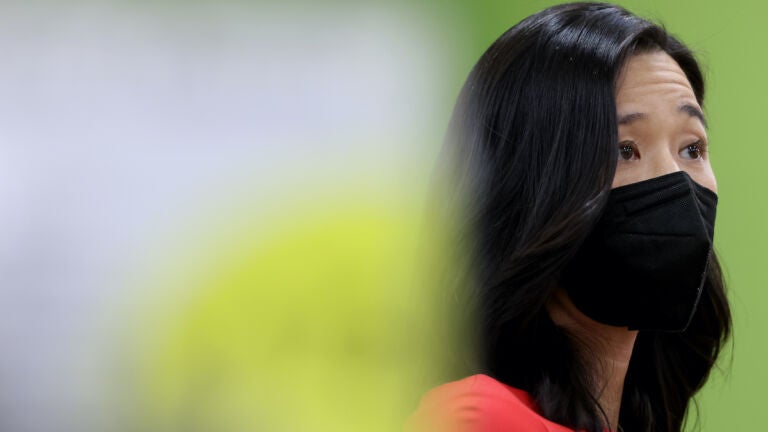
Mayor Michelle Wu said Wednesday she anticipates the city will file an appeal challenging a decision by a Massachusetts Appeals Court judge that blocks enforcement of her administration’s employee COVID vaccine mandate until the disagreements with the city and worker unions are resolved.
Speaking on GBH’s “Boston Public Radio,” Wu said Judge Sabita Singh’s decision to grant an injunction “goes against so much” of court precedent surrounding the government’s right to impose vaccination requirements.
In fact, the “very first precedent was set in Massachusetts,” she said, an apparent nod to a 1905 U.S. Supreme Court ruling on a case that originated in the Bay State affirming government-imposed public health measures, such as vaccination, are constitutional.
“Governments — city government, state and local governments — have the authority to be able to require vaccination in the midst of a public health emergency and so, you know, we are disappointed with where we are now in this,” Wu said.
However, the mayor said “there are multiple avenues here for the city.”
“I anticipate we will be filing our appeal,” Wu said.
Several city employee unions celebrated Singh’s decision on Tuesday as a victory.
The groups have pushed back on the rule since Wu first announced the policy –which requires employees to get vaccinated or else face termination from their jobs — in December. Unions have claimed the mandate violates their rights to collective bargaining and flies in the face of earlier agreements they reached with the city.
Three unions representing the city’s first responders filed the lawsuit in Suffolk Superior Court last month, but a judge ruled against them, saying that public health concerns outweighed their claims of harm.
However, the trio of unions filed an appeal, and Singh initially ordered a temporary stay on the mandate’s rollout, which was slated for Jan. 31 following an earlier re-scheduling.
Singh’s latest decision means an agreement between the unions and then-acting Mayor Kim Janey requiring workers be vaccinated or tested for COVID-19 once a week remains in effect.
“Given the limited harm to the city and the public health interest it seeks to promote, and the substantial harm likely to be sustained by the unions in the absence of an injunction, the balance of harms favors the issuance of an injunction to preserve the status quo, in view of the unions’ likelihood of success on the merits,” Singh wrote in her decision.
Singh also highlighted her decision weighed the potential harm of the city losing public safety employees. The “crux” of her decision was based on the city’s responsibility to negotiate these sorts of issues with the unions representing its workforce and its failure to do so to date, she wrote.
Later on GBH’s “Ask the Mayor” segment on Wednesday, Wu received a question from a caller identified as Jesse in East Boston, who asked what her administration’s push against the unions’ arguments could signal to the rest of the country and what it could mean for the future of local unions.
Jesse noted that although Boston has “a union stronghold,” many labor organizations in the United States “don’t have the have the same footing that they used to,” citing declining membership nationally.
Wu said she believes it’s critical that Boston continues to be a “union city” and that unions grow everywhere.
But she wanted to make one point clear.
“So much of what has happened over this vaccination mandate has not been about collective bargaining,” Wu said. “It’s been about a small group wanting to preserve the right for some people to be unvaccinated and to have an absolute to work, often in crowded spaces with others or, in the case of some of our public safety folks, living and sleeping in close quarters next to others who may be in multigenerational families and live with those who are immunocompromised. This is about a public health emergency.”
Indeed the vast majority of Boston’s public workforce is vaccinated. According to officials, approximately 95 percent of employees have gotten the shots, with many departments — including the fire and police departments — seeing vaccination rates of over 90 percent.
Wu said the city is “tangled up in what has devolved into a really unfortunate conversation.”
The mayor went on to note her administration has agreed on terms with some workers.
Last week, Wu announced a deal with the Boston Teachers Union to keep unvaccinated teachers employed, although the agreement stipulates those educators are not allowed to work in school buildings during times of virus surge.
Earlier this month, Wu administration officials met with local police and fire unions for nine hours one day to try to reach consensus, but were unable to hammer out a deal.
“We are continuing to bargain and to do our best to meet those obligations,” Wu said on Wednesday. “I look forward to finding ways to strengthen collective bargaining and unions in Boston.
“But this has not been an example of something that is actually tied to collective bargaining,” Wu continued. “This has been about getting people vaccinated and keeping people safe.”
Stay up to date on all the latest news from Boston.com



To comment, please create a screen name in your profile
To comment, please verify your email address
Conversation
This discussion has ended. Please join elsewhere on Boston.com