
Newsletter Signup
Stay up to date on all the latest news from Boston.com
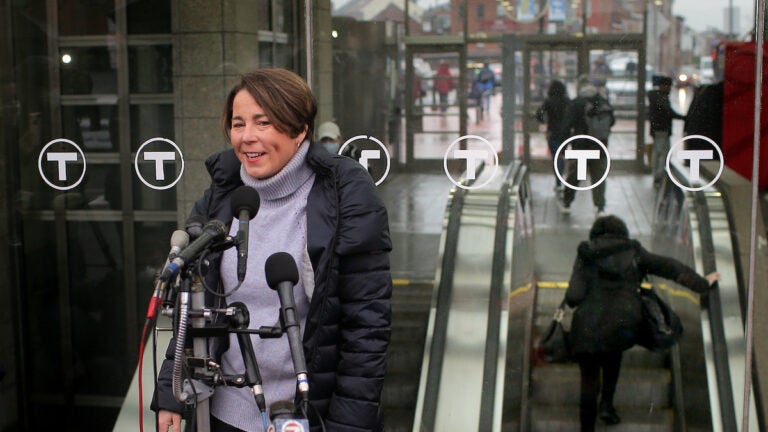
A new poll shows Attorney General Maura Healey has kicked off her campaign for governor with a significant leg up.
A MassINC Polling Group survey of likely voters in Massachusetts’s Democratic primary election this fall, sponsored by Policy for Progress, found Healey leads the field of candidates with 48 percent support among those surveyed.
State Sen. Sonia Chang-Díaz followed with 12 percent support, and Harvard professor Danielle Allen trailed with 3 percent.
The poll, released Monday, surveyed 504 registered voters across the state between Jan. 18 and 20. The survey has a 4.4 percent margin of error.
Healey, long rumored to launch a run for the corner office, made the move official on Jan. 20 and joined the race for the Democratic nomination that Chang-Díaz and Allen had entered long before.
The September primary, however, remains a long way off.
And even with Healey’s considerable lead in the Democratic field, 30 percent of voters indicated they are undecided at this point in the race. (Four percent of respondents said they would vote for “some other candidate,” and another four percent said they would not vote.)
“Particularly in party primaries, voters often take a much longer time to make up their mind,” MassINC Polling President Steve Koczela said during a Zoom call announcing the poll results on Monday. “One of the big reasons for that is there are more candidates who are within their kind of ideological space. So it’s not like a partisan matchup with with a Democrat and a Republican where you kind of know, or most voters know, where they are already, even before the candidates are announced.”
The recent poll suggests Healey may be buoyed by name recognition among voters.
Serving as the state’s attorney general since 2015, Healey was the best-known candidate among the voters polled, with only 20 percent of respondents having not heard of her.
Her opponents, meanwhile, face larger hurdles in making themselves known to voters: Fifty-one percent of those surveyed had not heard of Chang-Díaz, and 76 percent had not heard of Allen.
Koczela cautioned against interpreting Healey’s early lead as akin to name recognition, though.
“There’s no guarantee that candidates will become better known, and there are many recent examples where candidates have not become better known as the election approaches,” he said.
What could or could have balanced out the matchup against Healey so far is if Secretary of Labor Marty Walsh, the former mayor of Boston, had entered the race.
Walsh, after Healey’s campaign announcement, made clear he will not seek to be the governor of Massachusetts.
But the poll indicates if he were to run, he would enter the race a hair ahead of Healey. In that scenario, 32 percent of poll respondents said they would support Walsh, while Healey garnered support from 31 percent.
Among the current field though, Healey is the candidate the most voters regardless of party affiliation — 44 percent of those polled overall — viewed as “favorable.” (Nineteen percent responded with “unfavorable,” while 17 percent said they had heard of Healey but were undecided about how they viewed her.)
Both Healey and Chang-Díaz — considered “favorable” by 20 percent of those polled — were also more popular among respondents than the two declared Republican candidates for governor, former state Rep. Geoff Diehl and businessman Chris Doughty.
Poll results show 14 percent of respondents viewed Diehl as “favorable,” while 3 percent saw Doughty that way.
Both GOP candidates were also the only two gubernatorial hopefuls to have higher percentages of “unfavorable” views from voters surveyed than the percentages of voters who saw them positively, results show.
Sixteen percent of respondents harbored “unfavorable” views of Diehl, and 4 percent felt that way about Doughty.
Gov. Charlie Baker, even after enduring criticism throughout the COVID-19 pandemic from both the left and the right, still remains a rather popular governor, poll results show.
Sixty percent of all voters surveyed held a “favorable” view of the Republican governor, now heading into his final year in office. Twenty-three percent said they view Baker as “unfavorable.”
Poll findings also indicate the candidates seeking to succeed Baker could do well playing by his book: 45 percent of all voters surveyed said they want a candidate who is “about the same” as Baker.
Even more-so, 51 percent of Democratic primary voters want that kind of candidate — more than the factions of the party’s voters who want to see a more liberal version of the moderate Republican.
“His base has long been more in the Democratic Party than it has been in the Republican Party,” Koczela said. “And this poll finds that continues to stay.”
The poll also found 50 percent of Democratic primary voters surveyed said they would be “more likely to support” a candidate who receives Baker’s endorsement.
Twenty percent said the governor’s endorsement had no bearing on their vote, while an additional 17 percent said Baker’s support would make them “less likely to support” his chosen candidate.
“Voters aren’t always able to kind of parse what moves them to action, and whether it would actually increase their likelihood or decrease their likelihood (to support a candidate),” Koczela said. “But it is indicative I think of the warmth that Democratic primary voters feel towards Charlie Baker and the respect and admiration that they express across many different ways of asking about him.”
Although she has not announced a campaign, former Boston City Councilor and candidate for mayor Andrea Campbell appears to be a popular choice for attorney general among voters.
Thirty-one percent of those polled said they would back Campbell, who is reportedly seriously considering a run.
Meanwhile, former candidate for lieutenant governor Quentin Palfrey and labor attorney Shanon Liss-Riordan — the race’s lone declared candidate — garnered 2 percent and 3 percent of voter support, respectively, poll results show.
Fifty-four percent of respondents were undecided.
What’s been considered the state’s “hottest” race is already seeing some close, early competition.
Salem Mayor Kim Driscoll carried 10 percent of support from poll respondents, while three other candidates, state Sens. Eric Lesser and Adam Hinds and state Rep. Tami Gouveia, were virtually tied with 5 percent each.
Seventy-four percent of respondents were undecided.
Similarly, in the race for state auditor, state Sen. Diana DiZoglio carried 13 percent to 12 percent for Chris Dempsey, former director of the advocacy organization Transportation for Massachusetts. Seventy-five percent of respondents were undecided.
The secretary of state race was not polled because candidates had not announced campaigns yet when the survey was conducted.
Stay up to date on all the latest news from Boston.com



To comment, please create a screen name in your profile
To comment, please verify your email address
Conversation
This discussion has ended. Please join elsewhere on Boston.com