
Acting Mayor Kim Janey makes it official: She’s running for a full term
“I’ve been at the center of Boston history,” Janey said in her campaign video. “The bad and the good.”
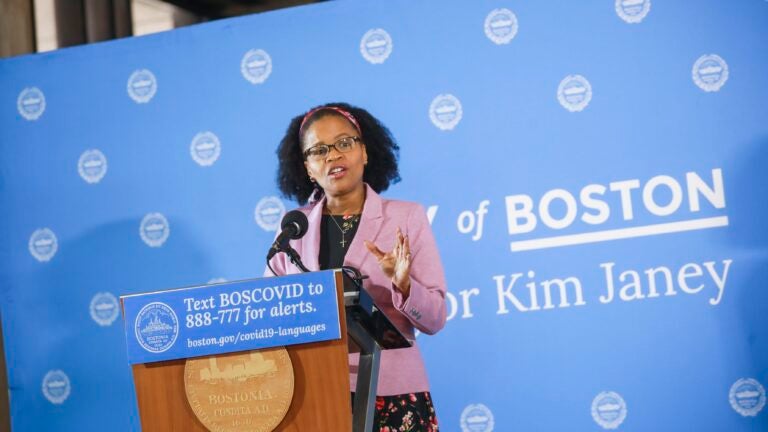
Ending months of intense speculation, Acting Mayor Kim Janey announced Tuesday she is running for a full term as the city’s chief executive, joining an already-crowded field in this year’s race.
Janey, who became acting mayor when Martin J. Walsh left his City Hall post to head the US Labor Department last month, made the announcement via a campaign video. “We’ve got work to do,” she intoned in the video.
https://www.youtube.com/watch?v=9ruoh3B7lJo&t=1s
Janey, who is the city’s first Black and first female mayor, is now officially in a race that includes five other major candidates: City Councilors Andrea Campbell, Annissa Essaibi George, and Michelle Wu, John Barros, who is the city’s former economic development chief, and state Representative Jon Santiago.
Tuesday’s campaign video features trailblazing Black Bostonians including Melnea Cass, Mel King, Tito Jackson, Charles Yancey, Bruce Bolling, Ayanna Pressley, and Rachael Rollins. Janey narrates the 3-minute-plus spot, lamenting affordable housing that isn’t actually affordable and deep racial inequities, referencing a 2015 report that found the median net worth of Black households is $8, compared to $247,500 for white households in the area.
“This recovery is our chance to build a more equitable city for every resident,” Janey said in the video. “We can’t go back, we can only go better.”
Janey, a 55-year-old former education advocate, was in her second term on the City Council, and serving as the body’s president, when she became acting mayor last month.
Hailing from a large and well-known Roxbury family, Janey grew up the oldest of six. Her father was an educator, serving at one point as a schools superintendent for Washington, D.C., and her mother a homemaker. Her parents divorced when she was young. She grew up in Roxbury and the South End.
In the strife-ridden 1970s, she was bused from the South End, where her great-grandmother and mother lived, to Charlestown for sixth and part of seventh grades, as part of the court-ordered desegregation of Boston’s schools, an experience she referenced as part of her Tuesday campaign launch.
“I’ve been at the center of Boston history,” Janey said in the video. “The bad and the good.”
By the eighth grade, she was attending school in Reading as part of Metco, a voluntary school integration program that enrolls Boston students in public schools in the suburbs. At 16, before finishing high school, she gave birth to a daughter, Kimesha, whom she raised in Boston and Connecticut, where her grandparents lived.
Janey attended two years at Greater Hartford Community College before studying at Smith College for two years, where she cleaned bathrooms as part of her work study. She stopped her studies before getting a degree, stymied by family obligations — she cared for her grandfather after her grandmother died — and financial challenges. It was at Smith where she first started her educational advocacy.
Janey was first elected to the City Council in 2017. As a councilor, Janey is known for her work around equity. She spearheaded Boston’s first ordinance to bring racial and economic equity to the burgeoning marijuana industry. She has also pushed to probe the process by which the city hands out municipal contracts for services such as trash pickup and food distribution, an effort that spurred the city to explore new ways to diversify its contracts.
Political observers have said that Janey serving as acting mayor will benefit her during the campaign and boost her name recognition citywide.
The ongoing COVID-19 pandemic, the re-opening of the city’s schools, and the implementation of police reform are among the pressing issues Janey faces as the city’s acting executive.
Boston has never elected a mayor who is not a white man. This year’s diverse field — all the major candidates thus far have identified as either Black, Latino, Asian, or Arab American — could see that trend come to an end.
Tuesday’s announcement came after months of rumors that Janey would run. She had retained the services a well-known local political consulting firm and recently avoided issuing denials when asked if she was planning to run.
State campaign finance records from last month made available on Monday offered additional evidence she was ramping-up for a run at a full term as the city’s chief executive.
Janey was active in the fundraising space in March, raising $187,000 and spending nearly $70,000, according to a bank report made public by the state’s Office of Campaign and Political Finance on Monday.
Her expenditures include a $10,000 payment to Northwind Strategies, a consulting firm whose founding partner, Doug Rubin, who has worked as a campaign strategist for Elizabeth Warren, Deval Patrick, and Joseph P. Kennedy III, among others. She also paid another political consultant, Andrea Dolan, $2,500, and dropped almost $15,000 on digital advertising. Another $1,000-plus went to a consultant for fundraising compliance. She also paid a design firm $5,000.
Perhaps most telling, Janey spent nearly $25,000 on a media production company with a national reputation for making ads for Democrats.
The March activity is far and away the most Janey’s campaign has raised and spent since she first filed a campaign finance report in January 2017.
Already-declared mayoral candidates also had a busy month. Essaibi George’s campaign raised the most for the month among the five major candidates, bringing in $240,000. The campaign for the at-large councilor from Dorchester spent about $88,000. She ended with a balance of $426,000 in her campaign coffers.
Campbell’s campaign raised $203,000 for the month, with expenditures topping $69,000. She has the largest campaign war chest in the race with $974,000.
Barros raised $182,000 for his campaign in March, ending with a balance of $228,000 in his coffers. His campaign spent $14,000 in the month, according to state records.
The campaign for Santiago raised similar numbers for March, pulling in $180,000. His campaign spent $42,000 and ended with a balance of $525,000.
Wu’s campaign raised $175,000 for the month, spent $67,000, and ended with a balance that topped $941,000, according to state records.





To comment, please create a screen name in your profile
To comment, please verify your email address
Conversation
This discussion has ended. Please join elsewhere on Boston.com