
Ayanna Pressley says Baker’s ‘half measures’ don’t do enough to address COVID-19 surge
"This is not a situation where we can have margin of error, because margin of error costs us human life."
Related Links
-
NEW COVID ADVISORIES
Charlie Baker announces a slate of new orders, including nighttime stay-at-home advisory and mask mandate, due to COVID-19 increase
-
COVID
Here’s the list of businesses affected by Charlie Baker’s new early closure order
-
Restaurants
Gov. Baker just issued a new table service mandate. Here’s how restaurateurs are responding.
Gov. Charlie Baker made waves Monday with the announcement of a series of executive orders, including a nighttime stay-at-home advisory and an expanded face covering mandate, to address rising COVID-19 infections and hospitalizations in Massachusetts.
Rep. Ayanna Pressley says those actions aren’t enough.
“You do know COVID-19 spreads during the day too, right?” Pressley tweeted in response to Baker’s announcement Monday. “These half-measures are not enough to address the spikes we’re seeing across the Commonwealth.”
.@MassGovernor, you do know COVID-19 spreads during the day too, right?
These half-measures are not enough to address the spikes we’re seeing across the Commonwealth.
We must do better.
P.S. Extend the moratorium on evictions and foreclosures. https://t.co/I1LhS3BYld
— Congresswoman Ayanna Pressley (@RepPressley) November 2, 2020
According to a Pressley spokesperson, the Boston Democrat thinks the state should “consider” additional measures, “including more robust stay-at-home orders, stronger workplace protections, decarceration and community supervision programs to reduce COVID spread in prisons and jails, and an extension and expansion of the eviction and foreclosure moratorium to keep people safely in their homes.”
“Since Governor Baker has so far failed to fight for tenants and extend the moratoriums, the Congresswoman has been advocating to her colleagues in the State House to codify those protections and provide robust financial support for our most vulnerable residents who are faced with eviction,” Pressley’s spokesperson told Boston.com in a statement.
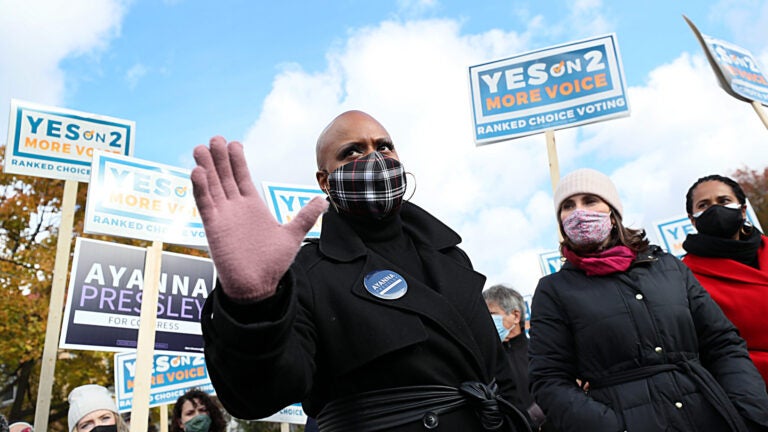
Following a rally in support of the state’s Question 2 ballot measure Tuesday morning, Pressley said she understands that Baker wanted to avoid “going back into a full-on lockdown.”
“But this is not a situation where we can have margin of error, because margin of error costs us human life,” she told Boston.com in an interview.
Pressley didn’t elaborate Tuesday on what a “more robust stay-at-home order” might look like; Baker did impose an all-day stay-at-home advisory for nearly two months at the beginning of the pandemic, instructing people to only leave home for essential trips and outdoor exercise. With COVID-19 deaths on the rise again, Pressley made clear that she felt the current actions weren’t enough.
“We have just hit a devastating milestone of 10,000 people, families changed forever with a permanent empty seat at their dinner table and in their lives,” she said. “We have got to stop the bleeding.”
Since Labor Day, Massachusetts has seen the number of new COVID-19 infections reported each day nearly triple, as well as a 143 increase in hospitalizations due to the disease. Baker said Monday that the trend could create capacity problems for the Massachusetts health care system by the end of the year if it continues unabated.
Baker’s latest executive actions, which take effect Friday, include a stay-at-home advisory between the hours of 10 p.m. and 5 a.m., an order requiring many businesses to close by 9:30 p.m., a tightened face covering requirement for when people are in public, and reduced limits on indoor and outdoor gatherings at private residences.
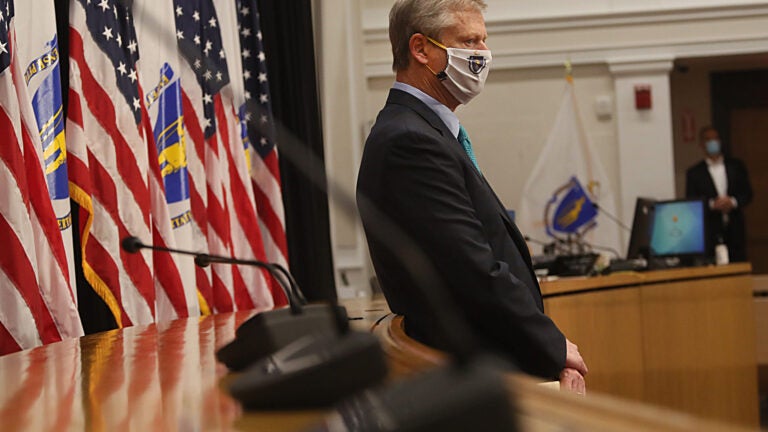
While he acknowledged Tuesday that the new orders may be “disruptive” to the restaurant industry, Baker said the “targeted” measures were the best way to address the concerning trends. The Republican governor has also argued that the ability of government action to stop the spread of COVID-19 is “nothing compared to the power of individual choice” and “personal responsibility,” putting the onus on residents’ adherence to face covering and gathering rules.
“We actually have some pretty well-known, well-established, well-tested tools to stop transmission,” Baker said during a press conference Tuesday. “And if we would just commit to being disciplined and vigilant and consistent about it, you could take all the gas out of the run rate that’s creating the concern we have right now in our health care community and in our hospital industry.”
Still, Pressley’s concerns were echoed Monday by the Massachusetts Public Health Association, a nonprofit focused on health equity, which called Baker’s new actions a “missed the opportunity to take the kinds of bold actions needed to protect all residents of Massachusetts.”
“Each of us must take responsibility to stop the spread, but COVID can’t be stopped by personal responsibility alone,” said Carlene Pavlos, the group’s executive director. “Workers, people who need to double up in apartments because they were evicted, people living in shelters, and people who are incarcerated are just some of the folks suffering the most through no fault of their own.”
Pressley reiterated Tuesday that Baker should have extended the state’s moratorium on most evictions and foreclosures, which the governor allowed to expire last month. While the administration announced an increase in rental assistance and other relief programs, housing advocates fear that the services won’t be ready to handle a wave of eviction cases in the coming weeks, which could exacerbate and prolong the pandemic at the worst possible time. Pressley was among a number of local Democrats who called on Baker to extend the moratorium — to no avail.
“That’s top of mind for me,” she said Tuesday. “We’re in the middle of a pandemic. We’re in the middle of a surge. We’ve just hit the very tragic milestone of 10,000 lives lost in the commonwealth because of coronavirus.”
It’s unclear if Baker has the statutory authority to reinstate the moratorium after allowing it to expire last month. The state law passed in April that originally implemented the moratorium only explicitly gave the governor the power to “postpone such expiration” in increments of up to 90 days during the declared COVID-19 state of emergency. That could put the issue in the hands of the state Legislature, where there are veto-proof Democratic majorities in both chambers.
“We all need to be legislating and making the investments accordingly to ensure the public health,” Pressley said Tuesday.
As coronavirus outbreaks continue to be reported at Massachusetts prisons, Pressley also said the state should be releasing more inmates who are vulnerable to the disease, such as those who are elderly, pregnant, or who have underlying conditions, as well as individuals being held in pre-trial detention.
“It’s an environment, to begin with, that was not the healthiest,” she said. “It’s overcrowded, and even with no visitations we’re seeing surges there.”
Pressley noted that the pandemic has “not been easy for anyone,” citing the “failures” of President Donald Trump’s administration, which she said had not “met the scale and scope of this hurt.” Pressley gave credit to Baker for the administration’s early investment in contact tracing and for being one of the first three states to collect racial data on COVID-19 cases in an effort to ensure an equitable response.
“I will give credit where credit is due,” she said. “But on this, we disagree.”



To comment, please create a screen name in your profile
To comment, please verify your email address
Conversation
This discussion has ended. Please join elsewhere on Boston.com