
Virus takes center stage at Pence and Harris vice presidential debate
It was a far more orderly affair than the encounter between Trump and Biden last week.
Related Links
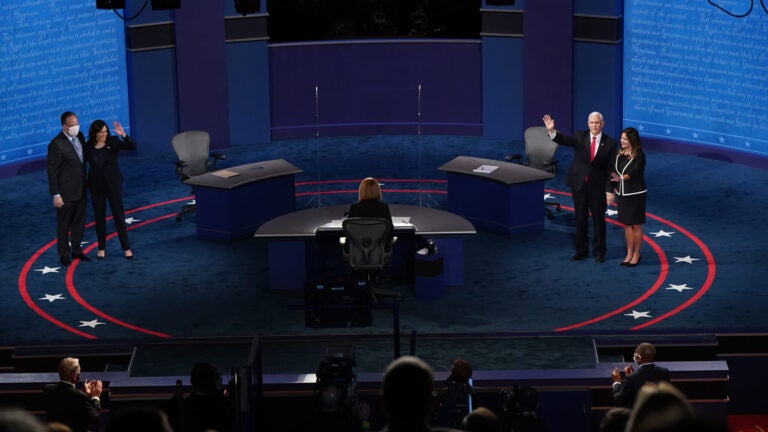
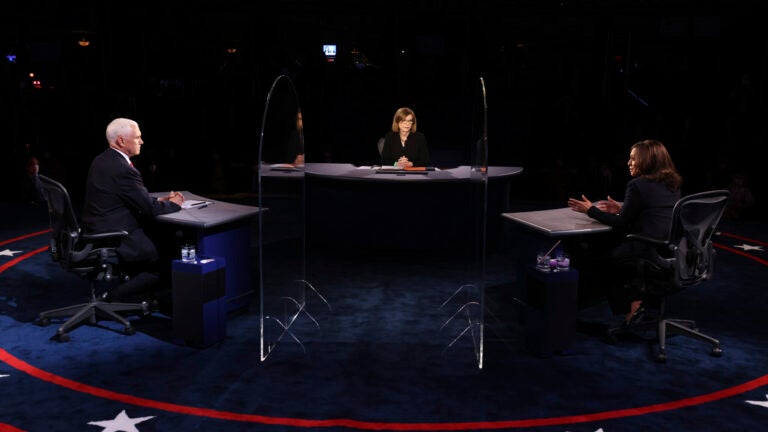
Vice President Mike Pence and Sen. Kamala Harris clashed over the Trump administration’s handling of the coronavirus pandemic on Wednesday night, with Pence defending the White House’s record without addressing its fundamental failures, while Harris accused him and President Donald Trump of presiding over a catastrophic failure in public-health policy.
Harris, the California Democrat who is Joe Biden’s running mate, delivered a comprehensive denunciation of the Trump administration’s policies, ranging from the economy and climate change to health care regulation and taxes.
As Harris attacked Trump, the vice president sought to recast Trump’s record on the pandemic and other issues in conventional and inoffensive terms, often in plain defiance of the facts.The vice president made misleading or plainly false claims about White House policies on a range of subjects weighing down Trump in the presidential race. Pence claimed that the president had a plan to protect people with preexisting medical conditions though he does not; hailed the “V-shaped recovery” of the economy in defiance of the latest government data; and repeatedly claimed that Trump would always “follow the science” on climate change, though he has spent his term denying the scientific consensus on global warming and dismantling environmental regulations.
After Trump’s belligerent performance against Biden last week, the Harris-Pence forum in Salt Lake City mostly stood out for how different it was from that debate. It was a gloves-on reminder of the conventional political debates of yesteryear, albeit one playing out in a moment of national crisis.
Harris used the debate to pursue two goals: to reassure voters that she and Biden are not as liberal as Republicans claim, including by disavowing policies she embraced during the Democratic primaries, and to carry a persistent set of attacks against the Trump administration. With a firm and careful performance aimed at keeping pressure on the Republican ticket rather than transforming the race, Harris appeared to avoid any misstep that would have given Pence and his boss the chance to shift voters’ attention away from the public-health issues that have dominated the campaign.
On no topic was Harris more assertive in confronting Pence than the coronavirus: She opened the debate by calling the White House’s response to the disease ”the greatest failure of any presidential administration in the history of our country” and saying Pence and Trump had “forfeited their right to reelection.”
She charged Pence and the president with dissembling about the cost of the disease as it was first hitting the country. “They knew, and they covered it up,” Harris said. “The president said it was a hoax. They minimized the seriousness of it.”
In a pattern that would endure throughout the debate, Pence sought to rebut Harris’ criticism by picking and choosing components of the administration’s response that he could cast in a relatively favorable light, including Trump’s imposition of a travel ban on China, while talking around the fundamental issue — that the disease has killed hundreds of thousands of Americans and shattered the country’s economy.
He credited Trump with leading “the greatest national mobilization since World War II” and attempted to minimize the differences between the two presidential tickets going forward where the coronavirus was concerned.
“When you look at the Biden plan,” he said, “it reads an awful lot like what President Trump and I and our task force have been doing every step of the way.”
Harris rebutted Pence’s swipes with the rhetorical equivalent of pointing to a morbid scoreboard: “Clearly, it hasn’t worked,” Harris said of the administration’s strategy, citing “over 200,000 dead bodies” as evidence.
Pence grasped for a series of counterattacks to rebut or at least divert attention from the pandemic. He invoked Biden’s 33-year-old plagiarism scandal, he cited the Obama administration’s response to the less-lethal swine flu and even suggested that Harris’ criticism of Trump’s handling of COVID-19 amounted to an attack on the American people.
For her part, Harris’ weeks of practice for the evening showed throughout the debate — both because she delivered a series of well-honed lines and because they were clearly practiced.
Pence was able to go on the offensive against Harris over whether Biden would be willing to add more justices to the Supreme Court, a popular idea on the left, because the former vice president himself has repeatedly refused to answer the question.
“The American people deserve a straight answer,” Pence said.
But Harris, uneasy about creating daylight with her running mate, declined to say, and eventually responded by changing the subject to note that Trump had not appointed a single Black federal judge. “She never answered the question,” Pence noted.
Toward the end of the debate, the moderator, Susan Page of USA Today, directed the discussion toward election legitimacy, asking Pence if Trump would concede the election should Biden be declared the winner.
Pence used the question to lash Democrats for opposing the president.
“You tried to impeach the president of the United States over a phone call,” he said, mimicking Trump’s frequent cry of outrage before echoing him again by asserting that universal mail-in ballots would lead to voter fraud.
Pence did not answer the question at hand but did express confidence that the country would have “a free and fair election.”
There was tension between the two candidates from the outset, but the forum proceeded as a far more orderly affair than the barroom brawllike encounter between Trump and Biden, during which the president relentlessly hectored his challenger in hostile terms. Pence, for instance, began by telling Harris that it was a “privilege to be onstage with you” — the kind of language Trump never used.
What commanded the attention of many viewers during Pence’s defense of law enforcement officers was not his praise for the police, but the fly that landed on the vice president’s well-coiffed hair.
The relatively restrained encounter represented a brief period of political conventionality during a time of extraordinary chaos in the nation’s capital, where the coronavirus is ripping through the White House staff, and the president is issuing conflicting decrees on social media about a possible economic relief package and calling on his attorney general to prosecute his political opponents. Indeed, much of the burden on Pence was to defend Trump by presenting that scenario as a case study in successful government.
After racing to the left in her own failed presidential bid, Harris spent much of the evening attempting to reassure moderate voters that Biden was no liberal. After noting that her home state is “burning,” she emphatically said that Biden “will not ban fracking” and repeatedly vowed that he would not raise taxes on middle-income earners.
Highlighting one of the greatest gulfs between the two parties, Pence declined to call climate change an existential threat to the country and dismissed accumulating evidence that natural disasters are growing more frequent and more devastating. He acknowledged that “the climate is changing” but did not address the proven role of human-made carbon emissions in driving global warming, nor did he propose any policies to address it.
The threat Pence wanted to address instead was that “climate alarmists” would “use hurricanes and wildfires to try and sell the bill of goods of a Green New Deal” — a left-wing climate platform Harris embraced at points during her own presidential campaign. Both she and Biden have distanced themselves from that specific agenda, though they are proposing a huge package of environmental regulations and investments in renewable energy.
Even as he defended Trump, Pence struck an implicit contrast with the president. The vice president looked at the camera and assured Americans that those who died of the coronavirus would “always be in our hearts and in our prayers” and invoked Dr. Anthony S. Fauci, the nation’s top infectious disease expert, to validate the administration’s response to the virus rather than to ridicule him.
In perhaps the most striking difference from last week, Pence looked at Harris, the daughter of Jamaican and Indian immigrants, and saluted her on the “historic nature of your nomination.”
Pence’s attempt to recreate Trump as a conventional Republican also extended to foreign policy, as he sought to portray the president as a tough-minded leader.
“What we’ve seen with Donald Trump is that he has betrayed our friends and embraced dictators around the world,” Harris said, citing the president’s warm relationship with Russian President Vladimir Putin.
Pence ignored the accusation and instead cited the president’s willingness to confront terrorists and a handful of regimes hostile to American interests.
“We’ve stood strong against those who would do us harm,” he said.
In a familiar ritual for the vice president, Pence repeatedly spent precious debate minutes arguing that Trump did not say things that he plainly did. He falsely accused the media of selectively or inaccurately quoting the president on subjects ranging from a 2017 white-supremacist march in Charlottesville, Virginia, to American war dead to the president’s remarks in a televised debate last week about a domestic extremist group.
As Harris called the economy “a complete disaster” Pence sought to shift attention from one of the most tragic years in the country’s history and cast the debate forward.
“The American comeback is on the ballot,” the vice president said, predicting that “2021 is going to be the biggest economic year in the history of the country.”
And Pence warned that Biden would raise taxes, even momentarily breaking the civility of the evening by interrupting Harris to urge her to “tell the truth” about the Democrats’ vow to repeal the Trump administration’s tax overhaul.
The debate figured to be among the most symbolically consequential vice-presidential duels in recent memory, because of the age of both presidential candidates and Trump’s illness. Either party’s nominee would be the oldest man ever to take office, and Biden would turn 80 midway through a four-year term.
Yet in a political season overwhelmed by a daily torrent of news about a pandemic, a recession and the eruptions of a volatile president, it was not clear that an evening of conventional repartee between running mates had the potential to change the race in a significant way. So far, both Pence and Harris have been relegated to the margins of a contest between two of the best-known presidential nominees in modern times.
Trump seemed determined to keep it that way on Wednesday. He released a video in the afternoon assuring voters he was enjoying a rapid recovery and offering an infomercial-style testimonial about one of the drugs he has been prescribed. The president also churned out a deluge of tweets into the night, including one that called for the remaining American troops in Afghanistan to be “home by Christmas!”
In some respects, the low profiles of the two running mates are not surprising. Vice-presidential candidates typically enjoy a burst of publicity when they are selected before assuming their roles as understudies to the two nominees. But rarely has this dynamic been so pronounced as in this election, which features an incumbent who demands the spotlight each day and whose closest competitor for attention is a global health emergency.
The debate could also have long-term implications for a pair of running mates with presidential aspirations of their own. Pence is widely expected to pursue the Republican presidential nomination in 2024, whether or not Trump is reelected; and if Biden is elected, Harris would most likely be seen as his heir apparent in 2024 or 2028, depending on whether he seeks a second term.
Get Boston.com's browser alerts:
Enable breaking news notifications straight to your internet browser.



To comment, please create a screen name in your profile
To comment, please verify your email address
Conversation
This discussion has ended. Please join elsewhere on Boston.com