
What to know about Elizabeth Warren’s clash with Steve Mnuchin over coronavirus loans
"What you're saying is that you won't do it."
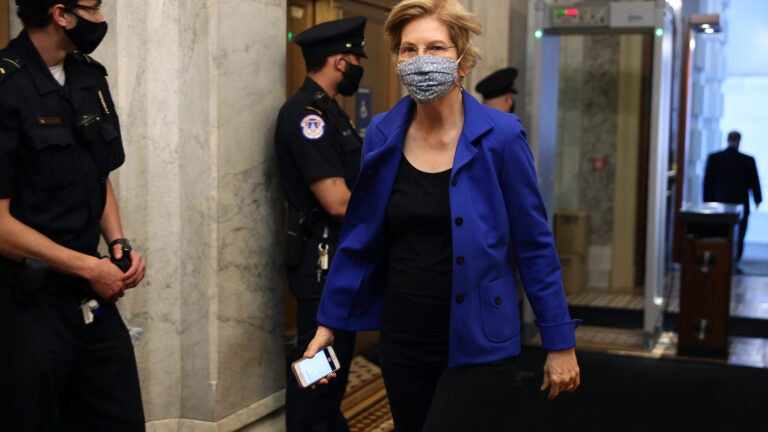
Sen. Elizabeth Warren pressed Treasury Secretary Steve Mnuchin Tuesday for new protections for employees of large companies that receive federal coronavirus relief.
She left the exchange wanting more.
Related Links
During a virtual Senate Banking Committee hearing Tuesday, the Massachusetts senator pressed Mnuchin over his authority to mold the Main Street Lending Program, which offers loans to large businesses affected by the coronavirus. Unlike the CARES Act’s forgivable loan program for small businesses that keep their employees on payroll, the nearly $500 billion Federal Reserve program — which Warren has criticized as a big business “slush fund” — does not require companies that receive money to keep employees on payroll.
As Mnuchin noted Tuesday, that’s in part because a divided Congress included no such requirement in the CARES Act (loans offered through Main Street program — generally available to businesses with between 500 and 15,000 employees — also must be repaid by recipients).
“These specifics were negotiated on a bipartisan basis — very clearly in each one of these programs — and it is our intent in the 13(3) facilities to fulfill both the spirit and the details of the law,” said Mnuchin, who negotiated the CARES Act on behalf of the White House. “So different facilities have different requirements.”
Warren, however, pointed out that the CARES Act also gave the Treasury Department and Federal Reserve the power to write “detailed rules determining which companies get taxpayer relief — and how they can spend that money.”
In other words, Mnuchin could simply add some sort of requirement that Main Street loan recipients do not furlough or lay off workers.
“You say the economy is going to recover,” Warren said. “It’s going to take jobs in order for that to happen, so what I want to know is, are you going to require companies that receive money from this half-a-trillion-dollar slush fund to have to keep people on payroll? It’s a simple question. Yes or no, are you going to require that?”
Mnuchin declined to give Warren a one-word answer.
Stressing that the administration’s “number one objective is keeping people employed,” he only reiterated what was already included in the law, such as prohibitions on stock buybacks, dividends, and raises for high-paid employees until a full year after the loans were repaid. The law also says recipients “should make commercially reasonable efforts to retain employees” during the term of the loan.
“We negotiated very significant restrictions on employee compensation, on dividends, on buybacks, and in the Main Street facility we have put in a provision that we expect people to use their best efforts to support jobs,” Mnuchin said Tuesday.
Warren remained dubious that simply encouraging “commercially reasonable efforts” would have much teeth.
“If they take a bunch of federal taxpayer money and they say, ‘Well, didn’t work out commercially for us,’ then they can fire people,” she said. “So I take it your answer to my question — whether or not you’re going to require as part of the terms of the loan that people be kept on payroll — is no?”
Mnuchin again fell back on the refrain that the subject was negotiated by “people on both sides of the aisle,” before Warren cut him off.
“You’re not going to require that they keep a single person on payroll,” she said.
Mnuchin hasn’t been completely unwilling to tighten payroll requirements — at least for smaller companies.
When it came to the Paycheck Protection Program for businesses with less than 500 employees, the Treasury Department did issue a rule requiring recipients to spend at least 75 percent of the funds on worker salaries in order to be eligible for loan forgiveness.
However, that rule has since drawn objections from businesses with high overhead costs, like hotels and restaurants, that are afraid of getting stuck with even more debt. Mnuchin and House Speaker Nancy Pelosi have both since expressed openness to changing the rule.
Regardless of where the rules ultimately land, Warren also pressed Mnuchin during the hearing Tuesday on one of her longtime objectives: criminal liability for executives who break them.
“We will review that,” Mnuchin said, when Warren asked him about creating a certification process to ensure executives are held “personally liable and are subject to criminal penalties if they provide false information or misuse bailout funds.”
He then returned to the previous subject, noting that the CARES Act’s sector-specific relief programs for industries like airlines did include “very specific requirements to keep jobs.”
“That’s right,” Warren said. “The rest was left up to you and what you’re saying is that you won’t do it.”
As tens of millions of workers file for unemployment, Warren accused Mnuchin of “boosting your Wall Street buddies” and “leaving the American people behind,” which he called “a very unfair characterization.”
“These issues were discussed with both Republicans and Democrats at the time,” he said. “You were not necessarily part of those discussions but these were completely discussed.”
Following the exchange, Warren got some backing from her former 2020 primary rival and presumptive Democratic presidential nominee, Joe Biden, with whom she recently called for more oversight to ensure coronavirus relief funds followed the intent of the CARES Act.
That’s exactly why @EWarren and I have called for more oversight. We need more conditions on corporations to ensure relief goes to their workers, not their CEOs. No $500 billion slush fund. No blank checks. The Trump Administration is prioritizing big corporations over workers.
— Joe Biden (@JoeBiden) May 20, 2020
“We need more conditions on corporations to ensure relief goes to their workers, not their CEOs,” Biden tweeted Tuesday night. “No $500 billion slush fund. No blank checks. The Trump Administration is prioritizing big corporations over workers.”




To comment, please create a screen name in your profile
To comment, please verify your email address
Conversation
This discussion has ended. Please join elsewhere on Boston.com