
‘We do not think it’s a reason for people not to vote’: What Massachusetts is doing about coronavirus concerns on Super Tuesday
Bring your own pen if you want — as long as it isn't red.
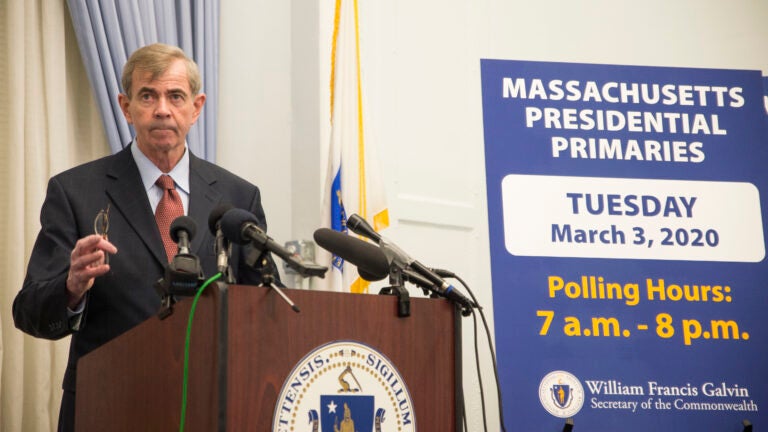
Election officials are making a last-minute effort to allay coronavirus concerns ahead of Super Tuesday, including in Massachusetts.
“Obviously, we do not think it’s a reason for people not to vote,” Secretary of State Bill Galvin told reporters during a press conference Monday in Boston. “But it has led to some concerns that are quite legitimate.”
Massachusetts is one of the 14 states holding its presidential primary this Tuesday. And with roughly a third of all national delegates set to be awarded in the competitive Democratic race, states across the country have been implementing precautionary measures to make sure fear about the domestic spread of the communicable disease doesn’t affect turnout.
Gov. Charlie Baker said Monday that Massachusetts — where one case has been reported — remains at low risk for coronavirus outbreaks, which has killed six people in Washington state and more than 3,000 worldwide.
Galvin started his press conference Monday by alluding to the “unusual aspects” of this year’s election. He said voters should feel free to bring their own pens to fill out their ballots, if they’re worried about touching the ones that are made available at the booths.
“The one common piece of equipment that might be used is the pen, so we’re suggesting that local election officials have extra pens, replace the pens, but also allow and encourage voters who might be concerned to bring their own pens,” he said.
Galvin added that the “only caveat” is to not bring a red pen, as the state’s voting machines will not be able to read ballots marked in that color.
In a memo to local election officials, Galvin suggested they make a “regular routine” of cleaning the voting booths.
“We’re certainly supportive of that in any financial way we may need to be,” he added.
Galvin’s office is also instructing local officials to allow people who have voluntarily “self-quarantined” to vote by absentee ballot, as if they have been admitted to a hospital.
While the state’s rules typically require absentee ballot applications be submitted by either the voter or the voter’s family member by noon the day before the election, they also allow people who have been admitted to health care facilities within five days of the election to have anyone — family member or not — request an absentee ballot, bring it to them, and deliver it to election officials on their behalf.
Galvin’s exception would allow people who are self-quarantining — regardless of when they started — to take advantage of that process.
“It’s the loosest absentee ballot requirements,” he said, adding that his office was “trying to be accommodating to citizens who are — hopefully in good faith — self-quarantining because they’re concerned about their potential to spread the coronavirus.”
Galvin said he doesn’t think it will be a “very large number.”
His office is also advising local election officials to have a pool of extra people available to work the polling places, in case some of the scheduled volunteers don’t show up. Given the competitive, open race in the Democratic primary, Galvin predicted a record turnout of 1.5 million ballots cast Tuesday — all the more reason to have back-up workers available. Polls across the state will be open from 7 a.m. to 8 p.m.
“Sometimes it’s been very quiet,” Galvin said. “I’ve mentioned some of the low turnouts we’ve seen; you might not think you need a lot of help. This one, we don’t think will be that quiet.”




To comment, please create a screen name in your profile
To comment, please verify your email address
Conversation
This discussion has ended. Please join elsewhere on Boston.com