
Ed Davis on his support for Mike Bloomberg’s campaign and the recent criticisms of the billionaire candidate
"Let's talk about stop and frisk for a second. I lived that life as well."
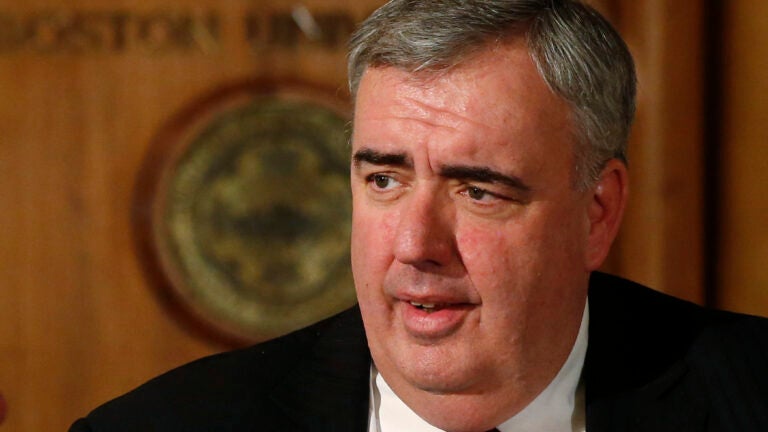
Mike Bloomberg may have made a late entrance into the Democratic presidential primary race, but Ed Davis has been acquainted with him for more than a decade.
Davis, who served as Boston’s police commissioner from 2006 to 2013, first met Bloomberg shortly after he founded Mayors Against Illegal Guns in 2006 alongside the late, longtime Boston Mayor Tom Menino. In an interview Tuesday afternoon, Davis said he was taken by the “courage” the then-New York City mayor and Medford native had to take on the powerful gun lobby at the time.
Now, he’s leading Bloomberg’s campaign in Massachusetts for similar reasons.
“He is exactly the leader we need in the White House, and he represents our best shot at beating Donald Trump in November,” Davis, the Massachusetts state chairman of Bloomberg’s campaign, said last week.
The multi-billionaire candidate is skipping the first four Democratic primary contests to focus on later-voting states, beginning with Super Tuesday on March 3. Massachusetts has the fifth-most delegates of the 14 states that vote on that day. Backed by the candidate’s unprecedented spending, Bloomberg’s campaign has quietly built a formidable operation in his home state with more than 50 staffers and six offices.
But with his ad-fueled rise has also come increased scrutiny. And while Davis said he’s not concerned about the potential impact that Bloomberg’s past remarks about “tough on crime” policing might have on his support, the former commissioner-turned-security consultant tempered expectations ahead of the candidate’s first debate stage appearance Wednesday night in Las Vegas.
“He hasn’t been in a debate in many years, and the other people on the stage have had a lot of experience recently,” Davis told Boston.com. “So we’ll wait to see how things play out.”
The following interview has been lightly edited for clarity.
Boston.com: How did you two first meet?
Ed Davis: I met Mayor Bloomberg at a congressional hearing where I was asked to testify along with Mayor Menino, Ray Kelly, and Mayor Bloomberg, so the two mayors and two police commissioners of Boston and New York.
It would have been at the beginning of Mayors Against Illegal Guns. I’m not quite sure of the date, but I was still in office, so I would say it was around 2009.
What did you work with him on?
ED: Getting the word out that we could pass commonsense regulations around background checks, keeping guns out of the hands of criminals and emotionally disturbed persons, tackling gun violence in the hardest hit communities, restrictions on assault weapons, and holding the gun industry accountable.
Those were the kind of things we spoke about then, and are still relevant today.
Was there anything you learned from Bloomberg — or were surprised by?
ED: I was surprised by his courage in this area, and the commitment by Mayor Bloomberg and Mayor Menino to really take on the unacceptable fact 100 Americans are killed every day with firearms. These guys were not afraid to stand up and say something needs to be done.
Why do you think he would be a better president than the other candidates running for the Democratic nomination?
ED: His experience and his record of accomplishment is the first thing.
The most compelling reason, from my perspective, is that he has the courage to stand up to this guy in a very effective way. I think Trump is a bully, and I believe it takes a man like Michael Bloomberg to stand up to him and call him on the false things that he puts out there.
What exactly does he do differently than the other candidates?
ED: He’s intimately familiar with Trump, coming from the same community. He knows Trump’s record better than anybody that I’ve seen confront him. He has insight into Trump’s reputation in business.
And I think that’s really important because Trump fools a lot of people because he’s got some money. But he’s — from everything I’ve heard — not a very good businessman, and I think that Bloomberg is, and can call him on that.
When you look at his actual platform of policy proposals, is there anything that sticks out that separates him from the other candidates?
ED: Well I think it’s the overall picture. I’m in lockstep with him on most of his policies.
I have a very close friend who took a test in one of the media outlets and he was most closely aligned with Bloomberg. So not only me, but my colleagues and contemporaries are really in agreement with what Mike stands for. And I think that’s the most important thing.
How concerned are you that some of his past remarks that have come under scrutiny — whether it’s supporting stop and frisk or citing the end of redlining for the financial crash — could affect his support, in either the primary race or general election?
ED: Let’s talk about stop and frisk for a second. I lived that life as well — in a different city and a different position.
In the 1990s, I had a chance to work on the crime bill for the Clinton White House, and everybody was talking about being tough on crime. There were 100,000 new police officers put on the street, because minority communities, crime-ridden communities were really begging for help. And we did what we knew to be the best policy back then, which was flood the neighborhoods with police officers.
We’ve learned that the price that the community paid for that strategy was unacceptable. Mayor Bloomberg has apologized and learned from that, and I think we all have. And we’ve all learned about a bunch of things relating to social issues. Anybody that has a 30-year track record will have some issues that come up, so I think he’s done the right thing on this.
What do you think of the criticism from some candidates (i.e. Elizabeth Warren, Bernie Sanders) over Bloomberg self-funding hundreds of millions on his campaign. Do you have any concerns about what that says about our democracy?
ED: I believe that we are in very unusual times right now.
And the net benefit of having someone run their own campaign, someone who won’t be answerable to special interests, and someone who is committed enough to this country to spend the kind of money that he’s spending is a net benefit. So I’m not worried about that at all.
There’s an argument from the same wing of the Democratic Party that says Trump is a symptom of a larger structural problem, whether it be economic or political. Is that something with which you agree?
ED: I don’t see him as a symptom of a problem. The country always faces challenges. Sometimes it’s war; sometimes it’s internal strife.
To see the landscape and then to leverage dissension by separating people is what’s a problem here. That’s a problem because one man has decided to do that, and it’s paid benefits to him. But I don’t think it’s what America was built on, and I think people are sick of it at this point and time.
The truth is that I believe that when problems arise in the country, it’s really important to have leaders that pull people together. There’s ways to do that; I’ve seen it happen.
Unfortunately we don’t have a leader right now that is oriented towards joining people together. He’s a divider, and I think that’s one of the fundamental problems. I really don’t believe he’s sort of symptomatic of a problem that can’t be solved.
Having qualified for the debate Wednesday night, it looks like Bloomberg will get his first major chance to make his case. What are your expectations for him?
ED: I’m optimistic. I think that’s he’s going to get a chance to tell people what his plans are and to demonstrate his commitment to the country.
But he hasn’t run for office in many years. He hasn’t been in a debate in many years, and the other people on the stage have had a lot of experience recently. So we’ll wait to see how things play out.
But I can tell you this: Over the rest of this campaign, Michael will get better and better no matter what happens. And I think he’s our candidate.




To comment, please create a screen name in your profile
To comment, please verify your email address
Conversation
This discussion has ended. Please join elsewhere on Boston.com