
Do Massachusetts residents support the TCI? Depends how you ask the question.
"There’s skepticism about whether TCI is the right action to take."
Do Massachusetts residents support Gov. Charlie Baker’s Transportation and Climate Initiative?
Related Links
Well, it depends how you frame the question.
A new poll released this week by the Fiscal Alliance Foundation, a Boston-based conservative nonprofit whose sister group is actively rallying opposition to the TCI, illustrated how Bay Staters’ opinions can differ when asked about the tradeoffs of the multi-state plan to curb greenhouse gas emissions.
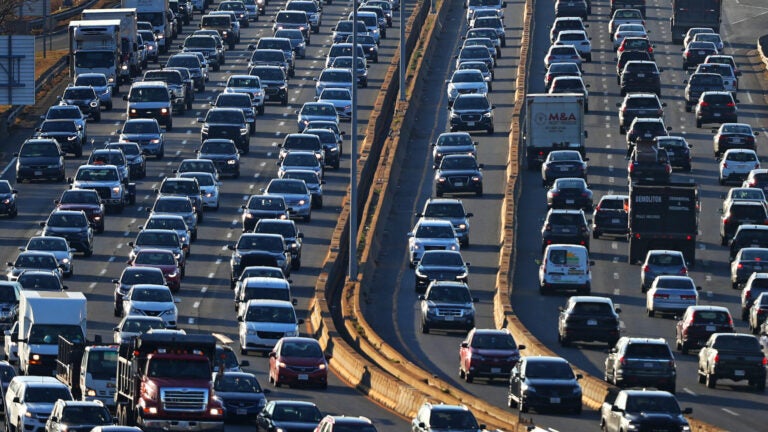
The regional effort, which is being spearheaded by Baker’s administration, would set a cap on the amount of vehicle emissions in 11 participating Northeastern states and make fuel companies pay for a permit to cover the carbon dioxide emissions they produce. Officials estimated that, depending on the cap, it would result in a 5 to 17 cent per-gallon increase in the price of gas.
The poll released Wednesday — conducted by Jim Eltringham, the vice president of the polling and data group Advantage, Inc. — found that 48 percent of likely Massachusetts voters supported the plan to “improve transportation and reduce carbon emissions from the transportation sector by increasing the costs of gasoline and diesel fuel.” Just over 41 percent said they were opposed.
But when asked about the potential 17-cent per-gallon increase, opposition surged to more than 60 percent, compared to 31 percent who said they still support TCI.
Those results were nearly the exact opposite of a previous poll, which made sure to mention the second half of the TCI’s “cap-and-invest” model. The MassInc poll in November asked if voters supported the plan to “charge gasoline distributors a fee based on the amount of pollution their fuels produce,” noting that Massachusetts “would dedicate a substantial portion of the money raised to reducing greenhouse gas pollution from transportation and improving public transportation.”
The results? Sixty-two percent said they supported the TCI, while 31 percent said they were opposed.
Eltringham says both polls similarly “showed strong initial support for TCI in general terms,” but that voters “react very negatively” when the actual impact at the gas pump — two or three extra dollars to fill one’s tank — is detailed.
What has yet to be detailed is what the specific transportation benefits would be. Baker’s administration says Massachusetts could get up to $500 million for sustainable transportation projects, though each state would ultimately decide individually how exactly to spend the revenue. Supporters also say TCI could result in more than 1,000 fewer premature deaths from air pollution across the region over the next 10 years.
Still, Eltringham says it takes work to convince voters they will see those longterm benefits.
“In our initial question, we see an electorate supportive of taking action for a healthier environment; the subsequent questions show that there’s skepticism about whether TCI is the right action to take,” he said.
MassInc’s poll was conducted before the estimates of the TCI’s effect on gas prices were released in December, though it also found Bay Staters sensitive to increased gas prices in a separate question at the time.
According to the survey, 52 percent of voters opposed a 15-cent increase in the state’s 24-cent per-gallon gas tax, compared to 43 percent who were supportive, even if “all the money raised were dedicated to improving roads, bridges and public transportation” in Massachusetts. Those figures changed to 49 percent support and 47 percent opposition, if the tax was incrementally raised over six years in three 5-cent increases.
Baker has opposed increasing the gas tax. His administration says that the TCI’s model is better because it would leave it up to fuel companies to decide how much of the costs of the carbon allowances they would have have to buy would be passed onto consumers. Baker says it would also incentivize fuel companies to invest in more efficient and cleaner energy.
Eltringham’s poll this week also found that 61 percent of voters oppose going forward with the TCI if an unspecified number of neighboring border states do not participate; New Hampshire has already withdrawn and some other New England governors have voiced concern. Only 27 percent said that Massachusetts should stick with it in that scenario.
During an WGBH interview Thursday afternoon, Baker has said he’s confident that (even without New Hampshire) a “significant” number of states will ultimately agree to the TCI, comparing the process to the formation of the Regional Greenhouse Gas Initiative, a similar cap-and-invest program applied to the power plant sector by 10 states, including Massachusetts, in the Northeast.
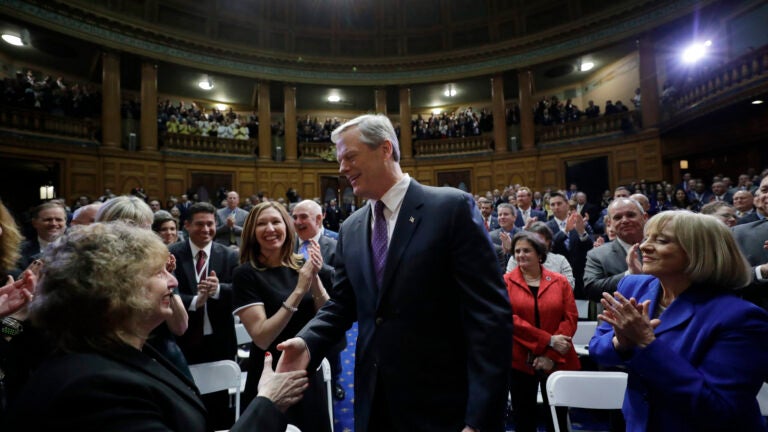
But without lowering emissions in the transportation sector as well, Baker says the state won’t reach its climate action goals. During his State of the State speech Tuesday, the Republican governor committed Massachusetts to achieving net-zero emissions by 2050.
“I get that this is going to be hard,” Baker said. “But together, we have a real opportunity, and a responsibility to achieve a significant reduction in transportation emissions.”


To comment, please create a screen name in your profile
To comment, please verify your email address
Conversation
This discussion has ended. Please join elsewhere on Boston.com