
Charlie Baker says calling Ayanna Pressley’s remarks a ‘rant’ was an ‘obviously terrible’ word choice
"She called me back, and I said 'I'm very sorry that I stepped on a beautiful moment for you.'"
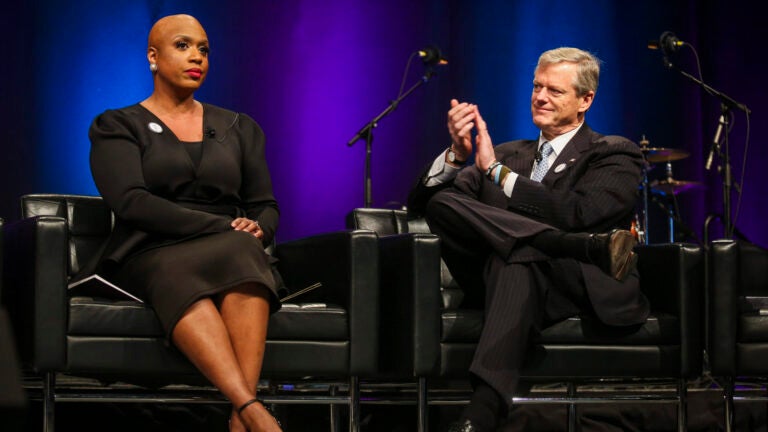
Gov. Charlie Baker remains contrite about referring to Rep. Ayanna Pressley’s remarks about fighting for the rights of women and people of color a “rant” earlier this week.
“My word choice was obviously terrible,” the Massachusetts governor said during an appearance Thursday on WGBH’s “Boston Public Radio.”
Pressley had received a roaring ovation Monday at the 50th annual Martin Luther King Jr. Day Memorial Breakfast in Boston, after delivering a crescendoing defense of “identity politics” and representation in government in the ongoing fight for “economic justice.” Baker — who applauded the Massachusetts congresswoman on stage along with Boston Mayor Marty Walsh and Sen. Ed Markey — was asked to speak next and jokingly questioned how he could follow “that rant.”
While the Swampscott Republican went on to say that Pressley’s comments were “absolutely so spot on,” his use of word “rant” received some groans from the crowd and strong rebukes from prominent local Democrats, including Attorney General Maura Healey, Boston City Councilor Julia Mejia, and Suffolk County District Attorney Rachael Rollins.
Baker said Thursday that it wasn’t until he was in the car on his way to another MLK Day event in Springfield that members of his staff told him “that the use of the word rant had upset a bunch of people” and reached out to apologize to Pressley.
“I called the congresswoman; she called me back, and I said ‘I’m very sorry that I stepped on a beautiful moment for you,’ and I apologized for the use of the word,” Baker said. “I said it was a poor choice of words, but that I thought what she said was exactly right.”
Baker said Pressley accepted his apology.
Asked about the tweet by Rollins asserting that his comments were emblematic of the fact that his cabinet lacked a single Black secretary and generally lack a voice in his administration, Baker named several other high-ranking Black appointees, including Chrystal Kornegay, the director of MassHousing and former Housing and Community Development undersecretary; Travis McCready, the president of the Massachusetts Life Sciences Center; and Ron Walker, the former secretary of Labor and Workforce Development.
“We try to be as broad as we can be with respect to filling key positions in our administration,” Baker said. “I take a lot of pride in many of the people we’ve appointed to significant roles who are people of color.”
The governor added that he meets every 90 days with the state’s Black and Latino Legislative Caucus, which he credited for the 2018 criminal justice law and recent legislation to reform the scandal-plagued State Police. Baker also said he didn’t think it was “fair” for Rollins to say the meetings with his administration’s Black Advisory Committee result in “NADA.” He credited the commission for influencing a range of legislation, including on workforce development, education, and his budget proposals.
“I don’t think it’s fair to demean them because they’ve been very successful,” Baker said.
During the MLK Day breakfast earlier this week, Baker said that the “greatest gift” of being governor was getting to “walk in the shoes” of people with differing life experiences.
“It’s one of the most important lessons I’ve learned as a public official,” he reiterated Thursday.
Baker slightly misinterpreted Pressley’s remarks, which focused on addressing the effects of systemic racism “codified” into government policy, in addition to outright white supremacy. But he fully agreed with her point about representation and identity politics.
“You walk around in all these other people’s shoes and you realize that their life experiences differ, and they differ for people for a lot of reasons,” Baker told WGBH. “And her fundamental point about the fact that hating somebody just because their life experience is different than yours — or that color is different than yours or their nationality is different than yours — is a much bigger problem than the fact that people want people in public life to factor into the way they make decisions the fact that a lot of people live a lot of different lives and see things from a lot of points of view.”





To comment, please create a screen name in your profile
To comment, please verify your email address
Conversation
This discussion has ended. Please join elsewhere on Boston.com