
Michelle Wu had mixed reviews for Marty Walsh’s State of the City speech
"I’m not sure what the big transportation announcement was."
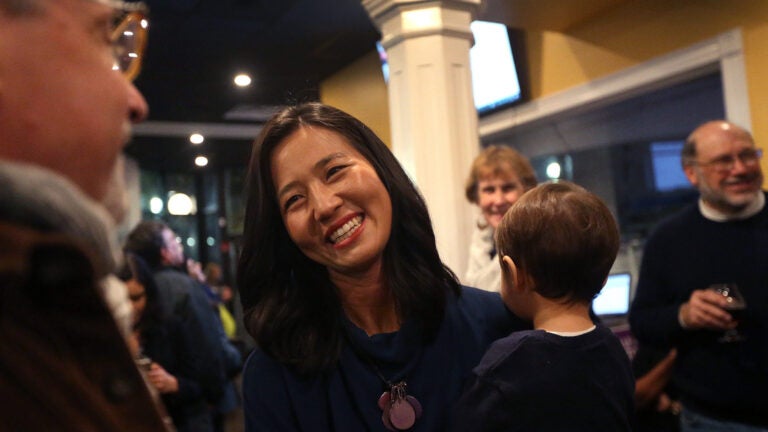
Boston City Councilor Michelle Wu says she and Mayor Marty Walsh are on the “same page” when it comes to their values around lifting up the city’s residents. But Wu wasn’t on the same page with everything announced in Walsh’s annual State of the City address Tuesday night.
Wu — the top vote-getter in the City Council elections last November, who some speculate could challenge Walsh from the left next year — applauded the mayor and his staff Wednesday morning for a “well-executed” and “beautiful” event. But in a series of tweets, the at-large city councilor said the policies announced by Walsh, a fellow Democrat, didn’t go far enough, zeroing in on the three major focuses on his speech.
“I’m not sure what the big transportation announcement was,” Wu wrote.
You can watch the video or read the transcript of the speech here: https://t.co/7xhQcYOKMh. I’ll share a few thoughts on some of the policy announcements unveiled last night, which focused on education, transportation & housing:
— Michelle Wu 吳弭 (@wutrain) January 8, 2020
Posting excerpts of Walsh’s speech on Twitter, the 34-year-old councilor suggested that the mayor’s announcement of a committee to tackle East Boston’s traffic issues, a city initiative to step up traffic enforcement, and renewed calls for laws allowing local ballot measures didn’t match up with the “bold” rhetoric of Walsh’s speech. She also rejected the notion that a “few bad drivers” could be blamed for the city’s congestion problems.
“It’s policy & infrastructure choices that deprive us of reliable alternatives to driving & force us to risk lives at the mercy of human error,” Wu wrote.
In his speech, Walsh did note that Boston was working to improve alternatives to driving — particularly pedestrian and bike infrastructure. Wu, however, has pressed for more aggressive action to incentivize less car use, like making the MBTA fare-free and charging Boston residents for parking permits (which Walsh opposes).
When it came to housing, Wu had a mixed response to the speech Tuesday. She applauded the mayor’s recognition of the local affordability crisis; Walsh announced an “unprecedented” $500 million investment in the creation of low- and middle-income housing over the next five years. But again, Wu “respectfully” disagreed with the mayor’s assertion that the efforts amounted to “one of the most progressive housing policies” without some form of rent control (which she now supports), community land trusts, and ending exclusionary zoning.
Wu also spoke out against the city’s plan to sell the Lafayette Garage to help pay for the $500 million affordable housing plan.
‘The garage is a stabilized asset & delivers an ongoing revenue stream to fund City services,” she tweeted. “Exchanging this for a one-time cash windfall needs very specific justification.”
Walsh’s office plans to present its proposal to sell the downtown garage to the City Council in coming months, which they say is “a unique opportunity to turn a City asset into an immediate and impactful investment through one-time revenue from the sale.”
Wu similarly praised Walsh’s $100 million increase in classroom funding over the next three years, but said the proposal needed more context about how it will be used. Walsh’s office said the multi-year investment be directed at students or school services, focusing on wellness and mental health supports, curriculum enrichment, and programming and activities.
Wu asked how the $33 million-a-year increase would get “deeper results” than the $51 million increase in funding that was adopted this past fiscal year.
“Let’s see what happens through the Council budget process,” she added.
Need more context on whether this is just front-loading new state funding & clear plans. How will the $33M get deeper results than this year’s FY20 budget (see press release below on increases touted last summer)? Let’s see what happens through the Council budget process. pic.twitter.com/3VQ6Ptp2Rb
— Michelle Wu 吳弭 (@wutrain) January 8, 2020
On this front, Wu wasn’t the only one on the council expressing skepticism. Andrea Campbell, the District 4 councilor, tweeted Tuesday night addressing the opportunity gap in Boston Public Schools would take “more than announcements & money thrown at the problem.” In his speech, Walsh acknowledged that public education in Boston has been a “tale of two districts.”
“The administration has failed to address our most pressing structural and systemic inequities in BPS: stalled progress on universal pre-k, crumbling buildings and infrastructure, and high schools that aren’t preparing children for success,” Campbell said.
The administration has failed to address our most pressing structural and systemic inequities in BPS: stalled progress on universal pre-k, crumbling buildings and infrastructure, and high schools that aren’t preparing children for success.
— Andrea J. Campbell (@AJCampbellMA) January 8, 2020
At least on social media, the other members of 13-member City Council voiced support, if anything, for the agenda Walsh presented Tuesday, especially his investments in affordable housing. Still, the critiques from Wu and Campbell comes as the progressive (and historically diverse) council has increasingly pressured the Walsh administration to take more urgent action to ensure the city’s economic gains are being broadly shared.
If the response to his speech this week is any indication, 2020 will be no different. And we haven’t even gotten to 2021.



To comment, please create a screen name in your profile
To comment, please verify your email address
Conversation
This discussion has ended. Please join elsewhere on Boston.com