
Massachusetts Republicans didn’t want Bill Weld to be on his own state’s primary ballot
However, the effort is being stymied by Bill Galvin.
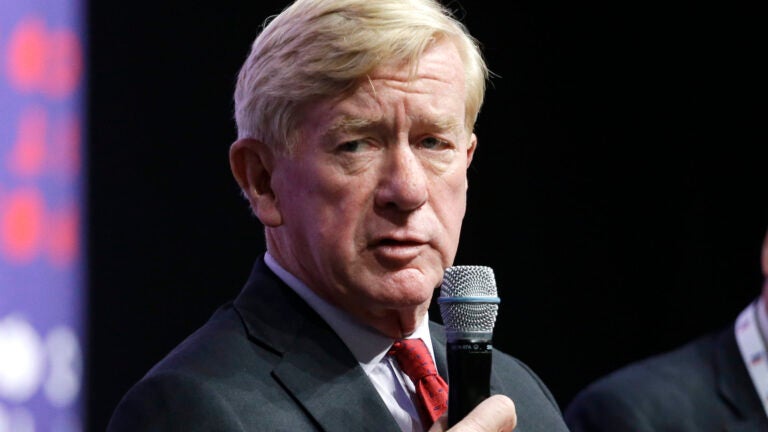
Bill Weld will be on his home state’s Republican presidential primary ballot after all, in spite of the efforts of the political party he used to helm.
As the State House News Service reported Thursday, the Massachusetts Republican Party left Weld’s name off the list of candidates (or, to be more specific, candidate) they want on the March 3 primary ballot. It’s the latest and most close-to-home attempt by GOP officials across the country to further undercut the former Massachusetts governor’s Republican long-shot primary challenge against President Donald Trump.
However, at least in this case, it won’t work.
Massachusetts Secretary of State Bill Galvin is planning to put Weld’s name on the ballot, along with Trump, who was the sole candidate submitted Thursday by the MassGOP.
According to state law, Galvin is required to put any candidate whom he determines to be “generally advocated or recognized in national news media throughout the United States” on the presidential primary ballot. A spokeswoman for Galvin told Boston.com that he determined Weld and former Illinois Rep. Joe Walsh, who is also challenging Trump in the GOP primary, both “meet those qualifications.”
Candidates can also qualify for the primary ballot by submitting 2,500 signatures to Galvin’s office.
Weld, a Canton Republican, who was the Libertarian Party’s vice presidential nominee in 2016, still faces a steep climb in his anti-Trump campaign. Polls show that the vast majority of Republicans support the incumbent president, including in New Hampshire, where Weld has focused his campaign. A WBUR poll released this week found that 74 percent of Republican primary voters in the Granite State are at least leaning toward Trump, compared to 9 percent who support Weld.
And that’s in a state where voters will actually have a chance to cast a ballot for Weld.
Hawaii became at least the sixth state Wednesday in which Republican officials have canceled the party’s presidential primary or caucuses. In other states, like Minnesota, Trump’s name will be the only one on the primary ballot. Weld has criticized such moves as “anti-democratic” attempts to “silence” the president’s intra-party critics, but Republican officials contend that it’s standard fare.
“Having a sitting President as the only name on the potential candidate list is not unprecedented, and is in fact, an established procedure,” Jim Lyons, the chair of the Massachusetts Republican Party, wrote in a letter Thursday to Galvin published by the State House News Service.
Lyons — a Trump supporter who became MassGOP chair in January — noted that both state parties had done similar things in 2004 and 2012, respectively, when first-term incumbent presidents George W. Bush and Barack Obama were running for re-election. Of course, neither at the time faced a primary challenge from a former governor or congressman.
A better comparison, as the State House News Service noted, might be 1992, when Massachusetts Republicans only submitted President George H.W. Bush’s name for the ballot, despite a high-profile challenge from Pat Buchanan, a former adviser to President Richard Nixon and conservative commentator. However, Buchanan’s name was added to the primary ballot after then-Secretary of State Michael Connolly decided he met the criteria of a serious candidate, according to Boston Globe reports at the time.
Weld, who was the state’s Republican governor at the time, supported the decision to add Bush’s challengers to the ballot. David Duke, the former Ku Klux Klan leader running in the Republican primaries that year, was also added by Connolly.
“I feel like a referee in the playoffs,” Weld told the Globe in December 1991. “Let ’em play.”
Bush went on to beat Buchanan in the Massachusetts primary by a margin of 66 percent to 28 percent. Duke got 2 percent.
Now a candidate himself, Weld forcefully criticized the actions of the current MassGOP — and thanked Galvin for stepping in.
“When I was Governor, Republicans and Democrats in the Commonwealth respected one another and actually worked together,” Weld told the State House News Service. “It is gratifying that such respect remains and that Secretary of State Galvin is ready to defend the rights of all Massachusetts voters.”
In April, an Emerson poll found Trump leading Galvin among registered Republicans in Massachusetts, 82 percent to 18 percent.




To comment, please create a screen name in your profile
To comment, please verify your email address
Conversation
This discussion has ended. Please join elsewhere on Boston.com