
Elizabeth Warren released a plan to pay for Medicare for All. That hasn’t stopped the criticism from her rivals.
Her support for Medicare for All even gained one critic: Bernie Sanders.
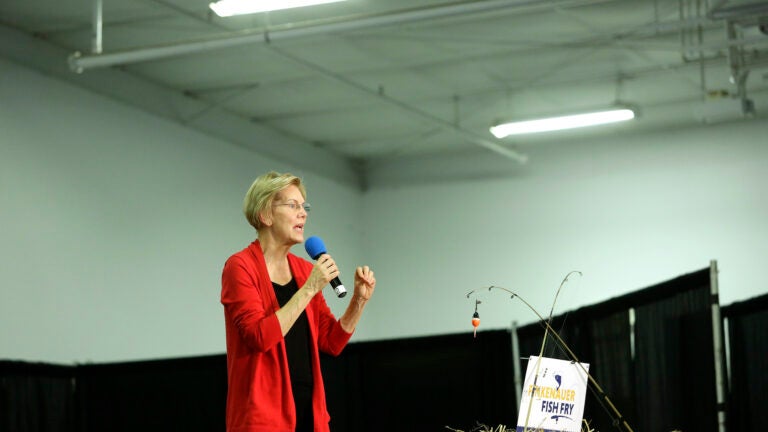
Following several weeks of intense scrutiny, Sen. Elizabeth Warren finally provided a direct response to the question of whether she would raise taxes on the middle class to pay for Medicare for All.
According to her plan, the answer is no.
But that hasn’t stopped the criticism from her fellow Democratic presidential candidates. Even Sen. Bernie Sanders, a fellow Medicare for All supporter, questioned Warren’s approach, along with several familiar critics.
The Massachusetts senator announced Friday that she would pay for the transformative overhaul of how the country pays for health care — shifting from a predominantly private insurance system to one where the government covers the cost of medical care — through a combination of cost reductions and new taxes on the wealthy. In total, Warren’s campaign assumes the single-payer system would cost the federal government $20.5 trillion over the next decade, which is significantly less than several previous estimates.
“She’s making it up,” Joe Biden told PBS Newshour in an interview Friday shortly after Warren’s plan was released.
The former vice president noted that other studies had put the cost of Medicare for All “between $30 trillion and $40 trillion” over 10 years.
“Nobody thinks it’s $20 trillion,” he said — even though Warren’s campaign released several letters from Biden’s colleagues in President Barack Obama’s administration supporting their estimates.
Earlier in the day, Biden’s campaign accused Warren of “mathematical gymnastics” in an attempt to avoid what they believe would be necessary tax increases on the middle class.
Sanders, the chief sponsor of Medicare for All, has proposed a number of different financing options, including a 4 percent payroll tax on families earning more than $29,000 a year, which he says would be more than offset by the elimination of health care premiums and other expenses. According to the Vermont senator’s office, the average American would ultimately pay less under that tradeoff.
Still, even with the middle-class tax hikes that Sanders has proposed, Biden — who supports the less expensive option of creating a government-run health insurance plan that would compete with private insurers — says the revenue wouldn’t be enough to pay for the total cost of Medicare for All.
“There’s no way,” he told PBS. “Even Bernie, who talks about the need to raise middle-class taxes, he can’t even meet the cost of it.”
Asked about Biden’s comments, Warren highlighted her plan’s support from former Obama administration members and suggested that any Democrat who would defend the private insurance industry was “running in the wrong presidential primary.”
Warren re Biden campaign calling her M4A “mathematical gymnastics” She cites numbers from Obama economists “if Joe Biden doesnt like that I’m just not sure where he’s going.” She adds any Dem who defends insurance profits “I think theyre running in the wrong presidential primary” pic.twitter.com/LdhyRrlWKz
— Adam Brewster (@adam_brew) November 1, 2019
South Bend, Indiana Mayor Pete Buttigieg voiced similar doubts about Warren’s plan.
Like Biden, Buttigieg also supports a public option, but says he could see Medicare for All as a “long-run destination.” However, during an interview Sunday on ABC News, he said he didn’t want to move the entire country to a single-payer system — at least not immediately — under that assumption.
“Let’s put this out there and see if it’s really the best plan for everybody,” Buttigieg said of the public option.
“If it’s the right plan, then everybody will move to it until it is the single payer,” he added. “And if it’s not the right plan for everybody, then we’re going to be really glad we didn’t kick some Americans off their private plans.”
Asked about Warren’s cost estimates, Buttigieg said that the “math is certainly controversial.”
In contrast, Buttigieg argued that his $1.5 trillion plan would avoid the multi-trillion-dollar disagreements and could be paid for fully through “rolling back” the cuts to the corporate tax rate signed by President Donald Trump in 2017 and savings from allowing the current Medicare to negotiate drug prices.
“It avoids these two major problems, the math problem that I think the economists are arguing over this weekend, and the problem of kicking Americans off their private plans, where not everybody wants to go,” said Buttigieg, whose calls for bringing the country together have increasingly clashed with Warren’s vision of bold, structural change.
“There are people who will just as easily give up on a big idea and sound oh so smart and oh so sophisticated,” the Cambridge Democrat said at a rally Sunday, according to The Boston Globe. (Buttigieg had voiced support for Medicare for All prior to his presidential campaign).
Recent polling by the Kaiser Family Foundation, a health policy nonprofit, has shown that more than 50 percent of Americans — including more than seven in 10 Democrats — generally supports Medicare for All, while a vast majority support some form of a public option.
Prior to 2016, most Americans opposed the idea Medicare for All, according to Kaiser, suggesting that Sanders’s first presidential campaign played a factor in its more recent popularity.
Sanders, who has continued to champion the concept in his 2020 campaign, told ABC News on Saturday that he and Warren were in alignment in shared support for Medicare for All. But he also drew a rare point of disagreement over her plan to pay for it.
“We do disagree on how you fund it,” Sanders said, adding that his approach “will be much more progressive in terms of protecting the financial well being of middle income families.”
Warren’s plan to pay for Medicare for All includes replacing employer’s current health care contributions with a new fee — an “Employer Medicare Contribution,” her campaign calls it — equal to 98 percent of what they currently spend. Warren’s campaign says businesses with less than 50 workers would be exempt if they don’t already pay for their employees’ health care and that companies with unionized work forces would be able to lower their contribution in return for increasing their employees’ wages and other benefits.
While the tax would be paid by companies, Sanders thinks it could have downstream effects on workers.
“I think that that would probably have a very negative impact on creating those jobs, or providing wages, increased wages and benefits for those workers,” he told ABC News.
Sanders has similarly suggested a tax on employers, with exemptions for small businesses, to help fund Medicare for All. In a white paper released earlier this year, his office proposed a 7.5 percent tax on company payrolls over $2 million.
“I think we have a better way, which is a 7.5% payroll tax, which is far more, I think, progressive, because it’ll not impact employers of low wage workers but hit significantly employers of upper income people,” Sanders said Saturday.
Asked about Sanders’s criticism, Warren said her plan would actually “help employers” since they would pay slightly less than they currently do for workers’ health care, as well as small businesses that are currently at a “competitive disadvantage” of not being able to offer health care benefits.
And unlike Sanders, her plan includes no direct tax hikes on middle-class individuals, which she said was “progressive” in its own right.
“I think it’s progressive when not a single person who makes less than a billion dollars has to pay one penny in additional taxes,” Warren said, according to ABC News.
At a campaign rally Sunday, Warren downplayed the disagreement with her longtime friend and progressive ally, instead highlighting their shared support for single-payer health care.
“Bernie may have a different vision of how to pay for it, but let’s be really clear: Bernie and I are headed in exactly the same direction,” Warren said, according to the Washington Post. “And that is the $11 trillion that families are going to pay over the next 10 years in out-of-pocket medical costs will go away.”



To comment, please create a screen name in your profile
To comment, please verify your email address
Conversation
This discussion has ended. Please join elsewhere on Boston.com