
Here are all 11 times candidates challenged Elizabeth Warren during the Democratic debate
And how it worked out.
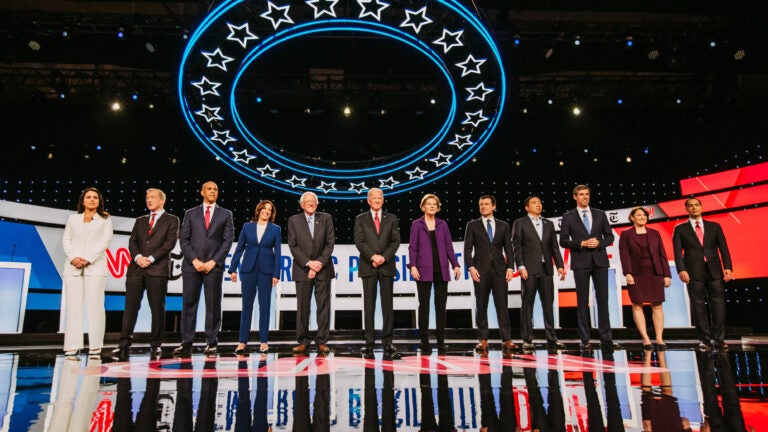
If the fourth Democratic debate Tuesday night made one thing clear, it’s that Sen. Elizabeth Warren is now the frontrunner in the presidential primary race — at least in the eyes of her peers.
In the first debate since Warren’s steady rise has taken her to the top in a number of national and early-voting state primary polls, the Massachusetts senator faced a fusillade of challenges from fellow Democrats on stage on everything from her positions on health care and taxes to President Donald Trump’s Twitter account. Her campaign says the attacks were a sign of her momentum.
“She took heat tonight as a result of that momentum, but she stayed focused on what’s broken and how she plans to fix it with a government and an economy that works for the people,” Warren campaign spokeswoman Kristen Orthman told CNN, which hosted the Ohio debate Tuesday.
CNN commentator David Axelrod tweeted that Warren’s frontrunner status was “certified by the amount of incoming she is getting tonight.” She ended up with by far the most speaking time, sheerly due to the disproportionate number of times she had to respond to other candidates. However, Warren also came into the debate with a plan. According to the Washington Post, she took more time off than usual before this debate to prep for the slate of attacks, which landed with varying degrees of success.
Here’s a breakdown.
1. Buttigieg calls out Warren for lacking a ‘plan’ to pay for Medicare-for-All
The candidate:
Pete Buttigieg
The attack: From the outset of the debate, the South Bend, Indiana mayor went after Warren for not directly answering the question of whether Medicare-for-All would raise taxes for the middle class, even if those taxes were offset by larger reductions in health care costs.
“We heard it tonight,’ Buttigieg said. “A yes-or-no question that didn’t get a yes-or-no answer. Look, this is why people here in the Midwest are so frustrated with Washington in general and Capitol Hill in particular. Your signature, Senator, is to have a plan for everything — except this. No plan has been laid out to explain how a multi-trillion-dollar hole in this Medicare-for-All plan that Senator Warren is putting forward is supposed to get filled in.”
Buttigieg went on to argue that his proposal for a public health care insurance option was more politically realistic and popular among American voters.
The response: Warren contested that Medicare-for-All was the only way to ensure health insurance to “every single American” and pledged not to sign any legislation that resulted in an overall increase in costs for the middle class (presumably when factoring both increased taxes and the elimination of health care premiums and other out-of-pocket expenses).
“I’ve laid out the basic principles,” she said. “Costs are going to go up for the wealthy. They’re going to go up for big corporations. They will not go up for middle-class families. And I will not sign a bill into law that raises their costs, because costs are what people care about.”
2. Klobuchar piles on
The candidate:
Amy Klobuchar
The attack: Klobuchar joined the early health care debate, suggesting that Warren — unlike Vermont Sen. Bernie Sanders, who acknowledged that, in a vacuum, taxes would go up for the middle class under Medicare-for-All — was not being “honest” about the proposed health care overhaul.
“I’m sorry, Elizabeth, but you have not said that, and I think we owe it to the American people to tell them where we’re going to send the invoice,” said the Minnesota senator, who also supports a public option.
Klobuchar also noted that passing Medicare-for-All would be difficult, given the political realities in Washington, D.C., where many Democrats remain cautious of the plan.
“The difference between a plan and a pipe dream is something that you can actually get done,” she said. “And we can get this public option done.”
The response: Warren noted that her past research as a professor found that two-thirds of people who went bankrupt due to a medical issue, which is one of the main causes of bankruptcy, actually had health insurance.
“The problem we’ve got right now is the overall cost of health care,” she said. “And, look, you can try to spin this any way you want. I’ve spent my entire life on working on how America’s middle class has been hollowed out and how we fight back.”
3. Yang and Warren clash over what’s causing manufacturing job loss
The candidate:
Andrew Yang
The attack: In June, Warren wrote that bad trade deals, rather than automation, were the biggest cause of job losses in American manufacturing. The estimates of the number of jobs that will be replaced by robots, relative to those displaced by globalization, are mixed. However, Yang has made his pitch for a version of universal basic income on the premise it is the best social policy to address the effects of job loss to automation, and he addressed Warren directly about the subject.
Citing increasing automation in the fast food, retail, and trucking industries, Yang said the effects could be widespread.
“What is that going to mean for the 3.5 million truckers or the 7 million Americans who work in truck stops, motels, and diners that rely upon the truckers getting out and having a meal?” he said. “Saying this is a rules problem is ignoring the reality that Americans see around us every single day.”
“Saying this is a rules problem is ignoring the reality that Americans see around us every single day.” #DemDebate #yanggang pic.twitter.com/IVxP0et6y3
— Andrew Yang🧢⬆️🇺🇸 (@AndrewYang) October 16, 2019
Her response: Warren said that everybody on stage was looking for the best way to “strengthen America’s middle class” and promoted her plan to increase Social Security benefits as akin to universal basic income.
“I’ve put forward a plan to extend the solvency of Social Security by decades and add $200 to the payment of every person who receives Social Security right now and every person who receives disability insurance right now. That $200 a month will lift nearly 5 million families out of poverty. And it will sure loosen up the budget for a whole lot more.”
Warren also responded to Yang’s earlier contention that a universal basic income would recognize the value of the work of stay-at-home parents and caregivers. She said her plan would also provide “an opportunity for them to get credit on their Social Security.”
4. Klobuchar: ‘Not even the billionaire wants to protect billionaires’
The candidate:
Klobuchar (again)
The attack: The Minnesota senator again rebuked Warren after she suggested other candidates on the debate stage felt it was “more important to protect billionaires than it is to invest in an entire generation of Americans” during a debate over her and Sanders’s proposals for a wealth tax.
“I am open to it,” Klobuchar said of the tax. “But I want to give a reality check here to Elizabeth, because no one on this stage wants to protect billionaires. Not even the billionaire wants to protect billionaires.”
“I want to give a reality check to Elizabeth [Warren], because no one on this stage wants to protect billionaires. Not even the billionaire wants to protect billionaires. … Your idea is not the only idea.” – Sen. Amy Klobuchar on Warren’s support for a wealth tax #DemDebate pic.twitter.com/7vxVy16IM0
— CNN (@CNN) October 16, 2019
The allusion to 2020 candidate and political mega-donor Tom Steyer drew laughs from the audience. Klobuchar said Warren’s “idea was not the only idea” and said she would repeal “significant portions” of the 2017 tax cuts signed by President Donald Trump.
Her response: Warren said that taxing income wouldn’t be as effective as taxing wealth.
“The rich are not like you and me,” she said. “The really, really billionaires are making their money off their accumulated wealth, and it just keeps growing. We need a wealth tax in order to make investments in the next generation. Look, I understand that this is hard, but I think, as Democrats, we are going to succeed when we dream big and fight hard, not when we dream small and quit before we get started.”
5. Beto enters the fray
The candidate:
Beto O’Rourke
The attack: Jumping into both the tax and Medicare-for-All debate, O’Rourke asserted that Warren was sometimes “more focused on being punitive and pitting some part of the country against the other instead of lifting people up.” Recalling the story of a single mother working four jobs in Las Vegas, the former Texas congressman also called out Warren for not being clear Medicare-for-All’s impact on middle-class taxes.
“Senator Warren said show me your budget, show me your tax plan, and you’ll show me your values,” O’Rourke said, paraphrasing Warren from earlier in the debate. “She has yet to describe her tax plan and whether or not that person I met would see a tax increase. Under my administration, if you make less than $250,000 a year as a family, you will not see a tax increase. That family needs to know that.”
Her response: “I’m really shocked at the notion that anyone thinks I’m punitive,” Warren replied. “Look, I don’t have a beef with billionaires.”
The senator went on to say that those who made fortunes in the United States likely employed workers educated at public schools, used public roads and bridges, and were protected by police and firefighters. Given those benefits, they should be willing to pay a 2 percent wealth tax, she said.
“All I’m saying is, you make it to the top — the top 0.1 percent — then pitch in two cents so every other kid in America has a chance to make it,” Warren said.
6. Gabbard singles out Warren on Syria
The candidate:
Tulsi Gabbard
The attack: The Hawaii congresswoman and critic of United States foreign intervention railed against the Trump administration and mainstream media for “championing and cheerleading this regime change war” in Syria. Gabbard then singled out Warren to ask if she “would join me in calling for an end to this regime change war.”
Her response: Warren responded that her goal is to get out of the Middle East altogether, but cautioned that it has to be done methodically.
“I don’t think we should have troops in the Middle East,” she said. “But we have to do it the right way, the smart way.”
Warren went on to blast Trump’s foreign policy for further destabilizing the region.
“We need to get out, but we need to do this through a negotiated solution,” she said. “There is no military solution in this region.”
7. Gabbard tries to challenge Warren on national security
The candidate:
Tulsi Gabbard (again)
The attack: Touting her experience as a veteran and member of several military-focused House committees, Gabbarrd again looked to challenge Warren, who was a law professor before winning her Senate seat, on national security.
“I am prepared to do this job, to fulfill this responsibility as commander-in-chief on day one,” she said. “I’d like to ask our other candidates this question. I’d like to start with Senator Warren — what her experience and background is to serve as commander-in-chief?”
However, the attempted confrontation came just as apologetic debate moderators tried to tell Gabbard it was time for a commercial.
Her response: There was none. The debate cut to a commercial break.
8. Harris urges Warren to agree with her Trump Twitter take
The candidate:
Kamala Harris
The attack: During a debate about regulating the tech industry, Harris brought up her own call for Twitter to suspend Trump’s account and repeatedly pressed Warren (who had laughed off the suggestion on the campaign trail) on why she did not agree. For its part, Twitter says it will not ban the accounts of world leaders who violate the platform’s terms of service — though they may label certain objectionable tweets — if they have a “clear public interest value.” Harris says Trump’s personal attacks on Twitter should merit the suspension of his account.
Sen. Kamala Harris to Sen. Elizabeth Warren: “When I called on Twitter to suspend Donald Trump’s account… you did not agree, and I would urge you to join me.” #DemDebate #DemocraticDebate pic.twitter.com/5rzAMYzADe
— The Hill (@thehill) October 16, 2019
“Senator Warren, I just want to say that I was surprised to hear that you did not agree with me that on this subject of what should be the rules around corporate responsibility for these big tech companies, when I called on Twitter to suspend Donald Trump’s account, that you did not agree, and I would urge you to join me,” she said during the debate, arguing that the president uses his account to threaten people, obstruct justice, and instigate violence.
“You can’t say you’re for corporate responsibility if it doesn’t apply to everyone,” Harris added.
Her response: “Look, I don’t just want to push Donald Trump off Twitter,” Warren said. “I want to push him out of the White House.”
As Harris repeatedly tried to continue to pin her down on the question, Warren shifted the conversation to her own proposal to break up big tech companies and the influence of corporate money in politics. Warren announced Tuesday morning that she wouldn’t accept donations of more than $200 from corporate interests and, in emphasizing the subject in response to Harris, seemed to make an implicit attempt to draw attention to the California senator’s acceptance of campaign contributions from Wall Street, Silicon Valley, and the pharmaceutical industry.
“You can’t go behind closed doors and take the money of these executives and then turn around and expect that these are the people who are actually finally going to enforce the laws,” Warren said.
9. Biden insists he ‘got votes’ for Warren’s consumer agency
The candidate:
Joe Biden
The attack: Reviving his criticism of Medicare-for-All, the former vice president accused Warren, as well as Sanders, of being “vague” about the price of the transformative health care overhaul, which is estimated to cost more than $30 trillion over 10 years.
“Senator Warren said we can’t be running any vague campaigns,” he said. “We’ve got to level with people. We’ve got to level with people and tell them exactly what we’re going to do, how we’re going to get it done, and if you can get it done. I’m going to say something that is probably going to offend some people here, but I’m the only one on this stage that has gotten anything really big done.
Biden went on the check off a number of accomplishments during his time in elected office, from the Violence Against Women Act and the Affordable Care Act to an economic stimulus bill and a (since repealed) federal assault weapons ban.
Her response: Warren pointed to the Consumer Financial Protection Bureau, a federal watchdog agency that she originally proposed in 2007 and then helped establish after President Barack Obama was elected.
In a remarkable confrontation, Biden repeatedly told Warren, “I got you votes” after she spoke about opening the CFPB, one of her signature achievements.
“I am deeply grateful to President Obama,” Warren replied, “who fought so hard to make sure that agency was passed into law.” pic.twitter.com/Ik5aplt0D9
— The New York Times (@nytimes) October 16, 2019
‘The big banks fought us. The Republicans fought us. Some of the Democrats fought us,” she said. “But we got that agency passed into law. It has now forced big banks to return more than $12 billion directly to people they cheated.”
Biden shot back that he went to the Senate floor and “got votes” for the financial reform bill that included the CFPB. Warren declined to directly give him credit (on Twitter, a former Biden advisor said Tuesday that the vice president fought hard for the bill and CFPB, though former lawmakers and reporters who worked on the issue said they didn’t recall him being deeply involved).
“I am deeply grateful to President Obama, who fought so hard to make sure that agency was passed into law, and I am deeply grateful to every single person who fought for it and who helped pass it into law,” Warren said, adding that Obama sometimes had to “fight against people in his own administration” to pass the CFPB.
“Not me,” Biden replied.
10 Buttigieg preaches
The candidate:
Buttigieg (again)
The attack: The Indiana native rebuked Biden’s argument that the Trump presidency is an aberration, arguing that “normal didn’t work” in the industrial Midwest. But he also disagreed with Warren’s implied argument that Democrats need to fight tooth-and-nail against Republicans and corporate interests to achieve structural change.
“I also don’t agree with Senator Warren that the only way forward is infinite partisan combat,” Buttigieg said. “Yes, we have to fight — absolutely, we have to fight for the big changes at hand, but it’s going to take more than fighting.”
Listing his own proposals — a public option, immigration reform, an assault weapons ban — Buttigieg said that his ideas would be the “boldest” reforms of his lifetime.
“Yet there are some here on this stage who say it doesn’t count unless we go even further,” he said.
Her response: There was none. The moderators moved the conversation on to Klobuchar. Speaking of which …
11. Klobuchar defends her own ‘bold’ ideas
The candidate:
Klobuchar (a third time)
The attack: Echoing Buttigieg’s argument, Klobuchar said that her candidacy was more feasible, both on the political and policy levels. Some metrics make the case that Klobuchar is among the most popular national Democrats, relative to her purple state’s political leanings.
“I want to win those states that we lost last time, and I have bold ideas to get us there,” she said. “And I think just because they’re different than Elizabeth’s doesn’t mean they’re not bold. But we can’t get any of this done on climate change or immigration reform unless they win.”
Her response: Warren said that pressing fights over health care, student debt, and racism were already ongoing — and suggested that Democrats need to nominate someone who was clear about what side they were on.
“People who are struggling to pay health care are fighting today. People who are getting crushed by student loans are in a fight today. People who are getting stopped by the police or paid less because of the color of their skin are in a fight today,” she said. “And anyone who doesn’t understand that Americans are already in these fights is not someone who is likely to win them. For me, this is about knowing what’s broken, knowing how to fix it, and, yes, I’m willing to get out there and fight for it.”




To comment, please create a screen name in your profile
To comment, please verify your email address
Conversation
This discussion has ended. Please join elsewhere on Boston.com