
Elizabeth Warren catches flak for her Medicare-for-All answer
"Your signature, Senator, is to have a plan for everything — except this."
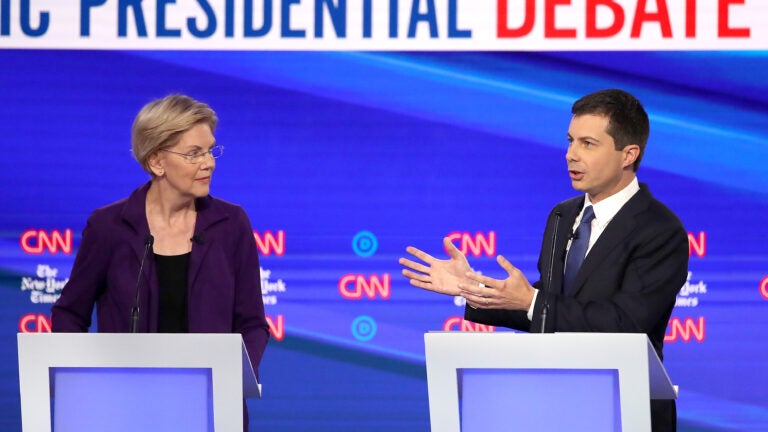
It’s a question that increasingly nags Sen. Elizabeth Warren: Would she raise middle-class taxes to pay for Medicare-for-All?
The Massachusetts senator was asked the question during the last two Democratic primary debates, during multiple campaign trail interviews, and even during an interview with Stephen Colbert. Each time, Warren — who hasn’t released her own health care plan, but supports the proposal by Sen. Bernie Sanders — has answered indirectly, maintaining that “total costs” for middle-class families would go down. The Washington Post recently called it the “question Elizabeth Warren won’t answer.”
So during the fourth Democratic debate Tuesday night, she was pressed on the question again — and not just by the event’s moderators.
“We heard it tonight,” South Bend, Indiana, Mayor Pete Buttigieg, who has called Warren “extremely evasive” on the question, said during the debate, after she gave her standard answer about overall health care costs.
“A yes or no question that didn’t get a yes or no answer,” Buttigieg said. “This is why people here in the Midwest are so frustrated with Washington, in general, and Capitol Hill, in particular. Your signature, Senator, is to have a plan for everything — except this.”
Buttigieg made the case for his health care proposal, “Medicare-for-all-who-want-it,” which would create a government-run health insurance program, but also give individuals the option of keeping their private plans. Warren hit back, arguing that his plan really meant “Medicare-for-all-who-can-afford-it” and that Medicare-for-All is the only way to ensure universal health care coverage. She also expanded on her past answer and pledged not to sign a bill that would result in a net increase in costs for the middle class.
“Costs are going to go up for the wealthy,” Warren said. “They’re going to go up for big corporations. They will not go up for middle-class families, and I will not sign a bill into the law that raises their costs, because costs are what people care about.”
Buttigieg argued that, under his proposal, health care would be “affordable for everyone,” since it would expand federal subsidies so that nobody would pay more than 8.5 percent of their income for a public or private health care plan.
“I don’t understand why you believe the only way to deliver affordable coverage to everybody is to obliterate private plans,” he said to Warren.
Buttigieg, who has recently begun drawing distinctions between himself and Warren, apparently came ready for the clash. Shortly after the exchange, his campaign sent out a press release to reporters claiming that “Elizabeth Warren Just Dodged Questions on Middle Class Taxes Again,” documenting eight previous times the Bay State senator didn’t directly say that Medicare-for-All would raise middle-class taxes.
Several observers speculated on social media Tuesday night that Warren was attempting to avoid providing an easy soundbite for a Republican attack ad in a general election, at the risk of sounding evasive.
For his part, Sanders was willing to go into more detail about the health care cost tradeoffs. As he has previously, the Vermont senator said that in order to provide universal coverage while eliminating premiums, co-payments, and deductibles, his Medicare-for-All legislation would raise middle-class taxes. However, he said the increase would be less than the overall reduction in health care costs. Sanders’s plan is estimated to cost more than $30 trillion over 10 years, but would result in less overall health care spending, since the United States spends disproportionately more on health care than other high-income countries.
“I do think it is appropriate to acknowledge that taxes will go up,” Sanders said. “They’re going to go up significantly for the wealthy. And for virtually everybody, the tax increase they pay will be substantially less than what they were paying for premiums and out-of-pocket expenses.”
“Well, at least that’s a straightforward answer,” Buttigieg remarked.
Minnesota Sen. Amy Klobuchar, another more moderate candidate, chimed in that “at least Bernie is being honest.”
“I’m sorry, Elizabeth, but you have not said that, and I think we owe it to the American people to tell them where we’re going to send the invoice,” Klobuchar said, arguing that Democrats should embrace a public option, as was originally proposed in the Affordable Care Act, rather than automatically kicking 149 million people off their private plans.
“I’m tired of hearing, whenever I say these things, ‘Oh, it’s Republican talking points,'” Klobuchar said, referring to Warren’s well-covered rebuke during the July debates. “You are making Republican talking points right now in this room by coming out for a plan that’s going to do that. I think there is a better way that is bold, that will cover more people, and it’s the one we should get behind.”
Warren noted that she made her pre-politics career studying the causes of bankruptcy, noting that two out of three families that went bankrupt because of a medical issue actually had health insurance.
“You can try to spin this any way you want,’ she said. “I’ve spent my entire life on working on how America’s middle class has been hollowed out and how we fight back. I’ve put out nearly 50 plans on how we can fight back and how we can rebuild an America that works.”
Sanders also jumped in to highlight the need for ambitious health care reform, saying he was “a little bit tired” of people defending a “dysfunctional” system that leaves 87 million individuals uninsured and results in tens of thousands in estimated unnecessary deaths.
“The issue is whether the Democratic Party has the guts to stand up to the health care industry,” Sanders said.
Correction: An earlier version of this article misattributed a quote by Sen. Bernie Sanders to Sen. Elizabeth Warren. It has been updated to correct the mistake.





To comment, please create a screen name in your profile
To comment, please verify your email address
Conversation
This discussion has ended. Please join elsewhere on Boston.com