MBTA fare hikes arrived Monday. So did protesters.
"The costs of delay and inaction continue to fall on families who can least afford alternatives."
MBTA riders may have noticed something different during their commute Monday morning — and not just that it cost more.
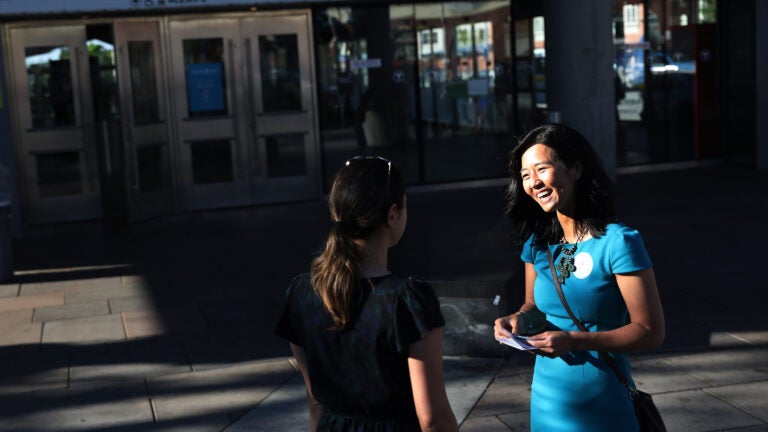
Dozens of local elected officials — joining a coalition of “at least” 350 people, according to organizers — dispersed across the MBTA’s subway and commuter rail stations to protest the first day of 6 percent across-the-board fare hikes, following two recent derailments and persisting delays.
The systemwide canvassing effort, dubbed the Boston T Party, was led by Boston City Councilor Michelle Wu, who has called for making the MBTA fare-free and giving local municipalities a seat on the board that oversees the transit agency.
“Starting today, commuters have to choose between paying more for unreliable MBTA service or sitting in the worst traffic in the country,” Wu said in a statement.
“Our transportation system is in crisis, and the costs of delay and inaction continue to fall on families who can least afford alternatives,” she said. “It’s time to marshal the political will for urgent progress toward a public transit system that serves everyone.”
During the rush-hour commute Monday morning, Wu met with riders at the MBTA’s Ashmont, JFK/UMass, and Park Street stations. And she was hardly alone.
With @wutrain to oppose #UnfairHikes. The majority of D4 residents rely on @MBTA, esp. the Red Line, and it is unacceptable to raise fares when our trains are still severely delayed. Grab a sticker and join us! pic.twitter.com/2PBtbrVH1I
— Andrea J. Campbell (@AJCampbellMA) July 1, 2019
Wu was joined by City Council President Andrea Campbell at Ashmont station. Fellow City Councilor Ed Flynn met with riders at the Red Line’s Broadway station. Councilor Lydia Edwards was at the Blue Line’s Maverick station in East Boston. Councilor Kim Janey’s team worked the Orange Line’s Ruggles station. More than a dozen Boston City Council candidates turned out across Red, Green, and Orange line and commuter rail stations.
According to Wu’s team, every MBTA rapid transit station in the Boston area was covered by a volunteer, activist, or local leader. And from Salem to Andover to Worcester, state and municipal lawmakers were present at various commuter rail stations.
Cassie Moreno, a spokeswoman for Wu, told Boston.com in an email Monday afternoon that they handed out more than 15,000 physical flyers and stickers, in addition to the material that was distributed digitally.
Rep. Ayanna Pressley, who sent staff members to canvass at Shawmut and other stations, said in a statement Monday that it was “unconscionable” that her 7th District constituents were faced with an “impossible decision” between rising fares and, according to some measurements, the country’s worst rush-hour traffic.
The #ATeam is out at stations throughout the district protesting these #UnfairHikes. We are organizing and mobilizing to develop solutions and create an affordable, inclusive, sustainable public transit system. #mapoli #MA7 pic.twitter.com/GFOkZaW4CF
— Congresswoman Ayanna Pressley (@RepPressley) July 1, 2019
While the respective mayors of Cambridge and Somerville also took part in the day of action, one person who did not participate in person Monday was Boston Mayor Marty Walsh, who has been at odds with Wu over her proposal for residential parking fees.
However, in a tweet early Monday morning, Walsh echoed Wu’s calls for local residents to have a say in how the MBTA is governed.
“Boston needs a seat on the Board to fight for Boston residents to finally have public transit that gets them where they need to go, when they need to get there — a service that they are already paying for & that they deserve,” he wrote.
Boston needs a seat on the Board to fight for Boston residents to finally have public transit that gets them where they need to go, when they need to get there — a service that they are already paying for & that they deserve. – MJW
— Mayor Marty Walsh (@marty_walsh) July 1, 2019
Following last month’s Red Line derailment, Walsh tweeted that the new fare increases should be delayed until after the damage from the incident is completed fixed. MBTA officials say that, due the the derailment, full Red Line service won’t be restored until at least Labor Day.
Even with the fare hikes, the new cost of riding the MBTA ride is about in line with the price of transit systems in other big American cities. Still, opponents say the increases are regressive — hurting lower-income residents more — and unfair to those who rely on public transit.
Last week, Gov. Charlie Baker announced his administration would seek a one-time $50 million investment to accelerate planned improvements to the MBTA’s infrastructure. During a rally Sunday at Park Street station, Wu criticized the administration for lacking “leadership and vision at the top and accountability to those most impacted.”
“We are going to show what a Boston tea party looks like in 2019,” Wu said. “We’re not dumping the T; we’re digging in to make our voices heard to Governor Charles.”