3 things to know if you missed the final mayoral debate between Marty Walsh and Tito Jackson
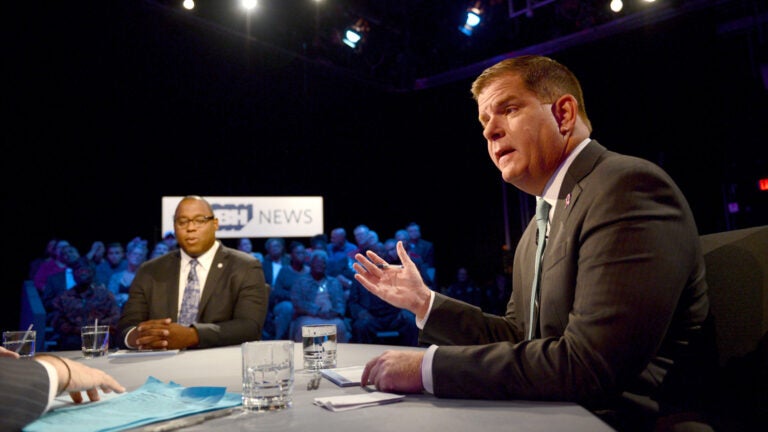
Two weeks before voters decide if he will get a second term, Boston Mayor Marty Walsh defended his record against criticism from challenger, City Councilor Tito Jackson, in what was the final debate of the campaign Tuesday night.
Hosted by WGBH, the debate was often contentious as the two Democrats presented starkly different views of the last four years in Boston and, at times, questioned each other’s facts.
Here’s what you need to know if you missed the hourlong event.
https://www.facebook.com/wgbhnews/videos/10155784767089609/
How to tackle affordable housing
According to a recent WGBH poll, the cost of housing was by far the most important issue identified by likely voters in Boston, which is in the midst of a historic development boom.
Walsh, whose administration has worked to encourage more relatively low-cost housing, said the issue of affordability was a “supply issue.” The mayor said the city permitted 22,000 of a planned 53,000 new housing units, almost 9,000 of which were low- or moderate-income housing.
But he admitted there is “more work to do” and said the city should focus on creating economic opportunities.
“This has to be a city for all people; it can’t be a city for a few people,” Walsh said.
Jackson said he had a different definition of affordable than the mayor.
“We know that affordable generally means in Boston $70,000 to $120,000 for families of four,” he said. “What we know in Boston though is that 50 percent of people make $35,000 or less. So the housing that Mayor Walsh is building that he says is affordable is not affordable for the people who actually need it.”
Jackson said he would dismantle the recently rebranded Boston Redevelopment Authority to create a “people-centric” city planning agency and would consider some sort of rent control, something Walsh said wouldn’t work in Boston.
Jackson said he would also raise Boston’s 18 percent inclusionary housing policy to 25 percent and create vouchers to help people from being priced out of neighborhoods.
On race
Jackson was pressed on his comments during the last debate that Walsh didn’t believe that “black lives matter” in his criticism of the mayor’s handling of last year’s controversy at Boston Latin School.
“You actually think that Marty Walsh doesn’t believe black lives matter?” asked moderator Jim Braude.
Sidestepping the question, Jackson said it was about Walsh’s “actions,” and called the mayor insensitive for dismissing a recent scathing report on his administration issued by the NAACP. The councilor also pointed to gaping racial gaps when it comes to wealth, life expectancy, and school achievement, noting how some public schools had seen their budgets cut.
“He’s making the wrong decisions,” Jackson said.
Overall, Walsh’s administration has increased the budget of Boston Public Schools by $154 million.
#WGBHDebate recap: @titojackson and @marty_walsh discuss race and diversity in Boston. Watch the full debate: https://t.co/yYKbFPszn2 pic.twitter.com/r6lLX62mXG
— GBH News (@GBHNews) October 25, 2017
Walsh said Tuesday it’s unfair to pin larger issues on race on him alone and claimed to have made gains in hiring at City Hall and in the education system, as well as having closed the achievement gap. He also touted last year’s town hall on race relations.
“I won’t deny there are definitely issues we have to deal with. … We’re talking about generational issues here that no one has ever tackled,” Walsh said. “My administration is tackling these issues.”
Bidding for Amazon
On the subject of Boston’s recent bid for Amazon’s second headquarters, Jackson accused Walsh of prioritizing flash over the everyday needs of local residents.
“We have a mayor who fast-tracks bids for Amazon, Olympics, Grand Prix, but he slowtracks changes to education and fully funding Boston Public Schools,” he said.
Jackson said he wouldn’t offer incentives to get the Seattle-based commerce giant to locate their planned 50,000-job headquarters in Boston and that the $25 million in tax incentives for GE’s headquarters was too much.
“Amazon should want to come here. They should want to come to the City of Boston,” he said.
#WGBHDebate recap: @titojackson feels that in Boston, corporations often come before schools. Watch the full debate: https://t.co/7uyikNJ4Bz pic.twitter.com/CCnUEbrAIr
— GBH News (@GBHNews) October 25, 2017
Walsh countered that the city “didn’t write a check” to GE, which he called a “tremendous opportunity” for Boston, and that they wouldn’t “give the store away” for Amazon.
Unlike New Jersey or Worcester, Walsh noted that the city’s bid offered no incentives upfront and that they would negotiate potential incentives if they get to the “next round.”