Paul Lepage says Charlie Baker is ‘not doing what he needs to do’
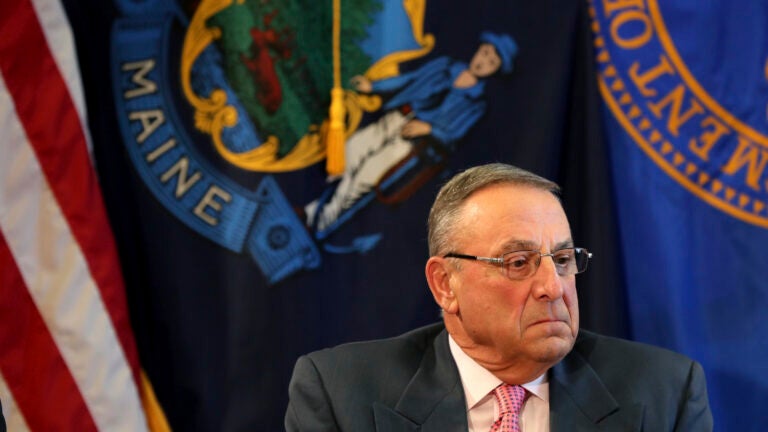
It’s not the first time Maine Gov. Paul LePage has taken a swipe at Massachusetts.
In an interview with The Boston Globe during a charity golf tournament Monday in Maine, the Republican governor critiqued his more moderate counterpart in the Bay State.
“I think Charlie Baker’s a nice man,” he told Globe columnist Thomas Farragher in a piece publish Thursday.
“But he wants to get reelected in a tough state,” LePage continued. “He’s not doing what he needs to do. Charlie Baker’s governing to the newspapers instead of governing for good policy.’’
LePage did not specify what policies he was referring to, and his office did not immediately respond to requests for clarification Thursday.
The two governors do however provide a stark contrast in their approach to governing. While Baker was enjoyed a relatively cooperative relationship with the heavily Democratic Massachusetts legislature, LePage has taken a notably more combative approach with his own state’s lawmakers.
In 2016, Baker criticized LePage’s racially-charged characterization of out-of-state drug dealers. Later that year, the Maine governor listed Lawrence and Lowell among the cities he said were responsible for his state’s opioid crisis. Asked about LePage’s comments at the time, Baker told reporters the “pervasive” epidemic “knows no neighborhood,” race, or class, but avoided directly criticizing his fellow governor.
In the interview this week, LePage doubled down on his recent criticism of reporters and stood by his claim that more than 90 percent of out-of-state heroin dealers are black or Hispanic.
“They attacked me for just telling the truth.,” he told Farragher. “I mean I kept track of every drug dealer who came into the state. It’s not my fault that 93 percent of them are one color. It’s not my fault. That’s the facts.’’
Last September, following numerous public records requests, media outlets obtained the binder LePage said he uses to back up his claim about the race of the state’s drug dealers. According to the Portland Press Herald, less than half appeared to be black or Hispanic.