Here’s how James Comey described his tense one-on-one dinner with Donald Trump
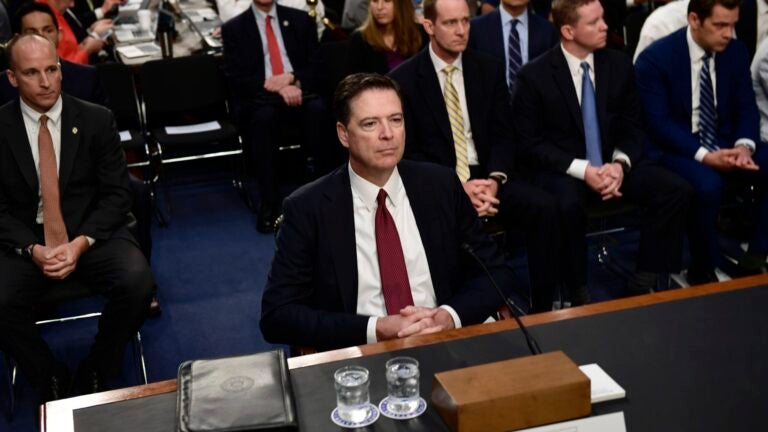
In a much-anticipated Senate hearing Thursday, former FBI Director James Comey elaborated on what happened during the private dinner he had with President Donald Trump in January, during which the president allegedly pressured him for loyalty.
Comey: My common sense told me Trump was looking to get something in exchange for granting my request to stay https://t.co/CMq1H2eST8
— CNN Politics (@CNNPolitics) June 8, 2017
Comey said Trump began asking about his position at the FBI. Comey said he thought this was unusual, since the president had previously and repeatedly expressed that he hoped Comey would stay on the job.
“My common sense told me that what was going on is — either he had concluded or someone had told him — that ‘You already asked Comey to stay, and you didn’t get anything for it,’ and the dinner was an effort to build a relationship — in fact, he asked specifically — of loyalty in the context of asking me to stay,” Comey said Thursday.
Trump has reportedly denied calling for Comey’s loyalty. But Comey’s seven-page written testimony told a different story.
“I need loyalty, I expect loyalty,” the president said during the dinner, according to Comey.
“I didn’t move, speak, or change my facial expression in any way during the awkward silence that followed,” Comey said in his written testimony. “We simply looked at each other in silence.”
Comey said Trump repeatedly pressed him for assurances of loyalty during the dinner. They eventually agreed, awkwardly, that the president would receive his “honest loyalty.”
Comey’s account of the dinner appeared to corroborate a New York Times account that was published shortly after he was fired in May. The story reported the former FBI director believed the meeting was a “harbinger of his downfall.” Trump later said he was thinking of “this Russia thing with Trump” when he decided to dismiss Comey.
Read Comey’s full description of the dinner below, as prepared for delivery in his written testimony:
The President and I had dinner on Friday, January 27 at 6:30 pm in the Green Room at the White House. He had called me at lunchtime that day and invited me to dinner that night, saying he was going to invite my whole family, but decided to have just me this time, with the whole family coming the next time. It was unclear from the conversation who else would be at the dinner, although I
assumed there would be others.It turned out to be just the two of us, seated at a small oval table in the center of the Green Room. Two Navy stewards waited on us, only entering the room to serve food and drinks.
The President began by asking me whether I wanted to stay on as FBI Director, which I found strange because he had already told me twice in earlier conversations that he hoped I would stay, and I had assured him that I intended to. He said that lots of people wanted my job and, given the abuse I had taken during the previous year, he would understand if I wanted to walk away.
My instincts told me that the one-on-one setting, and the pretense that this was our first discussion about my position, meant the dinner was, at least in part, an effort to have me ask for my job and create some sort of patronage relationship. That concerned me greatly, given the FBI’s traditionally independent status in the executive branch.
I replied that I loved my work and intended to stay and serve out my ten-year term as Director. And then, because the set-up made me uneasy, I added that I was not “reliable” in the way politicians use that word, but he could always count on me to tell him the truth. I added that I was not on anybody’s side politically and could not be counted on in the traditional political sense, a stance I said was in
his best interest as the President.A few moments later, the President said, “I need loyalty, I expect loyalty.” I didn’t move, speak, or change my facial expression in any way during the awkward silence that followed. We simply looked at each other in silence. The conversation then moved on, but he returned to the subject near the end of our dinner.
At one point, I explained why it was so important that the FBI and the Department of Justice be independent of the White House. I said it was a paradox: Throughout history, some Presidents have decided that because “problems” come from Justice, they should try to hold the Department close. But blurring those boundaries ultimately makes the problems worse by undermining public trust in
the institutions and their work.Near the end of our dinner, the President returned to the subject of my job, saying he was very glad I wanted to stay, adding that he had heard great things about me from Jim Mattis, Jeff Sessions, and many others. He then said, “I need loyalty.” I replied, “You will always get honesty from me.” He paused and then said, “That’s what I want, honest loyalty.” I paused, and then said, “You will get
that from me.” As I wrote in the memo I created immediately after the dinner, it is possible we understood the phrase “honest loyalty” differently, but I decided it wouldn’t be productive to push it further. The term – honest loyalty – had helped end a very awkward conversation and my explanations had made clear what he should expect.During the dinner, the President returned to the salacious material I had briefed him about on January 6, and, as he had done previously, expressed his disgust for the allegations and strongly denied them. He said he was considering ordering me to investigate the alleged incident to prove it didn’t happen. I replied that he should give that careful thought because it might create a narrative that we were investigating him personally, which we weren’t, and because it was very difficult to prove a negative. He said he would think about it and asked me to think about it.
As was my practice for conversations with President Trump, I wrote a detailed memo about the dinner immediately afterwards and shared it with the senior leadership team of the FBI.
Read Comey’s full written testimony here.
Later during the hearing Thursday, Comey said that Trump initiated the meeting and that he had to cancel a date with wife.
https://twitter.com/cspan/status/872844782569218048