Senators propose giving states option to keep Affordable Care Act
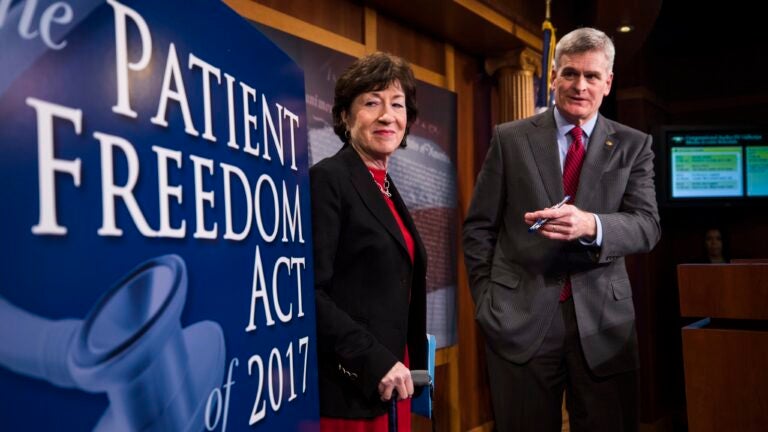
WASHINGTON — Several Republican senators on Monday proposed a partial replacement for the Affordable Care Act that would allow states to continue operating under the law if they choose, a proposal meant to appeal to critics and supporters of former President Barack Obama’s signature health law.
Under the proposal, by Sens. Bill Cassidy of Louisiana, a medical doctor, and Susan Collins of Maine, a moderate Republican, states could stay with the Affordable Care Act or they could receive a similar amount of federal money, which consumers could use to pay for medical care and health insurance.
“We are moving the locus of repeal to state government,” Cassidy said. “States should have the right to choose.”
The proposal shares some features with House Republican proposals: It would encourage greater use of health savings accounts and eliminate the requirement for most Americans to have insurance or pay a tax penalty. But its option to keep the Affordable Care Act alive in many states will rankle the most conservative Republicans who have been trying for nearly seven years to blow up the law.
“Obamacare is flawed, failing and not fixable, and it needs to be fully repealed,” said Rep. Mark Meadows of North Carolina, the chairman of the House Freedom Caucus.
If anything, the Cassidy-Collins bill may serve to show how difficult it will be for Republicans to pass a bill to replace the Affordable Care Act. Legislation that can pass muster in the more conservative House may not win over enough Republicans in the Senate. A bill with broad appeal in the Senate may fail in the House.
A stalemate would leave in place Obama’s health law, but efforts by President Donald Trump and Congress to undermine the law could send the existing health system into a tailspin. On Friday, as one of his first official acts, Trump signed an executive order designed to ease up on the mandate requiring most Americans to buy insurance.
Under the Collins-Cassidy bill, states could enroll people who would otherwise be uninsured in health plans providing basic coverage. These high-deductible health plans are intended to protect consumers against catastrophic medical expenses. They would cover generic versions of prescription drugs, and they would also have to cover recommended childhood immunizations without co-payments. States would contract with one or more insurers to offer this coverage.
“People could be automatically enrolled,” Cassidy said in an interview. “A state could say, ‘All those eligible are enrolled unless they choose not to be.’”
This “passive enrollment” would provide insurers with a large pool of customers, including many healthy people, without the coercion of the “individual mandate,” Cassidy said.
“We could cover more people than Obamacare,” Cassidy said, although he acknowledged that the effects of his bill had not been analyzed by the Congressional Budget Office, which serves as Capitol Hill’s official scorekeeper.
If a state opts out of the Affordable Care Act, many of the federal insurance standards established under the law would no longer apply. But parents would still be allowed to keep children on their insurance until the age of 26, and insurers could not impose annual or lifetime limits on benefits.
The Cassidy-Collins bill, called the Patient Freedom Act, would eliminate not only the unpopular individual mandate, but also the federal requirement for larger employers to offer coverage to full-time employees.
Cassidy said that Sens. Johnny Isakson of Georgia and Shelley Moore Capito of West Virginia, both Republicans, were also sponsors of the bill.
The Senate majority leader, Mitch McConnell, R-Ky., and the No. 2 Senate Republican, John Cornyn of Texas, were sponsors of a similar bill that Cassidy introduced in 2015. But the legislative landscape is different now. Republicans in Congress can repeal the Affordable Care Act, with support from Trump. In the Senate, they will need help from Democrats to adopt a replacement because Republicans are eight votes shy of the 60 needed to shut off a filibuster.
Democrats say they are willing to work with Trump on changes to the 2010 health law. “If he says he won’t repeal, we will work with him to improve it,” said the Senate Democratic leader, Chuck Schumer of New York. “But if he says repeal, we will fight it tooth and nail.”
Rep. Diana DeGette, D-Colo., made a similar point. “I say to my Republican friends, ‘We are happy to help you fix the Affordable Care Act,’” DeGette said. “But if you repeal it without working with us, it’s nuclear war.”