
Read highlights from the most famous inaugural addresses
"Ask not what your country can do for you—ask what you can do for your country."
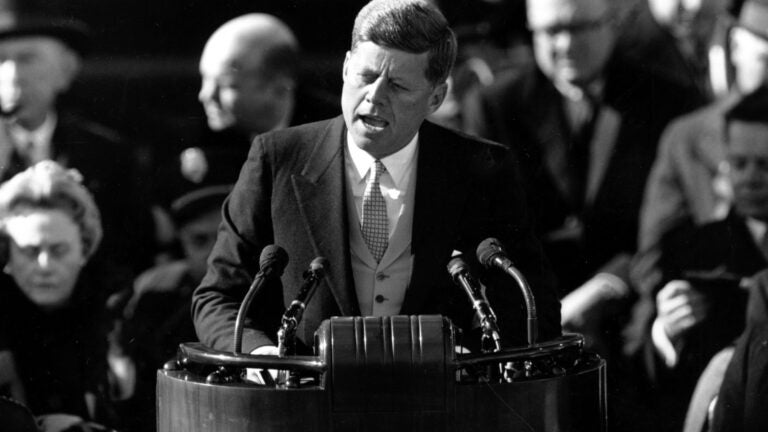
Crafting a memorable inaugural address is no simple feat, according to inaugural historian Jim Bendat.
Most inaugural addresses echo similar themes, such as national unity, and cover well-trodden topics, including the founding fathers and the Constitution.
“Most inaugural addresses do not stand out at all and do not withstand the test of time,” said Bendat, author of the book Democracy’s Big Day: The Inauguration of Our President 1789-2013.
So what’s the secret to a truly great inaugural address? Bendat says it’s in the words themselves–speeches with powerful phrases tend to be the most memorable.
Here are excerpts from five of the most famous presidential inaugural addresses:
Thomas Jefferson, 1801
Thomas Jefferson’s inauguration marked the first change of power in Washington. The previous two presidents, George Washington and John Adams, were Federalists, and Jefferson was a candidate from the Democratic-Republican Party. Jefferson aimed to unify the country in a time where party politics first came into play, Bendat said. This became the central theme of his inaugural address, but one sentence in particular made a lasting impression on the American people:
“We are all Republicans, we are all Federalists.”
Abraham Lincoln, 1865
Lincoln took office for the second time just as the Civil War, the nation’s bloodiest conflict with a death toll of approximately 130,000, was coming to an end. At around 700 words, Lincoln’s second inaugural address was one of the shortest. But his words were among the most iconic ones uttered by any incoming president in history.
“With malice toward none, with charity for all, with firmness in the right as God gives us to see the right, let us strive on to finish the work we are in, to bind up the nation’s wounds, to care for him who shall have borne the battle and for his widow and his orphan, to do all which may achieve and cherish a just and lasting peace among ourselves and with all nations.”

Abraham Lincoln taking the oath of office, as shown from an old print.
Franklin D. Roosevelt, 1933
When Roosevelt entered office, the United States was in the midst of the Great Depression, and he was tasked with reassuring a nation crippled with uncertainty.
“Everyone was very fearful that things were already bad and that things were going to become even worse,” Bendat said.
In doing so, he uttered what would become one of the most well-known lines from a presidential inaugural address:
“First of all, let me assert my firm belief that the only thing we have to fear is fear itself, nameless, unreasoning, unjustified terror which paralyzes needed efforts to convert retreat into advance.”
John F. Kennedy, 1961
Kennedy defeated Richard Nixon in 1960 to become the United States’ first Catholic president. Often lauded as a groundbreaking orator, there were many powerful phrases in Kennedy’s inaugural address, Bendat noted. One in particular, though, would become the most-quoted statement of Kennedy’s short but significant presidency.
“And so, my fellow Americans: ask not what your country can do for you–ask what you can do for your country. My fellow citizens of the world: ask not what America will do for you, but what together we can do for the freedom of man.”
Ronald Reagan, 1981
Reagan was elected amid economic troubles that left many Americans feeling apprehensive about the future. As such, he tried to evoke a sense of optimism and promote national unity in his inaugural address.
“Great leaders unify. They don’t divide,” Steven Jarding, lecturer of public policy at Harvard University, said about Reagan’s inauguration speech:
“In this present crisis, government is not the solution to our problem; government is the problem. From time to time we’ve been tempted to believe that society has become too complex to be managed by self-rule, that government by an elite group is superior to government for, by, and of the people. Well, if no one among us is capable of governing himself, then who among us has the capacity to govern someone else? All of us together, in and out of government, must bear the burden. The solutions we seek must be equitable, with no one group singled out to pay a higher price.”



To comment, please create a screen name in your profile
To comment, please verify your email address
Conversation
This discussion has ended. Please join elsewhere on Boston.com