David Petraeus visits Trump, emerging as candidate for the State Department
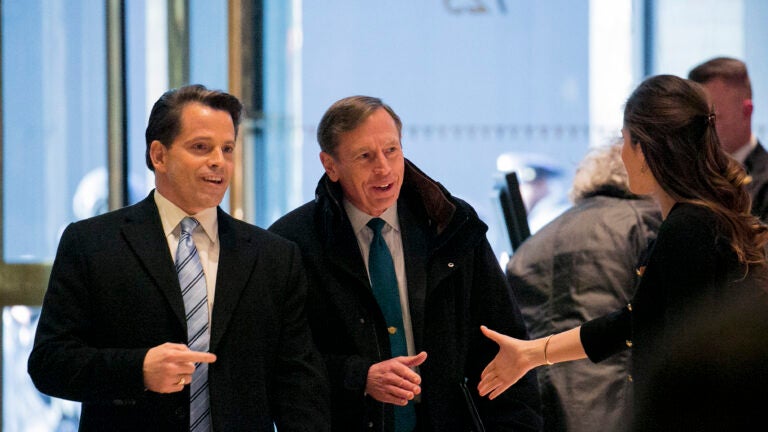
WASHINGTON — President-elect Donald Trump met on Monday with David H. Petraeus, the highly decorated but scandal-scarred former military commander, who has emerged as a new contender for secretary of state after days of bitter internal feuding over who will get the coveted post.
Petraeus, a retired general and former CIA director, spent an hour with Trump at his offices in Trump Tower in Manhattan and told reporters afterward that the president-elect had given him a tutorial on world affairs.
“He basically walked us around the world,” Petraeus said. “Showed a great grasp of a variety of the challenges that are out there and some of the opportunities as well. Very good conversation, and we’ll see where it goes from here.” In a Twitter post 15 minutes later, Trump said, “Just met with Gen. Petraeus — was very impressed!”
Just met with General Petraeus–was very impressed!
— Donald J. Trump (@realDonaldTrump) November 28, 2016
Also on Monday, a transition team official said that Trump had selected Rep. Tom Price, an orthopedic surgeon and six-term Republican congressman from Georgia who has led opposition to the Affordable Care Act, to be secretary of health and human services.
Trump spent the day in back-to-back meetings after a quiet Thanksgiving weekend at his Mar-a-Lago estate in Palm Beach, Florida. In addition to seeing Petraeus, he met with Frances Fragos Townsend, a homeland security official in the Bush administration, and with David A. Clarke Jr., the tough-talking Milwaukee County sheriff. Both are candidates for secretary of homeland security.
As he was leaving Trump Tower on Monday, Vice President-elect Mike Pence said, “There will be a number of very important announcements tomorrow.”
Trump has already conferred with the other two leading candidates for the State Department post: Mitt Romney, the former Massachusetts governor and 2012 Republican presidential nominee, and Rudolph Giuliani, a former New York City mayor. He was scheduled to meet Romney again for dinner on Tuesday.
But Trump’s deliberations have become bogged down, with people in his camp deeply divided over whether he should choose Giuliani, a steadfast loyalist with a record of problematic business dealings, or Romney, an establishment figure who denounced him during the campaign and has been publicly opposed by some of Trump’s closest advisers.
Petraeus, 64, has his own black mark: He was prosecuted for mishandling classified material in a scandal stemming from an extramarital affair with his biographer. During the relationship, he turned over his confidential diary to the biographer, Paula Broadwell, leading the FBI to recommend that he be charged with a felony. He pleaded guilty to a misdemeanor.
If he is nominated, that could raise hurdles for Petraeus with Democrats and even some Republicans at his Senate confirmation hearing. It could also prompt the intelligence agencies to recommend against giving him a security clearance, though legal experts said the president could override that.
At a minimum, it would open Trump to charges of hypocrisy. He made Hillary Clinton’s handling of classified information, through her use of a private email address and computer server, the centerpiece of his attacks on her character and trustworthiness. The director of the FBI, James B. Comey, has said that Petraeus’ transgressions were more serious than Clinton’s.
“The Petraeus case was a classic security breach that rightly resulted in criminal action,” said Richard W. Painter, the chief White House ethics lawyer from 2005 to 2007. “It just reeks of hypocrisy.”
Steven Aftergood, who directs the project on government secrecy at the Federation of American Scientists, said, “It suggests that much of the campaign hoopla directed against Hillary Clinton by Mr. Trump was manufactured, and not sincere.” But he added: “I don’t think it’s a fatal flaw. One could imagine more problematic candidates.”
Ethics officials who worked in the Obama administration agreed. Norman L. Eisen, who served as President Barack Obama’s ethics counsel during his transition and at the White House, said he believed that Petraeus had paid a price for his misdeeds and deserved a second chance.
“I do believe that at the career level, there would be reservations,” Eisen said. “But at the policymaker level, there will be a judgment that if the president deems it worthy, he should get the clearances he needs. My own judgment, for what it’s worth, is that I would support it.”
Petraeus, whose friends said he was eager for the job, would bring obvious qualifications to the State Department. He is a politically astute military commander with experience in Iraq and Afghanistan, two conflicts that will immediately confront the new president, as well as a Ph.D. in international relations from Princeton. His CIA experience gave him broad exposure to America’s clandestine operations.
Gen. Jack Keane, a former Army vice chief of staff, said he had recommended Petraeus to Trump in a meeting two weeks ago, when Trump was sounding Keane out for the job of defense secretary. Keane was a mentor to Petraeus, and saved his life in 1991 when Petraeus was shot accidentally during a live-fire exercise.
“He has an extraordinary portfolio, having run two theaters of war and directed the Central Intelligence Agency,” Keane said. “That level of experience would be invaluable to the president, given the fact that he is a strategic thinker, is well-versed on the issues of the day, and has an amazing network of heads of state and foreign and defense ministers.”
Petraeus was a central player in the George W. Bush and Obama administrations, winning renown for his leadership of the troop surge in Iraq and helping persuade Obama to pursue a similar counterinsurgency strategy, with more mixed results, in Afghanistan.
He would bring a worldview to the job of secretary of state that is more in line with the thinking of its current occupant, John Kerry, than with Trump’s. While Trump says the United States has spent trillions in the Middle East and gotten a “disaster” in return, Petraeus has argued that the investment in Iraq is finally paying off, though the future remains uncertain. He has advocated continued engagement in the region, warning that after the Islamic State is gone, another extremist group will replace it.
Petraeus is still frequently cited for his work as the editor of “The U.S. Army/Marine Corps Counterinsurgency Field Manual,” which laid out the troop-intensive strategy used by Bush in Iraq and Obama in Afghanistan. During the presidential campaign, Trump opposed such intensive American engagement and said the United States should stop nation-building overseas.
After taking direct command of the war in Afghanistan in 2010, Petraeus retired from the military and returned to Washington to head the CIA. In that role, he pushed — along with Clinton, then secretary of state — to supply weapons to moderate rebels in Syria.
He cultivated close ties with Clinton and might well have turned up on lists of her potential Cabinet picks had she won the election — a factor that might hinder him with some in Trump’s circle.
Because he was one of the few military officers of his generation to rise to national celebrity, there was even speculation that Petraeus might someday run for the White House himself.
Since leaving the government, Petraeus has worked for a New York investment firm, Kohlberg Kravis Roberts & Co., and held an array of fellowships and teaching appointments around the country.
__
David E. Sanger contributed reporting from Washington and Maggie Haberman from New York.