Officials fight Donald Trump’s claims of a rigged vote
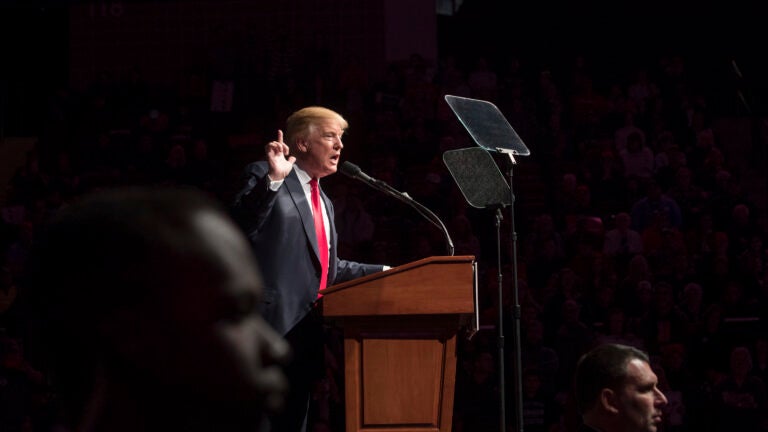
WASHINGTON — Republican leaders and election officials from both parties on Sunday sought to combat claims by Donald Trump that the election is rigged against him, amid signs that Trump’s contention is eroding confidence in the vote and setting off talk of rebellion among his supporters.
In a vivid illustration of how Trump is shattering American political norms, the Republican nominee is alleging that a conspiracy is underway between the media and the Democratic Party to commit vast election fraud. He has offered no evidence to support his claim.
“The election is absolutely being rigged by the dishonest and distorted media pushing Crooked Hillary — but also at many polling places — SAD,” Trump wrote on Twitter on Sunday.
Trump made the incendiary assertion hours after his running mate, Gov. Mike Pence of Indiana, tried to play down Trump’s questioning of the fairness of the election. Pence said on NBC’s “Meet the Press” that he and Trump “will absolutely accept the result of the election.”
Trump’s words, though, appear to be having an effect on his supporters, and are setting off deep concern among civil rights groups. According to an Associated Press poll last month, only one-third of Republicans said they had a great deal of confidence that their votes would be counted fairly. And election officials are worried that Trump’s continued pressing of the issue could dampen turnout or cause his supporters to deny the legitimacy of the results if he loses.
Last week, Trump called the presidential election “one big fix” and “one big ugly lie.”
Jon A. Husted, secretary of state of Ohio, said it was “wrong and engaging in irresponsible rhetoric” for any candidate to question the integrity of elections without evidence. Husted, a Republican, said he would have no reason to hesitate to certify the results of the election
“We have made it easy to vote and hard to cheat,” Husted said Sunday in an interview. “We are going to run a good, clean election in Ohio, like we always do.”
American elections are, unlike those in many democracies, largely decentralized, rendering the possibility of large-scale fraud extraordinarily unlikely. Further, the balloting in many of the hardest fought states will be overseen by Republican officials, individuals who would be highly unlikely to consent to helping Clinton rig the vote.
Chris Ashby, a Republican election lawyer, said Trump’s attacks on the electoral process were unprecedented and risked creating a fiasco on Election Day. Ashby also said Trump was “destabilizing” the election by encouraging his supporters to deputize themselves as amateur poll monitors, outside the bounds of the law.
“That’s going to create a disturbance and, played out in polling places across the country, it has the potential to destabilize the election,” Ashby said, “which is very, very dangerous.”
Trump’s claims, a little more than three weeks before the election, are once again forcing elected Republicans into a difficult spot as they try to balance offering assurances of the integrity of the election while not undercutting a standard-bearer many of their voters fervently support.
“Our secretary of state, Ken Detzner, has been very focused on making sure we have a smooth election,” said Jackie Shutz, a spokeswoman for Gov. Rick Scott of Florida, noting that Scott’s “goal is 100 percent participation and zero percent fraud.”
Representatives of other Republican governors offered only a terse “yes” when asked if their state’s balloting would be conducted fairly.
Yet other Republicans are appalled at Trump’s claims of widespread fraud, which are now a staple of his stump speech.
“It is so irresponsible because what he’s doing really goes to the heart of our democracy,” said Trey Grayson, a Republican and former secretary of state of Kentucky. “What is great about America is that we change our leaders at the ballot box, not by bullets,” Grayson said.
Still, some of Trump’s loyal backers are rousing one another with talk of insurrection should Trump be defeated.
In Wisconsin, David Clarke Jr., the sheriff of Milwaukee County, posted on Twitter on Saturday that it was “pitchforks and torches time,” along with a photograph of an angry mob wielding weapons. Clarke addressed the Republican National Convention in July and appears regularly on television as a Trump campaign surrogate.
Also, elements of Trump’s crowds have turned violent. At a rally in North Carolina on Friday, in which he alleged a large-scale conspiracy against him, one supporter lashed out physically at a protester in the crowd. And a CBS affiliate in Virginia reported over the weekend that pro-Trump demonstrators had flashed firearms outside the office of a Democratic congressional candidate near Charlottesville, in a threatening signal.
Republicans are also facing signs of menace: A party office in North Carolina was set on fire and spray-painted over the weekend, an act Trump wrote on Twitter was the act of “animals representing Hillary Clinton and Dems in North Carolina.”
Still, Trump’s campaign surrogates have not hesitated to join him in questioning the fairness of the electoral process: Newt Gingrich, a former speaker of the House, and Rudolph Giuliani, a former mayor of New York, both advisers to Trump, used TV interviews on Sunday to suggest that Democrats tend to cheat in elections, accusing them of counting votes from dead people.
And Sen. Jeff Sessions of Alabama, Trump’s closest congressional supporter and a member of the Senate Judiciary Committee, has warned that “they are attempting to rig this election.”
Civil rights groups have begun to express alarm at remarks from Trump that they see as goading his supporters to intimidate minorities at the polls.
Arturo Vargas, executive director of the National Association of Latino Elected Officials Education Fund, said he planned to formally contact the Justice Department as soon as this week, to ask that it guard against the kind of voting disruptions Trump has encouraged.
“It is a major concern that we have this candidate promoting vigilante poll watching,” Vargas said.
And Michael Podhorzer, political director of the AFL-CIO, said progressive groups were deeply concerned about the possibility of disruptions at the polls on Election Day. Podhorzer said Trump’s recent comments about a rigged election had the potential to “incite violence and bloodshed.”
Podhorzer said Democrats would be closely monitoring polling places for signs of interference in states where voters can cast their ballots before Election Day.
“We will start to see whether folks are out intimidating voters in predominantly African-American communities, and at least get a sense of what direction that might be going in,” Podhorzer said, adding of Trump’s speech, “This is beyond the pale.”
Other Democrats were just as bothered, but also amused about the unlikely prospect of a vast fraud plot unfolding at thousands of disparate polling places. “He’s fine with the system when he wins the primary, but now he’s pre-emptively claiming precinct-level fraud?” said Lt. Gov. Gavin Newsom of California, calling Trump’s language “unambiguously racist, but also absurd, ludicrous, and pathetic.”
Even House Speaker Paul Ryan, who just last week all but removed himself from the presidential campaign, was forced to issue a statement. “Our democracy relies on confidence in election results, and the speaker is fully confident the states will carry out this election with integrity,” said Ryan’s spokeswoman, AshLee Strong.
Pence is trying to walk a fine line. The governor, in a series of Sunday television interviews, sought to portray Trump’s criticism of the electoral process as relating entirely to what he described as unfair media coverage.