
Civil rights advocates have problems with Sen. Susan Collins’s ‘compromise’ gun bill
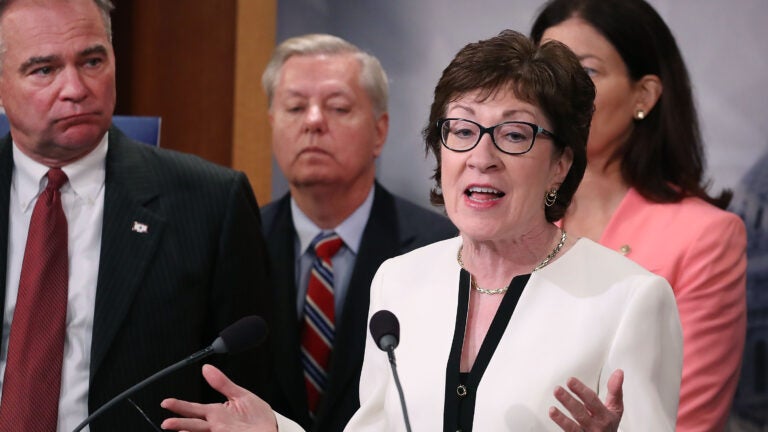
An effort being led by Sen. Susan Collins to prevent suspected terrorists from buying firearms is getting push-back from a surprising direction, considering the conventional politics of gun control.
Civil rights advocates say the Maine Republican’s proposal to ban people on the no-fly list and selectee list from buying firearms raises “even more serious problems” than previous proposals to keep suspected terrorists from purchasing guns.
The American Civil Liberties Union sent a letter to senators Wednesday urging them to vote against the bill, which they say uses watch lists that are error-prone and unfairly target American Muslims, without “basic due process protections.”
Based on previous studies, ACLU leaders wrote that though they believe guns should be subject to “reasonable” regulation, Collins’s legislation raises more serious civil liberties concerns.
The Collins Amendment would further entrench a watchlist system that is rife with problems. As we have long cautioned, our nation’s watchlisting system is error-prone and unreliable because it uses vague and overbroad criteria and secret evidence to place individuals on blacklists without a meaningful process to correct government error and clear their names.
For example, the late Sen. Ted Kennedy was famously stopped from getting on planes because he was mistakenly on the selectee list, prompting the Massachusetts Democrat to speak out against such terror watch lists. In fact, Rep. John Lewis, who led House Democrats’ sit-in for gun policy action, was stopped 35 to 40 times at airports within one year in the early 2000s, because the legendary civil rights activist was himself on the no-fly list.
Republican Rep. Justin Amash, a libertarian-leaning Michigan congressman who introduced legislation in 2014 to get rid of no-fly lists, tweeted Wednesday night that Democrats want to replace “due process with secret lists.”
My mom grew up under an authoritarian regime in Syria that used secret lists to deny rights. Shameful that some in Congress demand same.
— Justin Amash (@justinamash) June 23, 2016
The ACLU also wrote that Collins’s legislation would deny constitutional rights to due process, because of the secretive nature of the watch lists.
The Collins Amendment vests jurisdiction in federal courts of appeal, but only to hear claims based on a largely secret and one-sided administrative record to which a petitioner would not meaningfully be able to respond.
Finally, their letter raised the concern that the look-back provision in the Collins proposal, which would notify authorities if someone who had been on the broader Terrorist Screening Database in the prior five years buys a gun, would effectively create a new, broader watchlist.
On the Senate floor Thursday, Collins described the no-fly and selectee lists, which together contain roughly 2,700 Americans and 109,00 total individuals, according to her office, as “carefully defined” compared to the current larger database.
The Maine senator also pointed out that the bill includes provisions that allow citizens to appeal and recover attorney’s fees if they are wrongly denied the ability to buy a gun, as a result of being mistakenly on either of the lists.
The bill would also guarantee that citizens have “clear counsel” present during appeal, Collins said, “to make sure the government cannot take away a fundamental right.”
An effort to table—or in other words, kill—the bill failed on a 46-52 vote Thursday. The vote provides some measure of the current level of support in the Senate for the proposal, which would require a 60-vote majority in the 100-member upper chamber. Eight Republicans, including Collins, joined Democrats in voting against tabling the measure.
#Senate vote: Motion to table Collins amdt nt agreed to 46-52. GOP switchers: Alexander, Ayotte, Collins, Coats, Flake, Graham, Kirk, Toomey
— Senate Press Gallery (@SenatePress) June 23, 2016
Celebrating the majority support for the bill, Collins said in a statement Thursday she was “encouraged” by the test vote and looked forward to working with both sides of the aisle to push forward.
“We built a strong coalition of Senators united in their desire to get something significant accomplished,” Collins said. “Together we reached an important compromise that centers on a simple premise: if you are too dangerous to fly on an airplane, you are too dangerous to buy a gun.”





To comment, please create a screen name in your profile
To comment, please verify your email address
Conversation
This discussion has ended. Please join elsewhere on Boston.com