
The looming Trump-Clinton matchup looks a lot like Scott Brown’s run against Jeanne Shaheen
On one side, a Republican outsider candidate who made a stunning burst into political celebrity, powered by blue-collar appeal and a hard-line immigration message.
On the other, a well-known, establishment Democrat, with an extensive record of public service and breaking glass ceilings.
Forgive New Hampshirites if the profile and tone of the 2016 race between Donald Trump and Hillary Clinton feels familiar; they witnessed the prequel just two years ago.
On paper and in practice, according to those close to the 2014 campaigns, this year’s race looks very similar to the 2014 race when former Massachusetts Sen. Scott Brown nearly unseated Democratic incumbent Sen. Jeanne Shaheen—New Hampshire’s former three-term governor and senior senator—less than a year after he moved to the state.
There are of course the more glaring topline similarities.
“Obviously, Jeanne Shaheen and Hillary Clinton are both established politicians in the spotlight for decades with a long track figure,” said Republican strategist Ryan Williams, compared to Brown and Trump who ran as “outsiders in the race.”
“I mean literally, he came from outside New Hampshire,” Williams said of Brown, who announced his Senate run less than four months after moving to the state, following a near-three-year stint as Massachusetts’s junior senator and more than a decade in the state legislature.
Much like Trump, who has railed against “establishment” politicians, often even in his own party, Brown’s candidacy was “rooted in the idea that being an outsider is a virtue,” according to New England College political science professor Wayne Lesperance.
Beyond their outsider appeal, both Republican candidates also built their campaign on “being tough on illegal immigration,” said Williams, who advised the Brown campaign in 2014.
During the months leading up to the 2014 election, Brown linked issues of the day, such as ISIS and Ebola, to concerns about border security. Similarly, in the wake of the recent mass shooting in Orlando, Trump (who has proposed a Mexican border wall and a temporary ban on Muslims) raised fears that “thousands and thousands” of potential terrorists were “pouring into the country” due to lax immigration screening.
Despite the Republican National Committee’s recommendations otherwise, Brown found some success campaigning on a hard-line immigration message in New Hampshire, a state where Trump won his first primary victory in a landslide.
The message apparently found an audience among white men, whom exit polls showed Brown won by 11 points in 2014. That, however, did not make up for his campaign’s ultimately-fatal 19-point deficit among women.

Democratic Sen. Jeanne Shaheen greets Republican challenger Scott Brown before a debate in 2014.
Early polls show that Trump faces a similarly, if not more, daunting gender gap. Democrats also pointed out the national electorate is more diverse than New Hampshire’s mostly white population, which could also prove problematic given his immigration message.
Williams was sure to point out that Brown’s plan did not go as far as Trump, whose position he called “irrational.”
“Obviously, Scott did not call for ban on Muslims,” he said.
Brown, who was the first former or current senator to endorse Trump, did however suggest the United States should temporarily “stop all immigration” when asked in May about Trump’s proposed ban on Muslims.
Williams said that Brown used Shaheen’s vote for 2013 immigration reform (which passed in the Senate, but failed in the Republican-led House) as one example to paint her as a “rubber-stamp” for Obama. According to Williams, the campaign argued that Shaheen “had grown out of touch” and often highlighted her record of voting with Obama 98 percent of the time.
“Focusing on career politicians and a broken Washington resonates with voters,” Lesperance said, pointing out that it is a challenge that Clinton, who Trump has labeled “Crooked Hillary,” will have to over come.
“This perspective is based on the idea that Washington is broken because of career politicians,” he said.
The Shaheen campaign, however, did not view it that way—instead emphasizing the senator’s experience in office as a strength.
“What the Shaheen campaign really focused on was talking about Jeanne Shaheen’s record of accomplishment as a senator and a governor, what she had done for New Hampshire,” said Kathy Sullivan, the former New Hampshire Democratic Party chairwoman and an adviser to the Shaheen campaign in 2014.
Lesperance said he expects the general election “will follow closely to the Shaheen-Brown race,” with Clinton emphasizing her experience and “her notion that she better reflects American points of view” just as Shaheen campaigned on “putting New Hampshire first.”
As the New York Times wrote following Shaheen’s three-percentage-point win.
Ms. Shaheen dismissed Mr. Brown as fear mongering and said that finding solutions to complex problems required serious people to be thoughtful, suggesting that Mr. Brown was neither.
“In other words, being an outsider isn’t a virtue when the job is this important,” Lesperance said.
Sullivan also said there were similarities between the two Republicans in terms of their willingness (or lack thereof) to “dig into issues” compared to their Democratic opponents.
“Similar to Scott Brown, who never educated himself about New Hampshire, Donald Trump I don’t think educates himself about the issues,” she said.
Sullivan said she would not be surprised if during the debates Trump could come be glaringly stumped by a question, much like Brown’s infamous Sullivan County moment, where “he just doesn’t know.”
Not only was Brown not from New Hampshire, the Shaheen campaign argued, neither was he “for New Hampshire.” Sullivan drew parallels between Brown and Trump in that their “celebrity candidacies” were “all about me” rather than in the interest of voters.

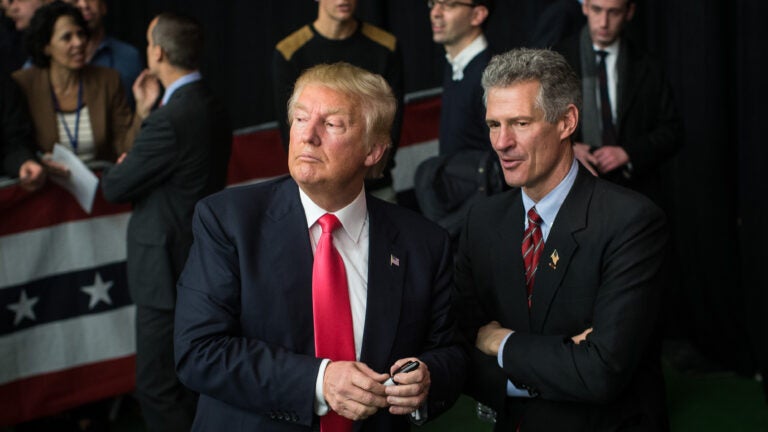
Former Massachusetts Sen. Scott Brown listens as Donald Trump speaks during a February press conference in Milford, New Hampshire.
Similar to the way other Democrats, such as Sen. Elizabeth Warren, have begun to take on Trump, Clinton recently blasted him as a “fraud.”
An apparent Democratic National Committee opposition research book on Trump leaked Wednesday previewed the top narrative to be unleashed against the businessman: “One thing is clear about Donald Trump, there is only one person he has ever looked out for and that’s himself.”
“He is trying to scam America the way he scammed all those people at Trump University,” Clinton said in a speech last week in New Jersey.
Lesperance said that this tactic comes into play with Clinton’s strategy to portray Trump as dishonest and out of touch with the majority of voters on the hard-line immigration message, even if it appeals to his base.
“All of this will be part of the larger strategy of portraying Trump as an unacceptable choice,” he said. “That is the same approach Shaheen took towards Brown.”
As far as the parallels may run, Williams disagrees Brown and Trump are similar as candidates.
“[Trump] is just such an unconventional candidate,” he said, adding that the Trump campaign does not appear to be driving a narrative, but rather careening from topic to topic when it instead should be hammering away at a single controversy, such as Clinton’s emails.
As multiple outlets have recently reported, despite turning into the general election, Trump still lacks the shape and staffing of traditional presidential campaign.
Williams says that, as well as Trump as a personality, are incomparable, for better or worse.
“This campaign seems to be distracted by unforced errors,” he said. “We certainly made errors on the Brown campaign, don’t get me wrong, but we had a coherent strategy.”




To comment, please create a screen name in your profile
To comment, please verify your email address
Conversation
This discussion has ended. Please join elsewhere on Boston.com