
Donald Trump versus Hillary Clinton would be a close race in New Hampshire, which equally dislikes both candidates
A new WBUR general election poll finds the two candidates are virtually tied in the Granite State.
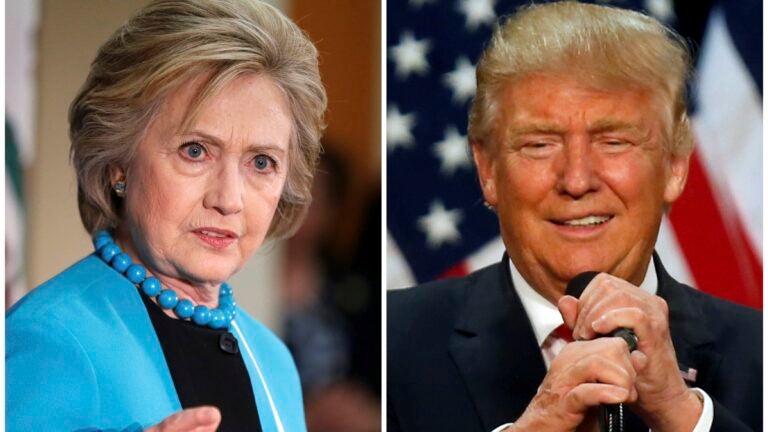
Donald Trump may not have much of a chance in Massachusetts. But if the general election were held today, it could be a close race between the presumptive Republican nominee and Hillary Clinton in New Hampshire.
According to a WBUR poll released Wednesday, Clinton leads Trump among likely voters 44 percent to 42 percent, with about 7 percent of voters in the state undecided. With a margin of error of 4.4 percentage points, the two candidates are virtually tied.
The Democratic presidential nominee has won five of the last six general elections in New Hampshire. But as unprecedentedly low Trump’s national unfavorable ratings are, Granite State voters are equally unimpressed with Clinton.
Both candidates are viewed unfavorably by 58 percent of voters. Clinton has a 35 percent favorable rating, well within the margin of error of Trump’s 33 percent favorable rating.
The results of the poll, which provide a snapshot of voters’ current feelings, are also affected by Trump having virtually locked up the nomination, as Clinton, the Democratic favorite, continues to slog toward the finish line in her race against Bernie Sanders.
Speaking of which, the Vermont senator, who won the New Hampshire Democratic primary in a blowout, fares much better against Trump (a point he has consistently made on the campaign trail). According to the poll Wednesday, Sanders (who has a favorable/unfavorable rating of 55 percent to 34 percent) would beat Trump by 16 points, 54 percent to 38 percent.
Despite a recent string of Sanders wins, Clinton remains on track to win the nomination with a firm grasp of the lead among pledged primary delegates. However, according to Steve Koczela—president of the MassINC Polling Group, which conducted the WBUR survey—the lack of enthusiasm among Sanders supporters for Clinton poses a problem that underscores the close race shown in Wednesday’s poll.
One out of four Sanders supporters said they would not vote for Clinton. According to the cross tabs, 9 percent said they would vote for Trump, 10 percent said they would be undecided and 6 percent said they would vote for another candidate.
“There’s still quite a bit of consolidation that the Clinton camp needs to do with former Sanders supporters to solidify them behind her,” Kozcela told Boston.com.
He added that it’s still very possible Sanders supporters will come around by November, but that there’s “not a lot of evidence of progress in that direction,” referring to the unrest at the recent Nevada Democratic Convention, along with continued fraught relations between Sanders backers and the party establishment.
For some historical perspective, it’s worth noting that in the midst of the heated 2008 Democratic primary, many Clinton supporters said they wouldn’t back the eventual nominee, President Barack Obama. Gallup found in March of that year that 28 percent of Clinton voters nationwide said they would vote for Republican nominee John McCain over Obama. And a CNN poll taken after the primary race had wrapped up found that 39 percent of Clinton voters said they would vote McCain or not vote at all.
But as Clinton did in 2008, Koczela said there’s only one person who can most effectively rally Sanders supporters around Clinton, if she does secure the nomination. And that’s Bernie Sanders.
“What he decides to say and what he decides to do, his words will have a lot of influence on his supporters,” Koczela said.
The poll also surveyed voters on a potential three-way race between Clinton, Trump, and Mitt Romney, as a third party candidate. Though the former Massachusetts governor and outspoken Trump critic has reportedly ruled out a third-party or independent campaign, his candidacy would have affected both candidates in New Hampshire, at least.
In the three-way race, Romney garners 21 percent of the vote, while Clinton gets 37 percent and Trump gets 33 percent.
“Romney pulls a surprising number of supporters,” Koczela said. “He’s not Ralph Nader. He does quite well in New Hampshire, but the impact that he has is not clearly anti-Trump; it is slightly anti-Tump.”
As Koczela wrote in a separate post for WBUR, the Romney effect would pose risks for both candidates, as 15 percent of Clinton voters would switch to Romney, while 22 percent of otherwise Trump supporters would defect to the former Bay State governor.
“In another cycle, if there were a Democrat with sparkling numbers running, it would be almost foolproof to have two Republicans run if you’re goal was to divide the party and hand it to the Democrat,” Koczela told Boston.com. “But in this case, Hillary Clinton’s numbers really aren’t that good. Her favorables aren’t good. Her support is not that committed. So if you introduce a third-party candidate, there’s more volatility that there would typically be.”




To comment, please create a screen name in your profile
To comment, please verify your email address
Conversation
This discussion has ended. Please join elsewhere on Boston.com