
More Republicans vow to block any Supreme Court nominee
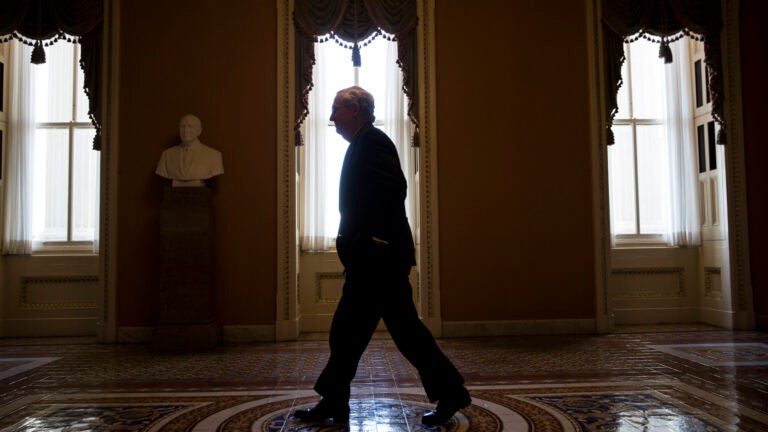
WASHINGTON — Senate Republicans on Monday began to close ranks behind a vow by Sen. Mitch McConnell, the Senate majority leader, to block consideration of any nominee to replace Justice Antonin Scalia, who died over the weekend, for the remainder of President Barack Obama’s term.
Sen. Rob Portman, R-Ohio, who faces re-election this year, said in a statement that the Senate should follow what he called “common practice’’ to stop acting on lifetime appointments during the last year of a presidential term. Sen. Patrick J. Toomey, R-Pa., agreed, leaving nearly every vulnerable Republican incumbent backing McConnell’s pledge.
Scalia’s death has given Obama a tantalizing opportunity to reshape the Supreme Court, but cementing a lasting legacy on American jurisprudence will present a familiar challenge: breaking the will of Republicans.
Top White House officials and senior Democrats on Capitol Hill have begun discussing themes to counter the Republican threat: insisting that the Senate follow its constitutional responsibilities, and portraying a yearlong obstruction as at odds with decades of precedent for Supreme Court nominations.
Denis R. McDonough, the White House chief of staff, began reaching out to Senate Democratic leaders on Monday, even as Obama hosts Southeast Asian leaders at a two-day summit meeting in California. A public campaign will focus in part on the fact that none of the last 12 successful Supreme Court nominees waited longer than 100 days for a confirmation vote. Obama will not leave office for 339 days.
Democrats said they would set up an online clock that would start the day Obama named his nominee.
“If you’re sitting in the White House, the question is: How do you put maximum pressure on the Congress?’’ said David Axelrod, a former top adviser to Obama. He added that Democrats hoped the public would recoil at the idea of “the Senate on strike, refusing to do its duty.’’
The looming clash on Capitol Hill is a testament to the stakes: A president has a chance to establish a clear liberal majority on the Supreme Court. That could shift the direction of legal thought on a wide range of issues like climate change, gay rights, affirmative action, abortion, immigration, gun control, campaign finance and labor unions.
Some Democrats expressed confidence that they could build public pressure on the Republicans to give Obama’s nominee a hearing.
“The idea of not even allowing a hearing strikes a chord that is pretty deep,’’ Sen. Chuck Schumer, D-N.Y., said. “It will mount; it will get much stronger when the president has a nominee.’’
But Republicans appear far more interested in mobilizing their base of conservative supporters than worrying about voters in the general election. Even if Republicans might appeal to moderate voters by giving Obama’s nominee a hearing, they reason, angering their own base would be more damaging.
Some allies of the president said they expected Republicans to hold firm, given the court’s crucial role and the intensity of feelings among conservatives. Axelrod predicted that McConnell and the other Senate Republicans would be “implacable’’ on the issue for the rest of the year.
“I don’t think they are going to move,’’ he said. “Any Republican who breaks rank on this will face the full fury of the base.’’
White House aides said the president would pick a nominee “in due time,’’ but they gave few hints about whom he was considering. Former top aides to Obama said they expected the White House to select someone who could overcome the Republican opposition.
“This is a lifetime appointment and an incredible part of his legacy,’’ said Stephanie Cutter, who helped guide the president’s previous nominees through the Senate confirmation process. Cutter said she expected Obama to avoid an obviously polarizing nomination in favor of a sitting judge who has had bipartisan support in the past.
“He’s going to make it as appealing as possible and as difficult as possible for the Senate not to confirm this person,’’ Cutter said. “He’s going to do everything he can to get this person through.’’
While Obama’s aides try to avoid the word “legacy,’’ the president’s final year in office was always going to be about defending his policies on health care, Wall Street regulation, outreach to Iran and Cuba, climate change and civil rights. Replacing Scalia with a liberal could do more to protect his policies than almost anything else.
Days before Scalia’s death, Obama said as much during two Democratic fundraisers in California. On Friday in Los Angeles, he said it had “never been more important’’ to elect senators who would confirm court nominees who would preserve hard-fought gains on “civil rights and equal rights.’’
Democrats are counting on Republicans who are up for re-election in states with large numbers of independent voters to support a hearing for Obama’s nominee. But they may be underestimating the fears those candidates have of a primary fight and the pressure from conservative groups.
“Sen. McConnell is right: Under no circumstance should the Republican Senate majority confirm a Supreme Court nominee as Americans are in the midst of picking the next president,’’ said Michael A. Needham, the president of Heritage Action, the political arm of the Heritage Foundation.
In the past, Obama has largely failed to win support from congressional Republicans on his signature issues, like his health care law, his economic stimulus package and his efforts to increase background checks for gun buyers.
At least one Republican, Sen. Susan Collins of Maine, who is not facing re-election, sought a middle ground. “Our role in the Senate is to evaluate the nominee’s temperament, intellect, experience, integrity and respect for the Constitution and the rule of law,’’ she said in a statement.
But Republicans were quick to seize on a July 2007 speech that Schumer gave to the liberal American Constitution Society in which he said that senators should “reverse the presumption of confirmation’’ for Supreme Court nominees during the remainder of George W. Bush’s term.
Schumer said the comparison was improper, because, unlike McConnell, he supported holding hearings on nominees. “What I said is after a hearing, if you’re not satisfied, it is legitimate to vote no,’’ he said. “That’s quite different than not having a hearing or a vote.’’



To comment, please create a screen name in your profile
To comment, please verify your email address
Conversation
This discussion has ended. Please join elsewhere on Boston.com