
‘The real legacy is that New Hampshire spooks front-runners’
New England College political professor Wayne Lesperance helps break down what the primary results in New Hampshire mean.
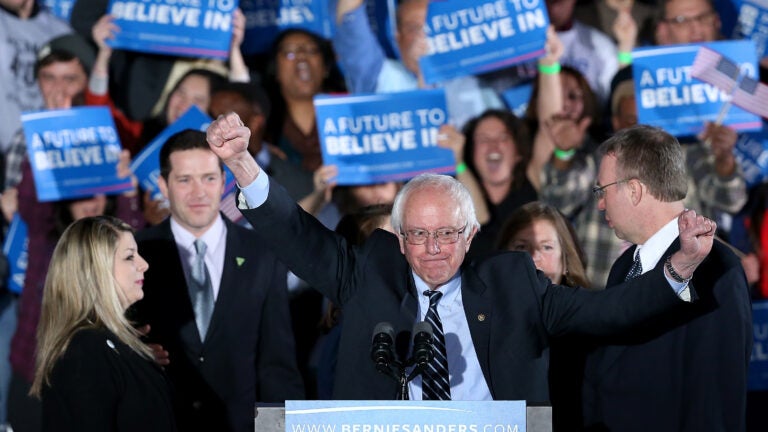
As the first stop in the presidential primary season, New Hampshire has often worked to separate the contenders from the pretenders.
But behind Donald Trump’s dominant win on Tuesday, the rest of the pack finished muddled together in the Granite State. There’s not a clear alternative yet for Republican voters who are opposed to Trump as the nominee.
We spoke with New England College professor of political science Wayne Lesperance for some answers as to what’s next. Who’s likely to drop out of the race? How important is New Hampshire’s role as a winnower of candidates? And who will take on the Republican establishment mantle?
Boston.com: New Hampshire has sometimes worked to shrink the field, as candidates who fare poorly suspend their campaigns. How important is that here?
Lesperance: I think the notion of winnowing the field is overstated. The real legacy is that New Hampshire spooks front-runners. If you think about 2008, Hillary [Clinton]’s win in New Hampshire scared the eventual nominee [President Barack Obama]. Bernie [Sanders] tonight is likely to have the same effect, in reverse, on Hillary. There are other examples. But, the net effect is to force front-runners to run more effectively. Another way to look at it is that New Hampshire prepares candidates for the rest of the country.
Boston.com: What are the major things candidates consider when they drop out or stay in the race?
Lesperance: It depends on the candidate and their long term goals. Typically, the question is viability, which is a mix of money, organization, and a way forward. But, some candidates will scale back and stay in to affect the conversation or position themselves for a role in the eventual nominee’s administration. Others will think to the next cycle and limit their exposure preferring to bow out and wait for another time to run.
Boston.com: Does Jeb Bush, who finished in fourth place with 11 percent support, stick around for a few more states?
Lesperance: Yes. Jeb has some support in South Carolina. Lindsey Graham will be helpful to him there. And the Palmetto State could be where he gets his second place finish. But, I expect he stays in through Super Tuesday.
Boston.com: What about New Jersey Gov. Chris Christie, who staked so much on New Hampshire?
Lesperance: If Christie finishes with 10 percent or more I think he will stay in. Otherwise, I don’t see a path forward for the governor. (Christie finished with 7.5 percent.)
Boston.com: How does Ohio Gov. John Kasich’s strong second-place finish here look for his campaign going forward?
Lesperance: It’s huge. Second place will invigorate his campaign. He heads to South Carolina with momentum. His success, when compared to Rubio’s disappointing finish, allows Kasich to claim the mantle of establishment leadership. If Christie pulls out, that support should flow towards whoever the perceived establishment front-runner is at the time. In this case, it is Kasich. Money and organization will follow for him.
Boston.com: Are those three governors—Kasich, Bush, and Christie—still in competition with each other for the same moderate audience?
Lesperance: For the establishment alternative to Trump/Cruz, it’s still the governors plus Rubio. I expect them to continue to fight for the same segment of voters.
Boston.com: If you could put odds on these candidates, who’s the most likely to drop out next?
I think Carly Fiorina, Ben Carson, and Christie will take a serious look at suspending their campaigns. Gilmore will wait until Virginia on March 1. But, in the next two weeks we should see the herd thinning.
Gallery: Photos of the New Hampshire primary.
[bdc-gallery id=”611023″]



To comment, please create a screen name in your profile
To comment, please verify your email address
Conversation
This discussion has ended. Please join elsewhere on Boston.com