
How much of a home-field advantage does Bernie Sanders actually have?
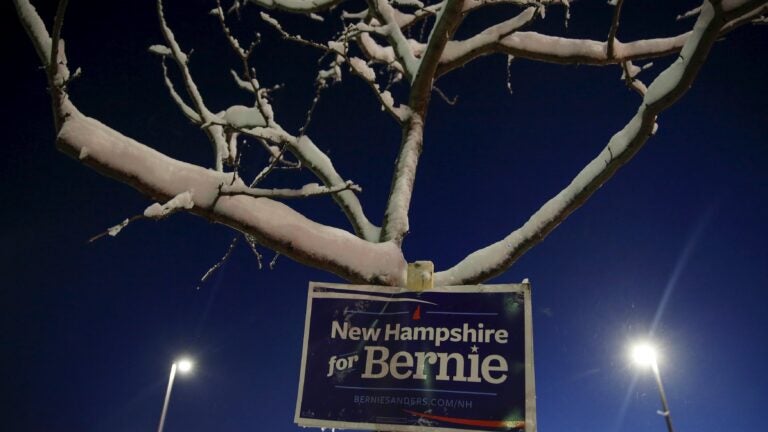
Don’t tell New Hampshirites that they’re in Bernie Sanders’ backyard.
In an attempt to downplay expectations heading into the nation’s first primary, Hillary Clinton’s campaign is suggesting the Vermont senator has an inherent advantage because of geography.
Clinton herself told CNN that some pundits advised her to skip the New Hampshire primary, where she won in 2008.
“Their argument is — and it has got some strength to it — look, you are behind here, you are in your opponent’s backyard,’’ she said.
While it’s true that Clinton is undoubtedly the underdog at this point in the state’s primary race, that wasn’t always the case. A year ago, in a February 2015 poll, Sanders had only 6 percent support to Clinton’s 58 percent.
And 37 percent of New Hampshire respondents did not know who the Vermont senator was (Clinton was unknown to just 1 percent of the state).
That’s because New Hampshire doesn’t have much interaction with Vermont, University of New Hampshire political scientist Andy Smith told Boston.com.
“Two-thirds of the population lives in the southeastern part of the state,’’ Smith said, noting most of New Hampshire is in the Boston market.
Smith says that while there certainly is an advantage of being a New England candidate, it’s mostly because candidates have similar voting concerns among the populations, adding that he wondered if most New Hampshire voters — now well introduced to Sanders — could name Vermont’s other senator.
“The advantage he has is just that the voters in New Hampshire aren’t that different from voters in Vermont,’’ he said.
But in a Politico roundtable Monday of Granite State political journalists, the idea that Sanders is practically a home-state candidate made some bristle. All five of the journalists interviewed agreed that Sanders was hardly known farther than 15 miles east of the Vermont border.
“The notion of favorite son from Vermont would make most New Hampshire stomachs turn,’’ said New Hampshire Public Radio senior editor Dan Barrick, noting that the Granite State tends to elect more rhetorically-conservative Democrats.
“People in New Hampshire call [Vermont] the upside down New Hampshire for a reason,’’ said Union Leader editor Trent Spiner.
The two northern New England states have somewhat of a quiet rivalry: warm, liberal Vermont versus brusque, independent New Hampshire.
A New York Times article Sunday explored the distinct personalities that two states developed out of geography and style of government:
Theirs is not a classic rivalry. New Hampshire, which has more than twice the population of Vermont, tends to ignore its neighbor to the west, turning its gaze instead toward Massachusetts and Maine; people in Vermont simply feel superior, in a laid-back kind of way.
“What has always struck me is how little anybody in New Hampshire cared about Vermont at all,’’ said Jeff Sharlet, an author who teaches English at Dartmouth and recently moved from New Hampshire to Vermont.
Of course, Smith said both campaigns will try to spin the primary results Tuesday, no matter the margin of victory. While Sanders is forecasted to win the state, Smith said the weather and his support among those less likely to vote could make the results closer than polls show.
A Sanders win of any degree could give the Vermonter momentum nationally, Smith said, where some polls show the two Democratic candidates in a virtual tie.
“Spin will matter,’’ Smith said, “but how [a Sanders win] is portrayed in the press will be most important.’’
[bdc-gallery id=”611023″]



To comment, please create a screen name in your profile
To comment, please verify your email address
Conversation
This discussion has ended. Please join elsewhere on Boston.com