
Trump’s ground game may still lack basics
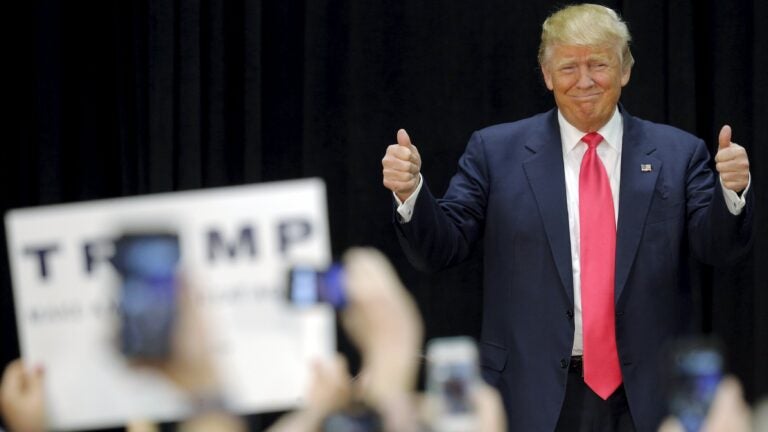
MANCHESTER, N.H. — David Carney, a veteran Republican strategist here, has received six phone calls at his Hancock, New Hampshire, home from Donald Trump’s campaign the last few days. But five came after the Trump volunteers were told that the occupants were backing another candidate: Carney’s wife is Carly Fiorina’s campaign director in the state.
For Carney, who has often praised Trump’s message, the wayward calls signaled impressive grass-roots enthusiasm. But they were also a telltale sign of strategic rudderlessness.
“They have a lot of volunteers and they’re proud about that, but volunteers is not a ground game,’’ said Carney, who was the top strategist for Rick Perry’s 2012 presidential race and has been deeply involved in studies of how campaigns use information about voters. “They’re basically just picking up the phone book.’’
Discerning the strength of any candidate’s ground game can be difficult. Trump has one key ingredient: an army of volunteers drawn to him by his popularity and his message. But precision counts, as Iowa demonstrated. And what Trump appears to lack is what could provide that precision: a direct-mail program, a comprehensive targeting effort to identify his supporters and their intensity, and a dedicated pollster to help pinpoint the voters to whom his television ads might appeal.
Until this week, Trump’s campaign projected enormous confidence in its get-out-the-vote abilities, predicting it would pull out a victory in Iowa and then blow away the competition in New Hampshire. But his aides shrouded their efforts in mystery, vaguely predicting an impressive result.
His not-so-narrow loss to Sen. Ted Cruz of Texas in Monday’s caucuses, however, raised the stakes in New Hampshire and has aimed a spotlight on Trump’s efforts to identify, organize and turn out supporters in the primary Tuesday. In revealing remarks, Trump publicly questioned his campaign’s efforts in Iowa, where he was out-hustled by the data-driven Cruz campaign. He blamed his team for not spending more money and even said he had not known what a ground game was before Iowa.
Now, Trump, who has boasted about spending so little on his campaign, must harness his supporters’ enthusiasm in New Hampshire, a state where, in such a crowded race against organized opponents, a good field organization might be crucial.
The question is how much better the turnout operation will be in New Hampshire. Three people briefed on internal discussions in the campaign said that repeated requests from employees in early nominating states for a greater focus on analyzing data had gone unanswered. And although the campaign started to put together a data operation last fall, it has had no direct mail effort — a fixture of Republican primary campaigns in New Hampshire.
Asked about those accounts, Corey Lewandowski, Trump’s campaign manager, insisted they were untrue.
“I know the budget process at the campaign, and I can’t think of three people who would have knowledge of the decision rights for this type of transaction,’’ he said in an interview. “Trump has never said no to a funding request.’’
Lewandowski, a longtime New Hampshire resident who oversaw the Iowa turnout operation but has an even firmer grip on it here, said he did not see the caucus defeat as indicative of larger organizational problems.
“They are two very different states,’’ he said. “I think the state of Iowa is a state that was tailor-made for Ted Cruz, and our candidate has been in politics for exactly six months and came away with a second-place victory. And we’re proud of that.’’
Lewandowski said that the campaign was using detailed consumer data to build lists of potential New Hampshire supporters but that the campaign, in something of a departure, was not narrowly focused on the most habitual voters.
“The people that we traditionally talk to are the ones who have been disenfranchised, or maybe they are the old Reagan Democrats,’’ he said. “We’re looking at those individuals who may not have been the traditional Republicans.’’
That includes independents, who can vote in either party’s primary, as well as registered Republicans who have not voted in the past four elections, he said.
If Trump has an ace in the hole in New Hampshire, it is Lewandowski, a wiry figure with a buzz-cut, an earpiece and a Secret Service pin. He previously worked for Americans for Prosperity, a conservative group funded by billionaire brothers Charles and David Koch.
The highest-profile race Lewandowski, a native of nearby Lowell, Massachusetts, has run before was the 2002 re-election campaign of Sen. Robert C. Smith, who lost in the Republican primary to Rep. John E. Sununu, a favorite of mainstream party leaders. Lewandowski has been more or less denouncing the state’s Republican establishment ever since.
Trump’s basic message, raising the alarm about national security and immigration, has played well in New Hampshire. And with a primary election a relatively simple proposition — the most votes wins — compared with a caucus, Trump may not need to rely so heavily on organization. The New Hampshire primary tends to be driven more by media coverage, and Trump’s popularity, coupled with a good performance in the Republican debate Saturday night, could suffice to spur his supporters to go to the polls.
“Momentum and buzz can be its own get-out-the-vote program,’’ said Mike Dennehy, who worked on Sen. John McCain’s winning primary campaign in the state in 2000.
Dennehy said he had seen many Trump lawn signs and bumper stickers, although he ranked Trump’s operation behind those of Jeb Bush, Sen. Marco Rubio of Florida and Cruz.
The Trump campaign has started emailing supporters nationally asking them to flood New Hampshire as volunteers. An email sent Thursday to his list of mid-Atlantic supporters offered “free lodging and meals’’ in the state as well as “potential opportunities to be near Mr. Trump.’’
Although Trump’s aides declined to detail their field operations in New Hampshire, they did say they had more than a dozen paid staff members in three offices in the state. That Trump has a lot of volunteers was evident on a visit to the office building that serves as his Manchester headquarters.
Beneath black-and-white photographs of Trump, including one with Ronald Reagan, roughly 30 volunteers stared at laptops or spreadsheets making calls. Fueled on pizza, bottled water and adrenaline, they have put in 12-hour days calling in support of Trump’s effort in the state.
Charles Bruckerhoff, 68, a Vietnam veteran who was calling undecided voters, said he had sped up retirement to volunteer.
“Many people who take the calls think that we’re a robocall,’’ he said. “And we’ll get about a half-sentence into it and they’ll say, ‘Are you a real person?’ And of course we are. We all are.’’






To comment, please create a screen name in your profile
To comment, please verify your email address
Conversation
This discussion has ended. Please join elsewhere on Boston.com