
Jeb Bush drops guard to share family account of addiction
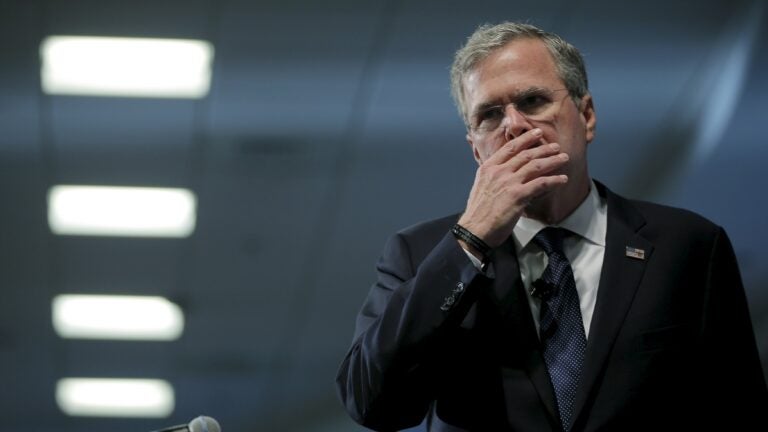
HOOKSETT, N.H. — Jeb Bush’s elder son, George P. Bush, is the land commissioner of Texas and is nicknamed “47’’ — a look ahead to when, many joke, he will become the 47th president.
His younger son, John Ellis Bush Jr., briefly saw his name floated as a contender for a Florida congressional seat.
But Bush’s daughter, Noelle Bush, has stayed far from the world of politics, in part because of her long struggle with addiction. She faced felony charges that she tried to fill a fraudulent prescription for Xanax when she was 24, and later ended up in jail after she was found with pills and then crack cocaine in her shoe.
On Tuesday, Jeb Bush spoke of how his family dealt with his daughter’s difficulties, which became uncomfortably public when he was governor of Florida.
“What I learned was that the pain that you feel when you have a loved one who has addiction challenges, and kind of spirals out of control, is something that is shared with a whole lot of people,’’ he said.

Jeb Bush, center, and his daughter, Noelle, at left, during a Mass last March. She has struggled with addiction.
Bush has said he first checked with his daughter, now 38 and in recovery, before sharing her story, which he did at a forum on heroin addiction.
To knowing murmurs, Bush spoke about how he will never forget the day his daughter successfully completed the Florida drug court program. “It was an extraordinary event,’’ he said, addressing more than 100 people — most of them involved in the treatment of substance abuse, and some in recovery themselves — in a ballroom at Southern New Hampshire University.
And he recalled realizing just how many families were dealing with similar challenges — how he’d be speaking about education policy or economic development and look out to see “people were looking at me, knowing that I was going through the same thing as a loved one.’’
For Bush, who often resists the soul-baring, emotive demands of modern politics, talking about his daughter’s struggles does not seem to come naturally. He spoke with restraint, though Monday he wrote more emotionally about his daughter in a blog post on Medium.
“As a father, I have felt the heartbreak of drug abuse,’’ Bush wrote. “I never expected to see my precious daughter in jail. It wasn’t easy, and it became very public when I was governor of Florida, making things even more difficult for Noelle. She went through hell, so did her mom, and so did I.’’
Drug addiction and its personal costs have produced many of this campaign season’s most memorable and poignant moments. Not long ago, Gov. Chris Christie of New Jersey told the story of a close friend who fell victim to prescription drug abuse and lost his family, his job and, ultimately, his life. The Huffington Post put a video of the talk online, where it has been watched more than 8 million times.
New Hampshire has been hit especially hard by the heroin epidemic, with opioid deaths up 76 percent in the state in 2014, according to state figures. That year, 325 people died from an opioid overdose, and since 2013, emergency room visits from heroin have more than tripled.
Bush was one of five Republican candidates to address the forum in New Hampshire, and was not the only one to speak in personal terms about how addiction has affected their families or loved ones. As Bush shared his family’s story, a camera crew for the campaign’s ad maker filmed his remarks.
Christie talked about his mother’s lifelong struggles with cigarettes and his close friend who died of an overdose.
Carly Fiorina talked about losing her stepdaughter, Lori, who died of drug addiction. Earlier, in an email to supporters, Fiorina spoke of Lori’s death to the “demons of addiction’’ and said, “If you’re criminalizing drug abuse and addiction, you’re not treating it — and you’re part of the problem.’’
And though Gov. John Kasich of Ohio said he had “no clue’’ about personally battling addiction, he teared up as he told the story of how he had met a young woman who had ended up in foster care as her parents battled heroin, only to become a Princeton graduate. (The woman, Jessica Hulsey Nickel, is now the executive director of the Addiction Policy Forum, the group that put on the event.)
Bush’s remarks came as he outlined his drug control strategy Tuesday, describing a plan with four main elements: preventing drug abuse and addiction, strengthening the criminal justice system, securing the border with Mexico to stop the flow of illegal drugs, and improving treatment and recovery programs.
“For dealers, they ought to be put away forever as far as I’m concerned,’’ he said, to applause. “But users — I think we have to be a second-chance country.’’
Noelle Bush’s challenges played out in a public fashion, while her father was governor of Florida and her uncle, George. W. Bush, was president. After she was arrested, Florida and national newspapers chronicled her travails with headlines like “Noelle Bush: A victim or princess?’’ and “Royal rehab: Nonviolent drug offenders should get the Bush treatment.’’
In 2003, Jeb Bush grew frustrated with a Miami Herald reporter, according to emails obtained by The New York Times through a public records request. “The only reason you wrote the piece or were told to write the piece is that my struggling daughter is the child of the governor,’’ Bush chided the reporter. “It won’t matter in the whole scheme of things, but I wish the media would leave my daughter alone. It would make it a whole lot easy for her to recover and live a life full of hope and promise.’’
On Tuesday, Bush instead focused more on his daughter’s triumph. “She is a courageous young woman,’’ he said.
While some in Florida suggested his daughter received special treatment from the judge overseeing her rehab, who had ties to a group that had received a state grant, Bush said: “She got extra treatment, as it relates to the scrutiny, and it was a difficult time for my wife and for me.’’
The message seemed to resonate with attendees.
One, Kirsten Doherty, said Bush’s credibility on addiction was enhanced by “telling personal stories about recovery, which always makes a difference.’’
“He seemed to be very educated about the topics, which is not true of all the presidential candidates,’’ said Doherty, who works for a Massachusetts advocacy group focused on addiction recovery. “I have family members in recovery. I think it says something when people aren’t ashamed to talk about their family experiences with addiction.’’



To comment, please create a screen name in your profile
To comment, please verify your email address
Conversation
This discussion has ended. Please join elsewhere on Boston.com